An Increase of 86.5 Billion Won (4.03%) Compared to the Initial 2025 Budget of 2.1455 Trillion Won
Active Budget Allocation by Maximizing Available Resources and Financial Capacity
Focus on Improving Living Conditions and Revitalizing the Local Economy for Citizens
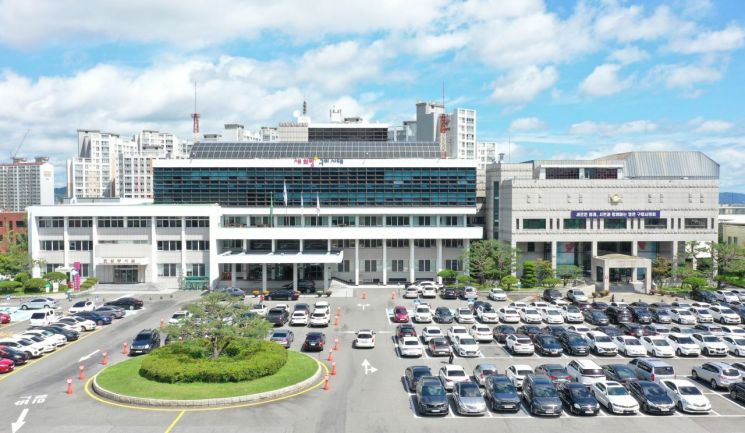
Gumi City in North Gyeongsang Province has drafted a 2026 budget proposal totaling 2.232 trillion won (1.856 trillion won for the general account and 376 billion won for the special account) and submitted it to the Gumi City Council on November 21.
This represents an increase of 86.5 billion won (4.03%) compared to the initial 2025 budget of 2.1455 trillion won. The expanded budget is expected to significantly support the smooth implementation of key projects, including improving living conditions that citizens can directly experience, revitalizing the local economy by supporting small business owners and SMEs, and boosting the regional economy.
Looking at the 2026 revenue budget by account, the general account is set at 1.856 trillion won, an increase of 81.5 billion won from this year, while the special account is set at 376 billion won, up 5 billion won from this year.
For the 2025 general account expenditure budget by function, the largest share is allocated to social welfare at 677 billion won, accounting for 36.47% of the general account budget, to respond to demographic changes such as low birth rates and an aging population. This is followed by agriculture, forestry, maritime affairs, and fisheries at 185.8 billion won (10.01%), national land and regional development at 137.5 billion won (7.41%), and transportation and logistics at 131.9 billion won (7.11%).
Key investment projects in the 2026 budget proposal aimed at improving the quality of residential environments that citizens can directly experience in their daily lives include 8.6 billion won for general waste collection and transportation (outsourced), 15 billion won for loss compensation on non-profitable routes, 3 billion won for the purchase of city buses, 8.9 billion won for the construction of a public truck parking lot, 6.2 billion won for expanding parking and convenience facilities in industrial complexes, 3.9 billion won for building a parking tower at the Olympic Memorial Hall, 1 billion won for replacing outdated bus information terminals (BIT), 2.6 billion won for establishing LPG pipeline networks at the village level (including 1.2 billion won in city funds), and 2 billion won for processing stored household waste at environmental resource facilities. These allocations are intended to improve public transportation accessibility and address waste management issues that directly affect citizens' quality of life.
To revitalize local commercial districts and stimulate the economy, the budget includes 7.6 billion won for special guarantee contributions and interest subsidies for small businesses, 7.5 billion won for compensation for Gumi Love Gift Certificate discount rates, 1 billion won for small business card fee support, 800 million won for the K-Onnuri Pass program, 500 million won for the local pack support project for small businesses, 2.1 billion won for the autonomous commercial district revitalization project, 11.5 billion won for Gumi-style job local investment promotion subsidies, 8.3 billion won for local business investment incentives, 1.2 billion won for the Gumi City New Venture Startup Support Project, and 1.2 billion won for the Gumi City TIP TOP Startup Development Project, among other various budget items to invigorate the local economy.
To expand cultural and sports infrastructure for citizens, the budget allocates 7 billion won for the construction of the Sangmo-Sagok National Sports Center, 2.7 billion won for land acquisition for the Gumi Cultural Center, 1.8 billion won for the construction of the Gumi Dorisa Citizen Healing Zen Center, 2 billion won for the Cheonsaeng Historical and Cultural Facility Project, 1.4 billion won for the Geumosan Scenic (Illuminated) Fountain Project, 2.6 billion won for the Geumosan Auto Camping Site Project, 1.2 billion won for the expansion of the Yangpo Park Golf Course, and 400 million won for the Open Culture Plaza Project (Riverside Baseball Field). The city will also actively support major festivals such as the Gumi Ramen Festival (800 million won), the Food Festival (600 million won), and the Romantic Night Market (300 million won), aiming to transform Gumi into a romantic cultural city and a stay-type tourism city where work and life are in harmony.
To enhance urban competitiveness, the city will continue investing in large-scale SOC projects, including 2.6 billion won for the Sangmo-Sagok Road Expansion Project (No. 2-5), 1 billion won for the construction of the Ye-gang Intersection Access Road as a national road alternative bypass, 2 billion won for the Songnim Intersection Grade Separation Project, 600 million won for the expansion (Section 1) of the Bisan Bypass Road (No. 1-12), 800 million won for intersection improvement on Deulseong-ro in Goa-eup, 1.4 billion won for the construction of the Otae Urban Planning Road (No. 3-26), 1 billion won for the expansion of the Indeok-ri Urban Planning Road (No. 1-151) in Sandong-eup, 700 million won for roundabout installation, 1.5 billion won for the construction of the Seongi Urban Planning Road (No. 2-429), 13.5 billion won for the Geumo Market Urban Regeneration New Deal Project, and 1.9 billion won for the Wanjeon-dong New Village Project in Seonsan-eup. Additional allocations include 300 million won for the Songjeong-dong Neighborhood Park Landscaping Project, 200 million won for the Sinpyeong 2-dong Mural Village Street Landscape Improvement Project, 200 million won for the Alley Landscape Project in front of Sagok Station, and 1.9 billion won for the Beautiful Street Plus Project, all aimed at providing citizens with quality relaxation environments and diverse attractions amid their busy daily lives.
For agricultural income and management stability, the agricultural budget includes 4.5 billion won for basic living infrastructure (environmental improvement), 2.8 billion won for the construction of a new agricultural machinery rental center in the urban area, 2.8 billion won for the construction of an eco-friendly microorganism cultivation center, 600 million won for the expansion of the Seonsan Agricultural Machinery Rental Center site, 8.1 billion won for agricultural and fisheries subsidies, 1.9 billion won for the Doge-Sillim District Surface Water Reinforcement Development Project, 1.2 billion won for the Seonsan-eup Rural Central Area Revitalization Project, 2.4 billion won for the Sandong-eup Rural Central Area Revitalization Project, 1.1 billion won for the Mueul-myeon Basic Living Base Development Project, 1.1 billion won for the Jangcheon-myeon Basic Living Base Development Project, 1.5 billion won for the construction of a livestock genetic resource distribution center road, 500 million won for support for the construction of a beekeeping product processing center, 800 million won for support for the purchase of small and medium-sized agricultural machinery, and 500 million won for support for the purchase of agricultural machinery in Gumi City.
To overcome the population crisis caused by low birth rates, aging, and population decline and to ensure stable welfare, the budget includes 149.8 billion won for basic pension payments, 63.4 billion won for livelihood benefits, 48.3 billion won for infant care fees, 30.3 billion won for child allowance support, 19.2 billion won for child care subsidies, 28.3 billion won for parental benefits (infant allowance), 23.5 billion won for senior job and social activity support projects, 25.7 billion won for disability activity support projects, 18.6 billion won for long-term care insurance medical benefit deposit costs, 4.1 billion won for the Gumi-style youth monthly rent support project, 1.9 billion won for the expansion of the Gumi City Family Center, 5.1 billion won for the First Meeting Voucher Support, 1.5 billion won for pediatric emergency patient care support, 500 million won for obstetrics and pediatrics ONE-hour care operation support, 200 million won for public children's rehabilitation center operation support, 600 million won for postpartum care support, 1.8 billion won for infertility couple support, and 1.5 billion won for the establishment of base-type Neulbom Centers.
Gumi Mayor Kim Jangho stated, "The 2026 budget proposal is designed to fulfill our promises to citizens and successfully conclude the eighth term of the civil administration. We will operate the city focusing on practical policies that can be felt in everyday life, thereby improving the quality of life for citizens and revitalizing the Gumi economy."
The initial 2026 budget proposal will be finalized on December 11 after deliberation at the 292nd regular session of the Gumi City Council.
© The Asia Business Daily(www.asiae.co.kr). All rights reserved.
![Clutching a Stolen Dior Bag, Saying "I Hate Being Poor but Real"... The Grotesque Con of a "Human Knockoff" [Slate]](https://cwcontent.asiae.co.kr/asiaresize/183/2026021902243444107_1771435474.jpg)
















