Advance Relocation of Gwangju Civilian Airport and Clarification of 1 Trillion Won Support
"Government-Led Solution Needed to Overcome the Limits of the Donation-for-Compensation Method"
Min Hyungbae, a lawmaker from the Democratic Party of Korea, stated that "the discussions on relocating the Gwangju military airport have entered the stage of broad agreement," evaluating this move as significant progress in negotiations between the government and local governments.
While emphasizing that this outcome is the result of citizens' demands and the efforts of local governments, Assemblyman Min also pointed out that revising relevant laws and systems remains a key task for the future.
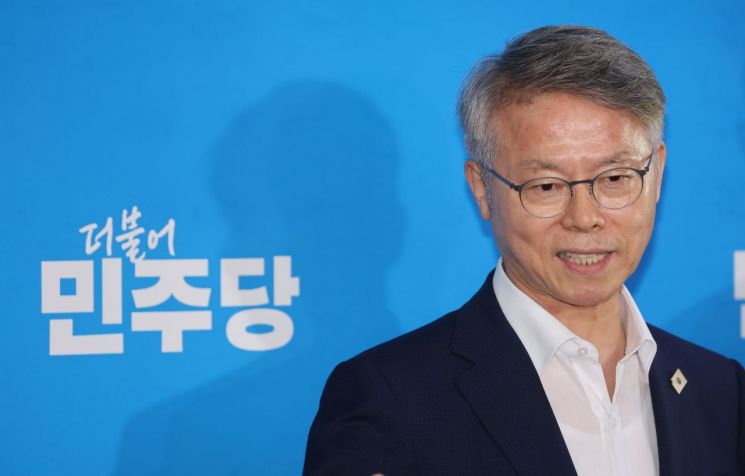
In a statement issued the previous day, Assemblyman Min said, "The issue of relocating the Gwangju military airport has finally made a major breakthrough," adding, "The earnest wishes of the citizens have prompted a decisive move by the government." He assessed that, through a four-party preliminary consultation between the Presidential Office, Gwangju, South Jeolla Province, and Muan, the discussions on the military airport relocation have entered the stage of broad agreement. He also expressed his gratitude to Gwangju Mayor Kang Gijung, South Jeolla Governor Kim Youngrok, and Muan County Governor Kim San.
Assemblyman Min outlined the core elements of the agreement as follows: the principle of relocating the Gwangju civilian airport in advance to coincide with the opening of the second phase of the Honam High-Speed Railway; the concretization of Gwangju City's promise to provide 1 trillion won in support, with the central government covering 300 billion won of this amount; and the provision of national-level incentives for the development of Muan. He stressed that the principle of "special compensation for special sacrifice" has begun to be reflected in both policy and financial measures.
He went on to say, "Gwangju will gain an opportunity to address noise and safety issues and to redevelop the Songjeong area, while Muan and South Jeolla Province will have the chance to expand their air routes and attract a national industrial complex." He evaluated this agreement as "a meaningful step forward, shifting from conflict to mutual growth."
However, he cited the need to supplement laws and systems as remaining challenges, stating, "The key issues are how to overcome the limitations of the donation-for-compensation method, how to reduce the financial burden on Gwangju City, and how to ensure that the relocation of the military and civilian airports is packaged together." He diagnosed that a "government-led solution, with clear state responsibility, is necessary."
Assemblyman Min referred to the "Special Act on the Relocation of Gwangju Military Airport and Development of the Former Site," which he co-sponsored, stating that it would "institutionally support a government-led relocation." He also added that, at the "Special Act Amendment Forum on the Relocation and Support of Military Airports" to be held at the National Assembly on the 24th, he plans to examine the structural limitations of the donation-for-compensation method and discuss ways to clarify government responsibility.
Assemblyman Min said, "The government must keep its promises, and local governments must cooperate with an open attitude," adding, "I will ensure that the safety and development of residents in Gwangju and South Jeolla Province are fully reflected in the upcoming six-party task force and National Assembly discussions."
© The Asia Business Daily(www.asiae.co.kr). All rights reserved.

















