Just One Day After Nvidia Dispelled AI Bubble Concerns
Ray Dalio, the "Godfather of Hedge Funds," Sounds the Alarm
Lisa Cook of the Fed Also Issues Consecutive Warnings
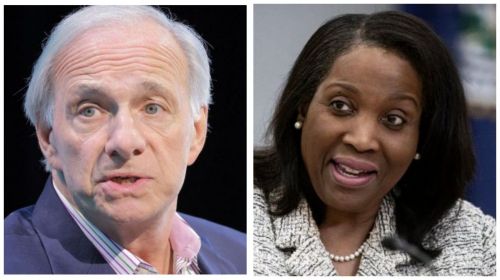 From the left, Ray Dalio, founder of Bridgewater Associates, and Lisa Cook, Federal Reserve Board Governor.
Just one day after Nvidia, an artificial intelligence (AI) semiconductor company, quelled the "AI bubble" debate with overwhelming performance, concerns simultaneously emerged from Wall Street and the Federal Reserve. It is interpreted that warning remarks from prominent figures amid mixed economic indicators fueled a wave of selling.
Ray Dalio, founder of Bridgewater Associates and known as the "godfather of hedge funds," addressed the AI sector bubble controversy in an interview with U.S. business channel CNBC on the 20th (local time), saying, "There is definitely a bubble in the market," and added, "A bubble bursts not because of long-term performance, but at the moment when (investors) are forced to sell assets because they need cash."
He explained that the bubble measurement indicator he monitors pointed to 100% just before the Great Depression in 1929 and before the IT bubble burst in 2000, and that it now stands at about 80%. On October 28, he had only mentioned that this indicator was "at a fairly high level," but this time he provided a more specific figure.
He cited tight monetary policy and wealth taxes as factors that could trigger a bubble collapse. Previously, in a lengthy essay posted on his social network service X (formerly Twitter), he noted, "A bubble does not burst because of overvaluation," and emphasized that bubbles occur when investors liquidate assets due to taxes, debt repayments, and liquidity demands.
He said, "What typically bursts a bubble is (tight) monetary policy, but we are not in such a policy environment right now," adding, "We are in bubble territory, but there is currently no factor to burst it."

He continued, "The need for cash always bursts bubbles," pointing out that the imposition of wealth taxes at the federal or state government level could trigger a bubble. For example, there is an ongoing discussion in California to introduce a 5% wealth tax. Recently, Zohran Mamdani, who was elected as the new mayor of New York, also pledged as a policy initiative to impose an additional 2% income tax on millionaires earning more than 1 million dollars (about 1.4 billion won) per year.
However, founder Dalio added, "Just because it is a bubble does not mean you should sell immediately," and noted, "A bubble is unsustainable, but it can rise quite a lot and for quite a long time before it bursts."
On the same day, Federal Reserve Board Governor Lisa Cook also contributed to weakening investor sentiment by stating that some asset overvaluations, including in the stock market, are evident.
During a public speech at the Georgetown University School of Business in Washington, D.C., Cook said, "My current impression is that the likelihood of overvalued asset prices declining has increased," citing the Financial Stability Report and pointing out signs of overheating in stocks, corporate bonds, leveraged loans, and the housing market.
However, she assessed, "Given the overall resilience of the financial system, I do not expect to see the kind of weakening that appeared during the 'Great Recession' triggered by the 2008 financial crisis."
The New York stock market, which started higher on this day, gave up all its gains and closed with a significant decline. The Dow Jones Industrial Average, focused on large-cap stocks, closed down 0.84% from the previous session, while the S&P 500 Index fell by 1.56%. Notably, the tech-heavy Nasdaq Index dropped by 2.16%.
U.S. business magazine Fortune analyzed, "Nvidia's stock reversed course and fell, giving up its gains immediately after Ray Dalio warned that the latest market rally was a 'huge bubble'," and added, "Dalio's comments weighed on the market, which was already under pressure from mixed economic indicators, uncertainty over the Federal Reserve's actions, a canceled jobs report, and conflicting labor market trends."
© The Asia Business Daily(www.asiae.co.kr). All rights reserved.


















