Chinese State-Owned Enterprises Ban Employee Travel to Japan
Caught in the Crossfire of China-Japan Tensions
Diplomatic tensions between China and Japan have reached a peak following remarks by Japanese Prime Minister Sanae Takaichi regarding Taiwan, resulting in unintended consequences for employees of Chinese state-owned enterprises and the public sector. As companies have begun to restrict even their employees' private trips to Japan, there has been a surge in sudden vacation cancellations.
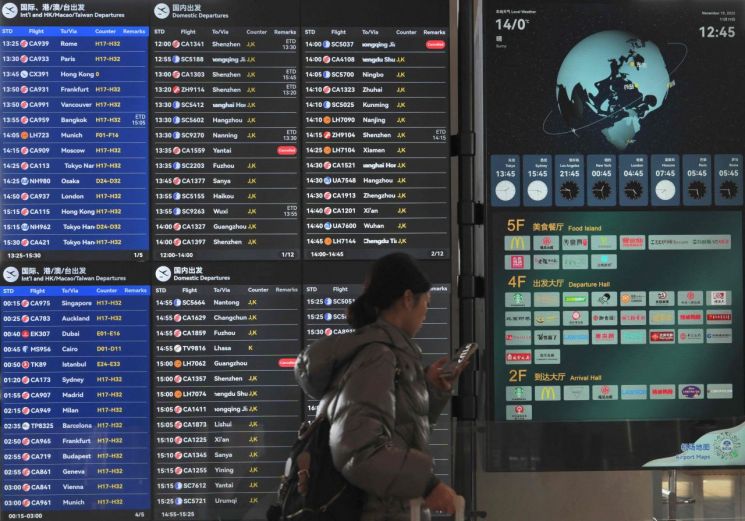 Passengers passing by the international flight information board, including flights to Japan, at Beijing International Airport. Photo by Yonhap News AFP
Diplomatic Dispute Fallout: Sharp Decline in Chinese Tourists
The current situation originated on November 7, when Japanese Prime Minister Takaichi stated during the House of Representatives Budget Committee that "if China resorts to the use of force by mobilizing its military, it could be considered a situation that threatens Japan's survival." The fact that a sitting Japanese prime minister mentioned the possibility of Japan exercising collective self-defense and intervening in the event of a Taiwan contingency caused a stir. The Chinese Ministry of Foreign Affairs strongly protested, and subsequently, beyond mere diplomatic protests, China has issued a series of practical measures, including advisories against travel and studying in Japan. On November 16, the Chinese Ministry of Culture and Tourism officially recommended that Chinese citizens refrain from traveling to Japan for the time being, citing safety concerns.
As the conflict between China and Japan intensifies, posts such as "Cancelling my trip to Japan" and "Going to Seoul instead of Osaka" have been trending on Chinese social media platforms. According to the airline industry, there has been a sharp increase in requests from Chinese tourists to cancel flights to Japan, and some airlines have voluntarily adopted policies allowing full refunds.
Companies Restrict Private Travel: "Losing More Than My Salary"
Some Chinese companies have taken a firm stance by instructing their employees to cancel trips to Japan. On November 19 (local time), the South China Morning Post (SCMP) reported that anonymous tips from employees of Chinese state-owned enterprises and public institutions have been pouring in, stating that they have recently been ordered by their companies to cancel trips to Japan.
According to the outlet, an engineer, referred to as Mr. A, working at a state-owned enterprise in Wuhan, received a call from the company's administration department on November 18, instructing him to cancel his planned vacation to Osaka, Japan, scheduled for next month. He told SCMP, "Overseas travel requires company approval, so I had already received permission for my vacation last month and booked both flights and hotels. However, as tensions have recently escalated, I now have to call off the entire trip." In Mr. A's case, he was able to receive a full refund for his flight and accommodation expenses, except for the visa fee.
However, there are also many cases where people end up losing money. Mr. B, a male nurse working at a national hospital in Beijing, is one such example. Earlier this month, Mr. B applied to his company for a weekend trip to Japan, but after the Chinese government issued a travel advisory for Japan, his supervisor denied his request, citing the advisory as the reason. Because his travel date was approaching, Mr. B is unlikely to receive refunds for most of the 6,000 yuan (approximately 840,000 won) he spent booking flights and accommodation through an online travel agency. He told SCMP, "My monthly salary is just over 4,000 yuan (about 780,000 won), so this is a significant loss for me."
SCMP also reported cases where employees are in a standoff with their companies over travel approval to Japan. An employee, referred to as Mr. C, at a state-run research institute in Beijing, said, "I planned to use my annual leave in Japan a month ago and started the approval process, but the company has not stamped the approval documents. They haven't explicitly said no, but it seems clear that they don't want me to go."
Severe Blow to Aviation and Travel Industry: Nearly 500,000 Ticket Cancellations
The travel and aviation industries have also been hit hard. Citing Japanese media such as Kyodo News, SCMP reported that "several major Chinese travel agencies have suspended sales of package tours to Japan," and "at least seven Chinese airlines have announced full refunds for tickets to Japan booked through the end of the year."
SCMP also cited an aviation analyst specializing in the Chinese market, who stated that "as of November 17, Chinese airlines had received approximately 491,000 cancellation requests for flights to Japan, accounting for about 32% of all reservations for Japan-bound flights held by Chinese airlines." The actual impact may be even greater when considering individual cancellations not captured in the statistics.
The Japanese tourism industry, which had been enjoying a boom thanks to the weak yen, is now facing an unexpected setback. According to data from the Japan National Tourism Organization (JNTO), more than 6.7 million Chinese visitors traveled to Japan between January and August this year, a significant increase from 4.6 million during the same period last year. China was also the largest source of inbound tourists to Japan in the first three quarters of this year.
Alternative Destinations Emerge Amid China-Japan Tensions
On the other hand, from the perspective of the Korean aviation industry, this China-Japan discord is seen as an opportunity. Tourists from Greater China are increasingly choosing Korea as an alternative destination. As Korea competes with Japan for tourists, it is expected to absorb the demand from Chinese travelers who are shifting their overseas travel plans from Japan to Korea.
© The Asia Business Daily(www.asiae.co.kr). All rights reserved.

![Clutching a Stolen Dior Bag, Saying "I Hate Being Poor but Real"... The Grotesque Con of a "Human Knockoff" [Slate]](https://cwcontent.asiae.co.kr/asiaresize/183/2026021902243444107_1771435474.jpg)
















