Non-Regular Workers in School Meal and Care Services Begin Strike
KFTA Holds Press Conference at National Assembly on the 20th
"Do Not Justify Infringing on Children's Right to Eat"
As non-regular workers responsible for school meals and care at kindergartens, elementary, middle, and high schools nationwide launched a general strike, the Korean Federation of Teachers' Associations (KFTA) called on the National Assembly to promptly enact the "School Strike Damage Prevention Act" to prevent the suspension of student meal services.
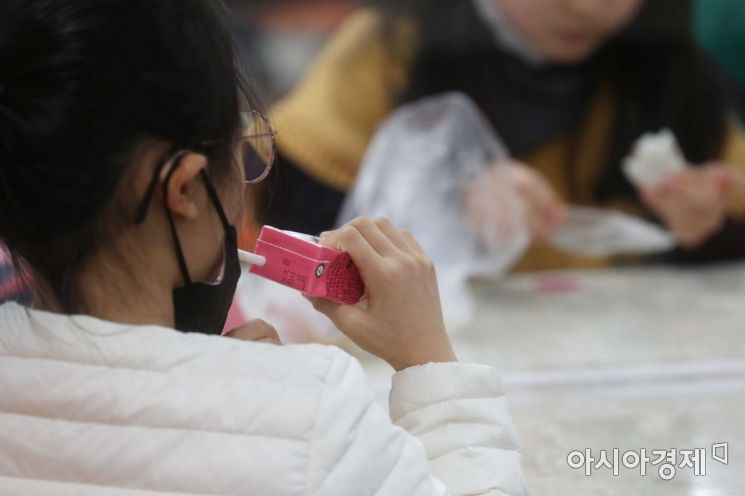 On the 2nd, non-regular school workers responsible for meals and care entered their second general strike to demand better treatment. At Ahyeon Elementary School in Mapo-gu, Seoul, students are eating bread, rice cakes, and juice prepared as substitute meals. Photo by Moon Honam munonam@
On November 20, the KFTA held a press conference in front of the main gate of the National Assembly in Seoul, stating, "It is the students who suffer from repeated disruptions in meal services," and argued that school meal services, care, and health services should be designated as essential public services.
This press conference was held in response to the announcement by the National School Irregular Workers' Solidarity Council (comprising the Korean Public Service and Transport Workers' Union School Irregular Workers' Division under the Korean Confederation of Trade Unions, and the Korean Women's Union) that they would stage a total of four relay strikes.
The Solidarity Council announced plans for the relay strikes to begin on November 20 in Seoul, Incheon, Gangwon, Chungbuk, and Sejong; to continue on November 21 in Gwangju, Jeonnam, Jeonbuk, and Jeju; on December 4 in Gyeonggi, Daejeon, and Chungnam; and on December 5 in Gyeongnam, Gyeongbuk, Daegu, Busan, and Ulsan. Disruptions are expected to be unavoidable in all areas of care, meal services, and special education handled by these workers.
Kang Juho, President of the KFTA, stated, "Schools are essential public goods that must never come to a halt, even for a moment." He added, "While we respect workers' demands for better treatment, it cannot justify infringing upon the children's right to eat and to be safely protected."
Difficulties at schools also continued. Kim Dojin, President of the Daejeon Teachers' Association, said, "In Daejeon, repeated strikes have made meal service disruptions a routine occurrence. Two years ago, a prolonged strike lasting over 50 days forced students to eat convenience store lunch boxes for more than a month. This year, due to collective sick leave and strikes by kitchen staff, there were even days when 'seaweed soup without seaweed' was served." He continued, "The abnormal situation where teachers have to stand at the serving line instead of preparing for classes leads to infringements on students' right to learn and excessive workloads for teachers. This is a serious problem caused by the lack of institutional safeguards to protect schools and the lukewarm response from the education authorities," he criticized.
At the press conference, students and parents, who are directly affected by the strike, also spoke in solidarity.
Student representative Kim Hajin (Kangkyung Commercial High School in Chungnam) said, "Whenever I hear news of a strike each year, I first worry, 'Will I be able to eat a proper lunch this time?'" He appealed, "For students like me who live in dormitories, school meals are not just a meal but essential to our health and growth." He requested, "Please enact a law so that students do not suffer as victims caught in the conflicts of adults."
After the press conference, the KFTA delivered a legislative request to the National Assembly's Climate, Energy, Environment and Labor Committee, urging the swift passage of the "School Strike Damage Prevention Act (Amendment to the Trade Union and Labor Relations Adjustment Act)," which was sponsored by Assemblyman Jeong Seongguk of the People Power Party.
The bill designates meal services, health, and care work at kindergartens, elementary, middle, and high schools as essential public services, and allows for substitute labor within 50% of the total workforce in the event of a strike.
The KFTA stated, "The National Assembly must immediately move to amend the law," and requested, "Teachers' unions and the two major labor federations should also support the passage of the bill, setting aside organizational structures and ideological stances, for the sake of protecting children's right to learn and their safety."
© The Asia Business Daily(www.asiae.co.kr). All rights reserved.

















