Bipartisan Lawmakers’ Association
China Economic Research Institute Presents Findings
Director Jeon Byeongseo: "Securing Market Leadership Is Essential"
The Korea-China Parliamentary Friendship Association, a bipartisan group, held a seminar at the National Assembly on the 20th to discuss concrete measures for future Korea-China industries centered on artificial intelligence (AI). The association was established with bipartisan participation from lawmakers to promote parliamentary diplomacy in a long-term and stable manner.
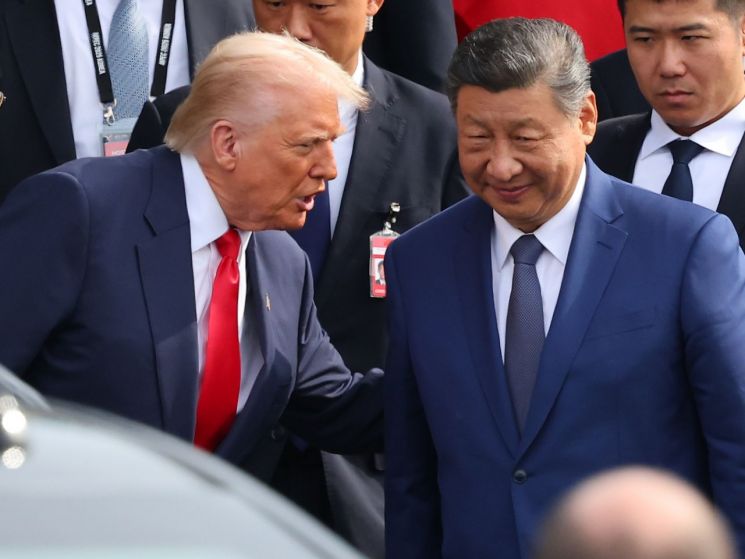 Donald Trump, President of the United States, and Xi Jinping, President of China, are seen leaving the meeting room while conversing after concluding the US-China summit at the Naraemaru Protocol Office of Busan Gimhae Air Base on October 30th this year. Photo by Yonhap News
Kim Taenyeon, a lawmaker from the Democratic Party of Korea and president of the association, hosted a research presentation at the National Assembly Members’ Office Building under the theme “Prospects for China’s Semiconductor Industry at the Center of the AI War and Korea’s Response Strategy.” He stated, “The growth of China’s semiconductor industry is almost intimidating,” and added, “It is a critical time for Korea to decide what response strategy to formulate and implement.”
Assemblyman Kim said, “The six major policy recommendations announced today by the China Economic and Financial Research Institute will be shared with all relevant government ministries so that we can consider how to establish and implement a national-level strategy.”
Jeon Byeongseo, director of the China Economic Research Institute and presenter for the day, proposed six policies as Korea’s response to the rise of China’s semiconductor industry: ▲Strategic investment in subsidies ▲Specialization of local clusters and global linkages ▲Management of HBM as a strategic material ▲Reclassification of semiconductor subsidies as ‘national security budget’ ▲Comprehensive improvement of regulations such as permits, electricity, and visas ▲Focus on automotive semiconductors (establishing a Hyundai-Samsung-SK alliance) ▲Integration of memory, AI chips, and packaging to build an ‘AI semiconductor platform’.
Director Jeon emphasized, “The biggest difference between Korea’s semiconductor industry policy and that of China, the United States, and Japan is whether subsidies are provided directly or not,” adding, “Securing the market is just as important as achieving a technological edge.”
Meanwhile, the Korea-China Parliamentary Friendship Association currently includes over 100 lawmakers from both ruling and opposition parties.
© The Asia Business Daily(www.asiae.co.kr). All rights reserved.

















