10-Year Government Bond Yield Hits Highest Level in 17 Years
"Excessive Fiscal Spending Could Undermine Confidence"
Kyodo News reported on November 19 that the Japanese government is preparing a large-scale economic package worth over 20 trillion yen (approximately 18.8 trillion won) to address high inflation and an economic slowdown. The initial estimate was around 17 trillion yen (about 16 trillion won), but fiscal spending has been further expanded in line with Prime Minister Sanae Takaichi’s cabinet policy of “responsible and proactive fiscal management.”
The new measures will include a supplementary budget for the 2025 fiscal year (April 2025 to March 2026) and tax cuts. The supplementary budget is currently being coordinated at around 17 trillion yen, which significantly exceeds the 2024 supplementary budget of 13.9 trillion yen.
Through these economic measures, the Japanese government plans to provide a subsidy of 20,000 yen (about 190,000 won) per child and distribute “rice gift certificates” worth approximately 3,000 yen (about 28,000 won) per person through local grants. In addition, from January to March next year, the government will support electricity bills for ordinary households by about 7,000 yen (about 66,000 won).
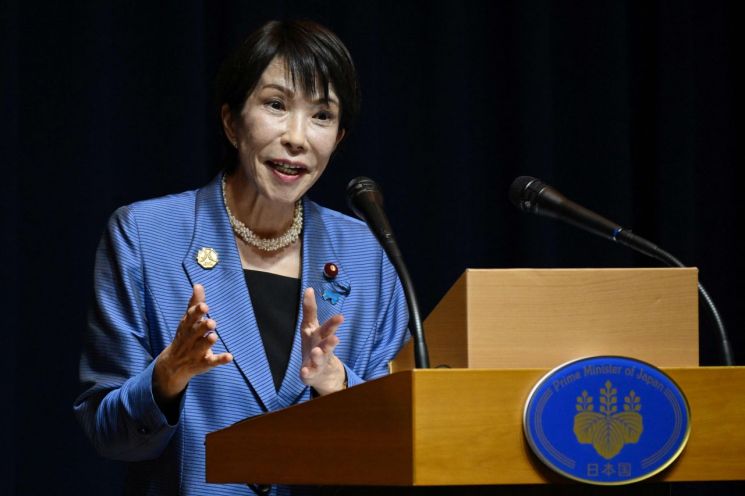
The Japanese government is expected to finance a significant portion of these economic policies through the issuance of government bonds. Kyodo News noted, “The aim is to stimulate personal consumption and strengthen growth strategies, but concerns over fiscal deterioration are pushing up long-term interest rates in the market,” and suggested that Prime Minister Takaichi should carefully explain the necessity of the economic package to the market.
On the Tokyo bond market that day, the yield on 10-year government bonds, the benchmark for long-term interest rates, rose to as high as 1.775%. This is the highest level in about 17 and a half years since June 2008.
The Mainichi Shimbun reported, “The outstanding balance of long-term government bonds for both the national and local governments in Japan stands at 1,330 trillion yen (about 1,254.2 trillion won), by far the highest among developed countries,” and warned, “Unlimited fiscal spending could undermine confidence.”
The newspaper also cited the case of former UK Prime Minister Liz Truss, who was forced to resign early after her 2022 tax cut policy triggered a plunge in government bond prices. It cautioned that if government bond yields rise, issuing new bonds may become difficult, potentially leading to a suspension of government services. The article added, “While it seems highly unlikely that Japan, as a major economic power, will face immediate difficulties in fiscal management, it is a fact that the market is experiencing anomalies, such as long-term interest rates rising to their highest level in 17 and a half years.”
© The Asia Business Daily(www.asiae.co.kr). All rights reserved.
![Clutching a Stolen Dior Bag, Saying "I Hate Being Poor but Real"... The Grotesque Con of a "Human Knockoff" [Slate]](https://cwcontent.asiae.co.kr/asiaresize/183/2026021902243444107_1771435474.jpg)
















