Four Rounds of Strikes Announced After Breakdown in Collective Wage Negotiations
On the First Day, Schools Provide Substitute Meals to Minimize Disruption
Ministry of Education and Education Offices Activate Situation Rooms for Response
Non-regular workers responsible for school meals and after-school care at kindergartens, elementary, middle, and high schools nationwide have begun region-by-region "relay strikes." The education authorities plan to operate alternative programs to address gaps in after-school care and provide substitute meals such as bread at schools where meal service disruptions are expected, in order to minimize the impact on students.
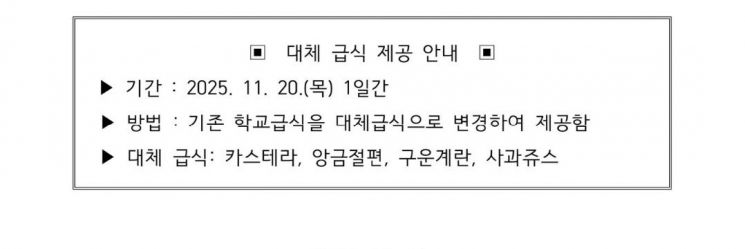
A public elementary school in Seoul, where the first strike took place on November 20, focused on reducing confusion by sending home notices to parents a week in advance. In the notice sent nine days before the strike, the school stated, "Due to the participation of cooks and kitchen staff union members in the strike, it will be difficult to provide normal school meals," and specified, "Alternative meals will be provided on that day." On this day, the school's lunch was replaced with "castella, rice cake, baked eggs, and apple juice."
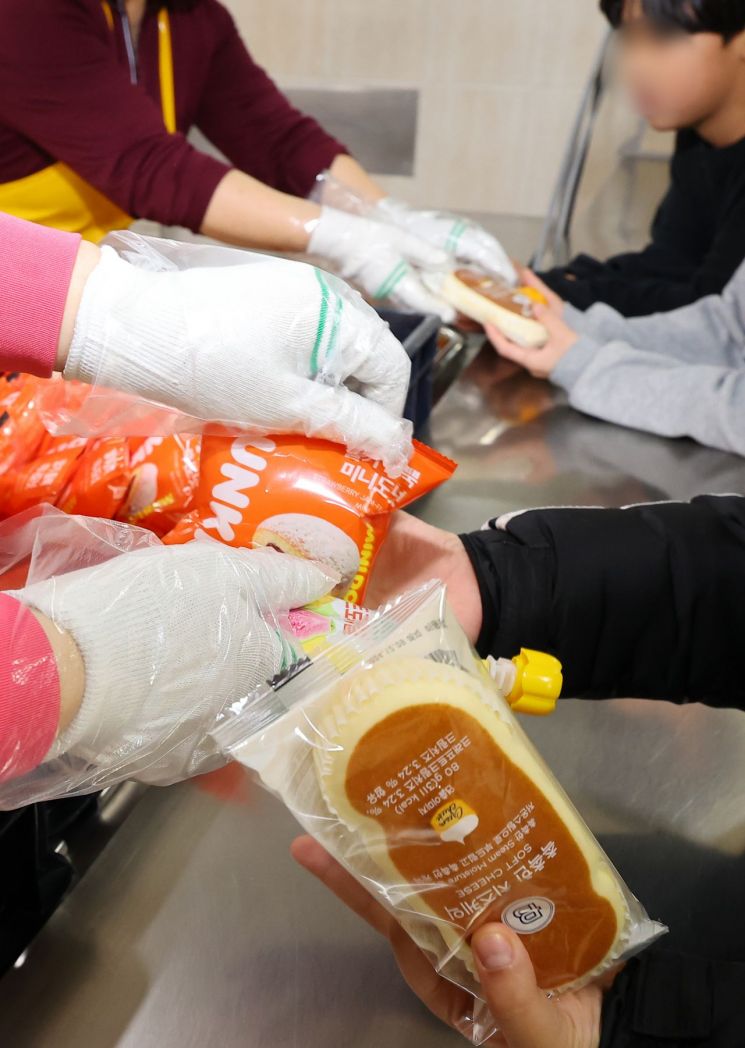
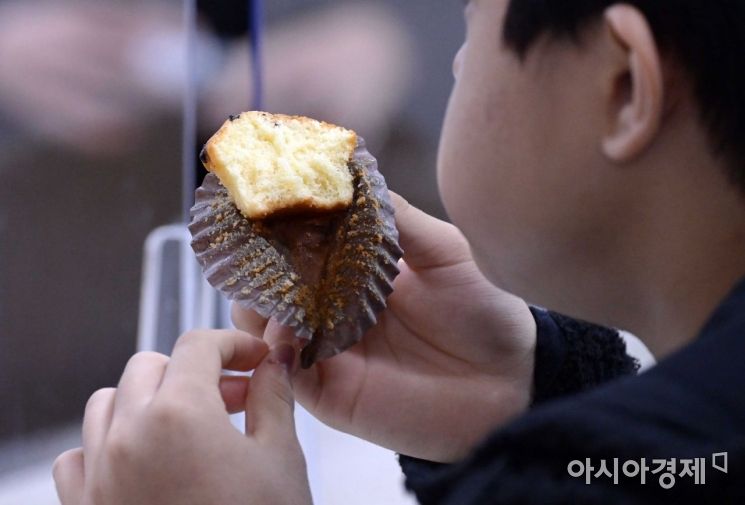 When non-regular school workers went on a general strike demanding the elimination of wage discrimination with regular workers, students at a middle school in Seongdong-gu, Seoul, were seen having alternative meals such as sandwiches and muffins instead of school lunches. Photo by Joint Press Corps
The National School Irregular Workers Solidarity Council (comprising the Korean Confederation of Trade Unions National School Irregular Workers' Union, the KCTU Public Transport Workers' Union National Education Public Workers' Headquarters, and the Korean Women's Trade Union) has been engaged in collective wage negotiations with the Ministry of Education and 17 provincial and metropolitan education offices since August, but failed to narrow their differences, resulting in a breakdown of talks. The council demanded measures such as an increase in base salary to close wage gaps and improvements in employee welfare, but the education authorities maintained that it was difficult to accept these demands due to budget constraints.
As a result, the council announced a four-stage relay strike: starting with Seoul, Incheon, Gangwon, North Chungcheong, and Sejong on November 20; Gwangju, South Jeolla, North Jeolla, and Jeju on November 21; Gyeonggi, Daejeon, and South Chungcheong on December 4; and South Gyeongsang, North Gyeongsang, Daegu, Busan, and Ulsan on December 5. Disruptions are expected across all areas of after-school care, meal service, and special education managed by these workers.
The education authorities have determined that it is impossible to prevent the announced strikes and are instead focusing all efforts on minimizing the impact on students during the strike period.
The Seoul Metropolitan Office of Education is operating "strike response situation rooms" at its main office, district offices, and individual schools to ensure immediate action in case of emergencies. Regarding meal service, each school has been instructed to simplify menus, allow students to bring packed lunches, or provide substitute food items. In addition, for after-school care and special education at kindergartens and elementary schools, the plan is to utilize as many school staff as possible to fill any gaps.
There are also calls for the introduction of a "School Strike Damage Prevention Act" in response to the annual repetition of strikes by non-regular school workers. The Korean Federation of Teachers' Associations (KFTA) held a press conference at the National Assembly on this day, urging the passage of the bill. The main point of the bill is to designate school meal service, after-school care, and health services as essential public services, so that a minimum number of substitute workers can be deployed during strikes. Current law prohibits the use of substitute workers during union strikes.
The KFTA stated, "While we agree on the need to improve the working conditions of education public workers, including school meal staff, it cannot be justified to repeatedly strike against students and schools, who are not direct parties to the negotiations."
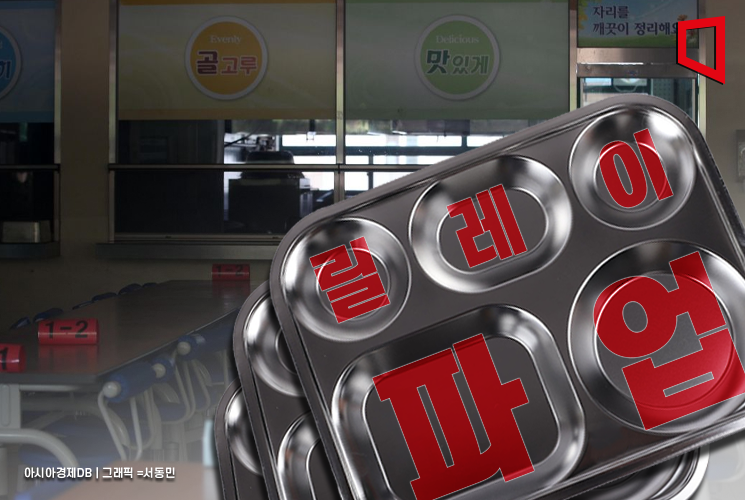
The final tally of participation in the first day of the relay strike will be announced in the afternoon.
Last year, a general strike took place on December 6 for one day, and meal service was suspended at 3,910 out of 12,727 schools nationwide (30.7%).
© The Asia Business Daily(www.asiae.co.kr). All rights reserved.

![Clutching a Stolen Dior Bag, Saying "I Hate Being Poor but Real"... The Grotesque Con of a "Human Knockoff" [Slate]](https://cwcontent.asiae.co.kr/asiaresize/183/2026021902243444107_1771435474.jpg)

















