UNESCO Recommends Heritage Impact Assessment
Ongoing Confrontation Between Seoul City and National Heritage Administration
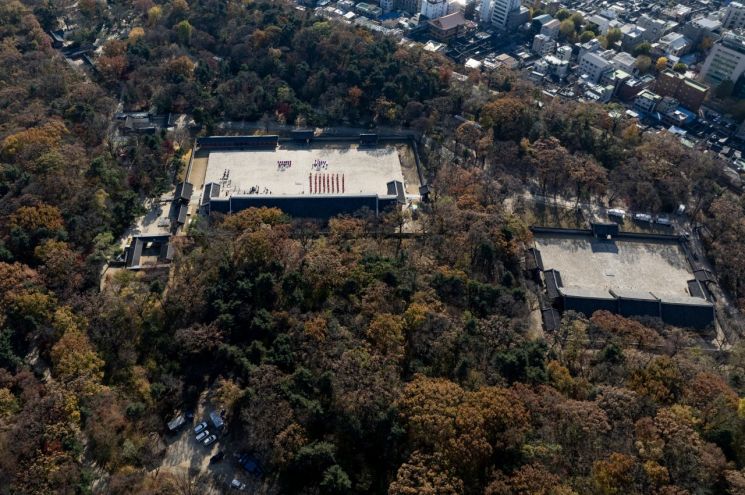 A ceremony is being held on the 18th at Jongmyo in Jongno-gu, Seoul, where the ruling and opposition parties continue to clash over redevelopment near Jongmyo. Photo by Yonhap News
The controversy over high-rise development in Sewoon District 4 in front of Jongmyo in Seoul has now escalated to concerns that the area could lose its World Heritage status, drawing attention to the potential repercussions for the national brand and the credibility of Korea’s cultural diplomacy.
Jongmyo was inscribed as Korea’s first UNESCO World Heritage Site in 1995. It is the first national facility of the Joseon Dynasty, established even before Gyeongbokgung, the official royal palace, when the capital was moved to Hanyang in 1394. However, during the Japanese colonial period, a tram line was built between Changdeokgung and Jongmyo, and in the 1960s, the development of Sewoon Shopping Center severed the urban axis that once connected Changdeokgung, Jongmyo, and Namsan, resulting in significant damage.
While the World Heritage inscription recognized Jongmyo’s value for preservation, the recent high-rise development plan for Sewoon District 4 by the Seoul Metropolitan Government has brought a new crisis. UNESCO has recommended that the Korean government conduct a Heritage Impact Assessment, and on the 20th, the Cultural Heritage Committee of the National Heritage Administration issued a statement saying, “The Seoul Metropolitan Government is unilaterally disregarding the social consensus reached in 2018,” and urged the city to “promptly carry out the Heritage Impact Assessment.”
Losing World Heritage status is recorded internationally as a “failure of preservation and management.” When Liverpool was delisted as a World Heritage Site in 2021, the British media called it a “national disgrace of the 21st century.” Experts point out that if Jongmyo is delisted, it will inevitably have a negative impact on cultural diplomacy, the national brand, and the credibility of cultural policy.
The bigger issue is the impact this could have on future World Heritage strategies. UNESCO reviews the entire preservation and management system of a country that loses a World Heritage Site. After the Dresden Elbe Valley was delisted in 2009, Germany was required to present much more detailed management plans for other candidate sites. Experts warn that the Jongmyo case could disadvantage Korea in future evaluations for the Demilitarized Zone, additional temple areas, or the expansion of the Baekje Historic Areas.

Currently, confrontation is deepening in front of Jongmyo rather than efforts to find a solution. The Seoul Metropolitan Government insists on creating a vast green corridor from Jongmyo to Namsan, flanked by high-rise buildings, while the National Heritage Administration opposes the plan, arguing that the visibility of high-rise buildings from Jongmyo would undermine its World Heritage value. With local elections approaching next year, the debate is escalating into an emotional conflict.
The Heritage Impact Assessment is not a system designed to suppress development, but rather a tool to balance development and preservation. Introduced by UNESCO and its advisory body ICOMOS in 2011, it is an international system aimed at minimizing the negative impact of development projects on the Outstanding Universal Value of World Heritage Sites.
Experts point out that various alternatives exist. One prominent example is the European approach, which increases floor area ratios by raising building coverage rates while keeping structures low-rise. Dresden, Germany, lost its World Heritage status due to the construction of a bridge over the river, but at the time, there was no proper assessment tool. Experts believe that, had an assessment been conducted, an alternative bridge design could have been found.
In its statement, the Cultural Heritage Committee warned, “We must avoid reducing this issue to a simple political confrontation or a conflict of interests among stakeholders over development profits,” and emphasized, “Everyone should participate in the process of finding the best solution that harmonizes preservation and development.”
© The Asia Business Daily(www.asiae.co.kr). All rights reserved.













