Moon, a 60-year-old home care worker in Ansan, Gyeonggi Province, feels disheartened by the hourly wage of 12,700 won, which has remained unchanged for nearly 20 years. Despite her 17 years of experience working at nursing homes and home care agencies, as well as the various training programs she has completed at different institutions, her efforts have become a matter of personal passion. Moon said, "During my shift, I do everything from feeding patients through a gastrostomy tube, suctioning phlegm, and changing diapers to tidying rooms and doing laundry. There is nothing I don't do." She added, "It is common to work two to three hours of overtime to accompany clients to the hospital. When I adjust my schedule with other elderly clients because of this, it leads to complaints, and if I lose work, it results in financial losses-a vicious cycle."
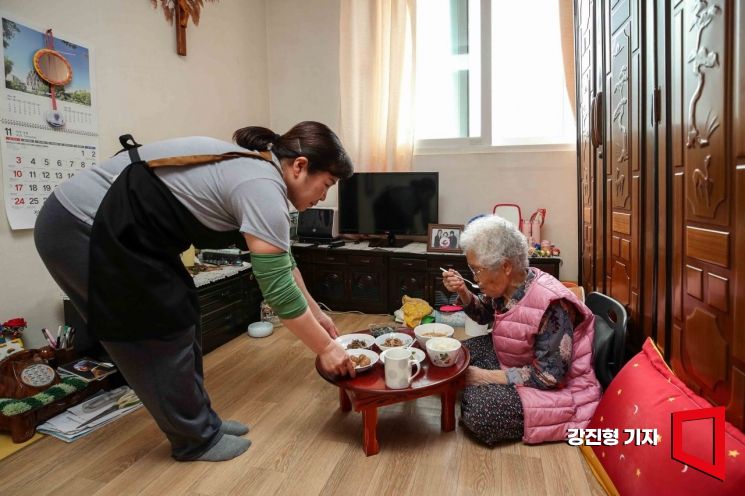
Kim, a 66-year-old home care worker in Namyangju, Gyeonggi Province, also described the high intensity of care work. She explained that she must be a jack-of-all-trades, not only providing one-on-one physical care for elderly clients but also handling cleaning and emotional labor. Kim said, "Some clients have oral diseases that make it difficult to swallow saliva, so they spit anywhere, and even when I explain, they often don't understand." She continued, "When clients have bowel accidents and I try to change their diapers, they sometimes instinctively resist and become violent." Kim added, "I have even had to clean not only the client's room and activity area but also other family members' rooms, and during kimchi-making season, I was expected to help with kimchi preparation, which was awkward. I think the most important thing is whether the client's personality and preferences are a good match."
As the shortage of care workers continues, efforts have begun to train foreign caregivers and other care personnel. However, the fundamental issue of working conditions for caregivers has remained unchanged for years.
According to the National Health Insurance Service as of July this year, there were 698,063 active care workers. Of these, half are aged 60 or older, and there are only 1,080 workers in their 20s or younger. The number of care workers in their 20s is extremely low due to low wages and poor working conditions.
In reality, care workers' wages remain at the legal minimum wage level. There is no separate wage system based on years of service or experience, resulting in an unstable wage structure. If a worker changes agencies, their experience is not recognized, making them ineligible for long-term service incentives. As of this year, the standard monthly wage for care workers at elderly care facilities is 2,921,000 won; for day and night care workers, it is 2,769,000 won; and for short-term care workers, it is 2,771,000 won.
As a result, the supply of labor in the care industry is also declining. The number of applicants for the care worker certification exam has dropped sharply. According to the Korea Health Personnel Licensing Examination Institute, the number of exam takers fell from 339,377 in 2023 to 181,890 in 2024, and to 129,602 as of October this year.
In response, the Ministry of Health and Welfare announced that it will focus on improving working conditions to attract new care workers and prevent existing workers from leaving. Starting next year, workers who have served at the same agency for over a year will receive long-term service incentives, and care workers with seven years of service will receive a monthly allowance of up to 380,000 won in addition to their base salary. Care workers who have worked for more than five years and completed 40 hours of promotion training will be designated as senior care workers.
Experts say that wage disparities between regions and institutions for the same work should be reduced, and the wage system should include additional compensation for difficult duties such as night shifts and caring for severely ill clients. Heo Junsu, a professor in the Department of Social Welfare at Soongsil University, stated, "A grading system should be established among care workers to recognize working hours and experience. Improving the treatment of older care workers is essential to attract younger workers to the field."
© The Asia Business Daily(www.asiae.co.kr). All rights reserved.












