Entry into Korea After the Financial Crisis
Acquisition of Distressed Companies, Real Estate, and Korea Exchange Bank
Controversies Over Major Shareholder Eligibility, Fire Sale, and Asset Stripping
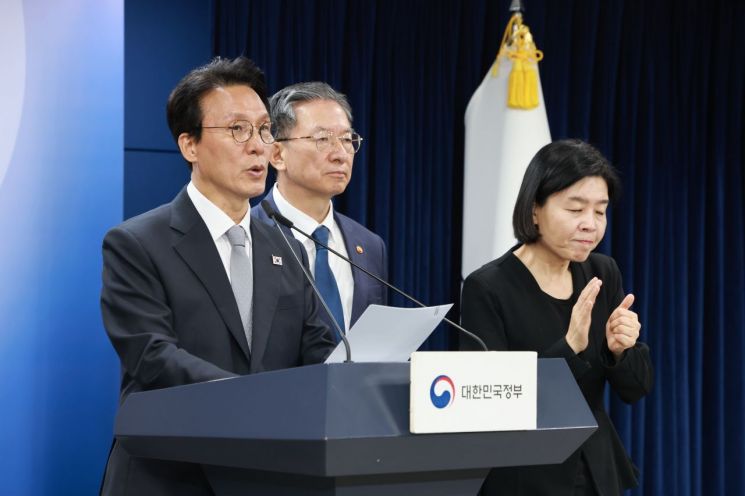 Prime Minister Kim Minseok announced on the 18th at the Government Seoul Office that South Korea won the decision from the International Centre for Settlement of Investment Disputes (ICSID) annulment committee regarding the 'Lone Star international investment dispute (ISDS) annulment application.' Photo by Yonhap News
On the 18th, the South Korean government won the annulment case regarding the international investment dispute (ISDS) with the American private equity fund Lone Star, bringing an end to a contentious relationship that lasted more than 20 years. After Lone Star acquired Korea Exchange Bank 22 years ago, suspicions regarding the eligibility as a major shareholder and the sale price led to audits by the Board of Audit and Inspection, investigations by prosecutors, and trials. Subsequently, Lone Star launched an international legal battle against the South Korean government.
Lone Star entered South Korea in 1998, right after the Asian financial crisis, purchasing non-performing loans from Korea Asset Management Corporation (KAMCO) and others, reselling them for profit. In the 2000s, Lone Star also acquired domestic companies and real estate facing liquidity crises, such as Kukdong Construction and Star Tower in Yeoksam-dong, Gangnam-gu, Seoul. However, Lone Star became widely known to the Korean public when it acquired Korea Exchange Bank.
Debate Over Major Shareholder Eligibility and Fire Sale of Korea Exchange Bank
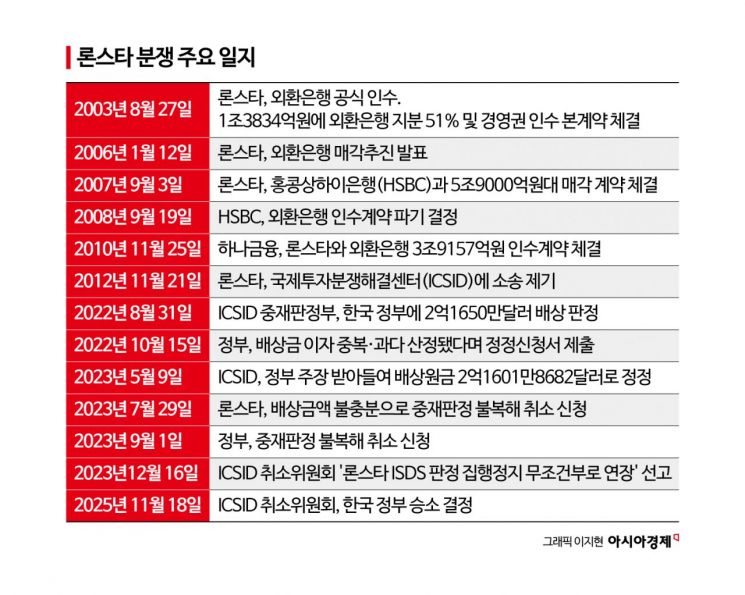
The government sought to sell Korea Exchange Bank, which was suffering from severe insolvency, but neither domestic commercial banks nor foreign financial institutions were willing to acquire it. In 2003, Lone Star was virtually the only party to express interest in the acquisition, and in October of the same year, it became the major shareholder by securing a 51% stake for approximately 1.3 trillion won.
Immediately after Lone Star’s acquisition of Korea Exchange Bank, legal controversies arose regarding its eligibility as a major shareholder. At the time, the Banking Act stipulated that industrial capital (non-financial business groups) with non-financial assets exceeding 2 trillion won could not own more than 10% (or 4% of voting shares) of a bank’s stock. However, the financial authorities applied an exception clause for “special circumstances such as the resolution of insolvent financial institutions,” approving Lone Star’s acquisition in September 2003.
The basis for insolvency was the estimated BIS (Bank for International Settlements) capital adequacy ratio of 6.16% contained in five pages of faxes sent by Korea Exchange Bank to the Financial Supervisory Service. Since this figure fell short of the normal standard (8%), the government argued that the exception clause alone justified approval of the acquisition. On the other hand, civic groups such as the Spec Watch Korea criticized the deal as a fire sale, citing that Korea Exchange Bank’s actual BIS ratio at the end of 2003 was 9.32%.
In June 2006, after the Board of Audit and Inspection concluded that “Lone Star was not eligible for acquisition,” the prosecution indicted former Korea Exchange Bank President Lee Kangwon and former Director General of Financial Policy at the Ministry of Finance and Economy Byun Yangho on charges including breach of trust. However, both were ultimately acquitted by the Supreme Court in 2010.
'Exit Controversy' and the 6 Trillion Won ISDS Lawsuit
In January 2006, Lone Star sought to sell Korea Exchange Bank. In March, Kookmin Bank was selected as the preferred bidder, but ongoing investigations by prosecutors and audits by the Board of Audit and Inspection led Lone Star to cancel the sale contract with Kookmin Bank in November.
Subsequently, in September 2007, Lone Star signed a sale contract with HSBC for 5.9376 trillion won. However, legal disputes over Lone Star’s acquisition process and major shareholder eligibility delayed the approval process. Additionally, the value of Korea Exchange Bank declined due to the U.S.-originated financial crisis, leading HSBC to abandon the acquisition.
In February 2012, Lone Star sold its stake to Hana Financial Group for 3.9157 trillion won and exited South Korea. Including capital gains from the sale of additional shares acquired through call options and dividends, estimates suggest that Lone Star’s pre-tax profit from the acquisition and sale of Korea Exchange Bank reached approximately 4.7 trillion won, fueling intense criticism over its “exit strategy.”
This contentious relationship escalated into an international dispute. In November 2012, Lone Star filed an ISDS lawsuit against the South Korean government, citing the Korea-U.S. Free Trade Agreement (FTA), and sought $4.6795 billion in damages. Lone Star argued that it was forced to sell its stake to Hana Financial Group for 3.9157 trillion won, rather than the 5.9376 trillion won it could have received from HSBC, due to delays in regulatory approval by the Korean financial authorities, and that it suffered losses from arbitrary taxation by the National Tax Service.
The International Centre for Settlement of Investment Disputes (ICSID) tribunal partially accepted Lone Star’s claims and ordered the South Korean government to pay $216.5 million in damages. Dissatisfied with the amount, Lone Star filed for annulment of the ruling in July 2023, and the government also filed for annulment and a stay of enforcement in September of the same year. Two years later, on the previous day, the ICSID annulment committee ruled in favor of the South Korean government, bringing the 13-year international legal battle between Lone Star and the South Korean government to an end.
Lessons from the Lone Star Case
The Lone Star case left significant lessons for Korean society. It is often cited as a representative example of the need to uphold the principle of separation between industrial and financial capital (“firewall principle”), and it led to stricter reviews of major shareholder eligibility by financial authorities. In addition, the domestic private equity fund (PEF) system was introduced in 2004 to curb reckless speculation by foreign private equity funds like Lone Star and to foster homegrown capital.
Furthermore, the system for responding to international investment disputes was strengthened. This was the first ISDS case brought by a foreign investor against the South Korean government. The Ministry of Justice enhanced its response capabilities by establishing the International Legal Affairs Bureau and the International Investment Disputes Division.
© The Asia Business Daily(www.asiae.co.kr). All rights reserved.