National Heritage Administration Announces Rule Amendment Proposal
Continuous Concerns Raised by Civic Groups and Academia
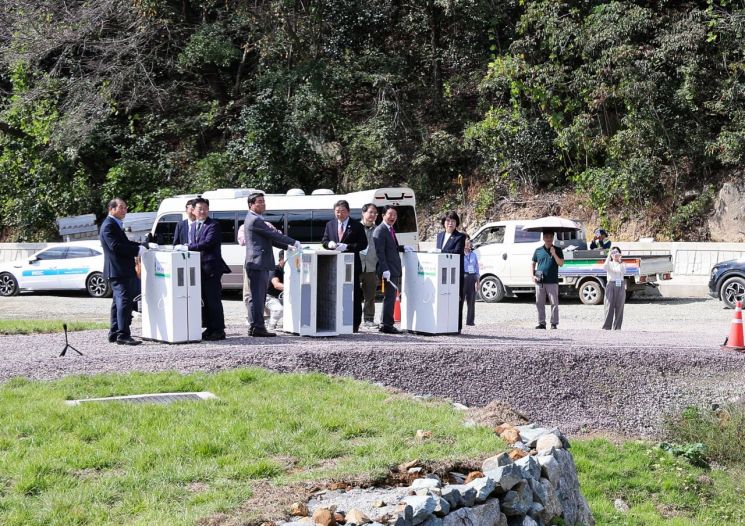 One of the storks released during the recent opening ceremony of the Hapocheon Wetland Science Center in Gimhae City, Gyeongnam Province, died, sparking controversy. Gimhae City released three storks at the science center's opening ceremony held on the 15th of last month. Among them, a male stork came out of a wooden cage with an internal width of about 30 to 40 cm but was unable to fly and collapsed. Although the caretakers nearby quickly moved the stork back to the breeding facility, it ultimately died. Yonhap News
It has been acknowledged that treating the death of living creatures as if they were objects is inappropriate. The National Heritage Administration has decided to use the term "death" (paesa) instead of "loss" (myeolsil) when referring to the deaths of animals designated as natural monuments. On November 19, the agency announced a partial amendment to the Enforcement Rules of the Act on the Preservation and Utilization of Natural Heritage to reflect this change.
According to the Standard Korean Language Dictionary by the National Institute of the Korean Language, "loss" (myeolsil) refers to the severe destruction of objects or houses to the extent that they lose their value due to disasters. Based on this definition, the National Heritage Administration has required the submission of a "loss report" when animals designated as natural monuments, such as gorals or storks, die, and has managed related statistics such as the "list of lost natural monument animals."
Even when the mass deaths of gorals became an issue during the winter of 2023-2024, the National Heritage Administration's official documents referred to the incidents as "goral loss reports" and "1,026 gorals lost in 2024."
Civic groups, animal rights organizations, and academics have continuously raised concerns about this terminology. The civic organization Citizens for the Protection of National Parks pointed out in October last year, "There is no need to downgrade the deaths of animals, which are precious living assets and natural monuments, by using the term 'loss,' which denotes the disappearance of an object's property value." The group also argued, "When different government ministries use different terms for the same situation, it can cause confusion."
In fact, ministries such as the Ministry of Environment, the Ministry of Agriculture, Food and Rural Affairs, and the Ministry of Oceans and Fisheries use the term "death" (paesa) for the deaths of animals and "carcass" (paesache) for animal remains.
An official from the National Heritage Administration stated, "The term 'death' is more accurate than 'loss' when referring to the deaths of animals designated as natural monuments, so we will amend the legal terminology to ensure accuracy and efficient application." The agency will review public opinions on the amendment until December 29.
© The Asia Business Daily(www.asiae.co.kr). All rights reserved.
![User Who Sold Erroneously Deposited Bitcoins to Repay Debt and Fund Entertainment... What Did the Supreme Court Decide in 2021? [Legal Issue Check]](https://cwcontent.asiae.co.kr/asiaresize/183/2026020910431234020_1770601391.png)















