Consulting Requests Surge Among Manufacturing and IT Firms
Subcontract Agreements Under Review for 'Employer Status'
SMEs Without In-House Labor Experts Increasingly Rely on External Support
Lack of Detailed Guidelines Highlights Limits of Legal Counsel
Kim, the CEO of a semiconductor parts manufacturing company with 300 employees in Hwaseong, Gyeonggi Province, recently sought advice from a labor law firm in Seoul. He determined that his company would not be able to handle the situation related to the Yellow Envelope Law, which is set to take effect in March next year, relying solely on its own capabilities. Since there is no labor union at Kim's workplace, the company has not experienced any notable labor-management disputes so far.
Nevertheless, Kim's concerns are growing due to the possibility that unions formed at subcontractors may engage in disputes over working conditions. Kim said, "With the implementation of the Yellow Envelope Law, it is said that subcontractor workers could go on strike against the management of the primary contractor. In such a case, I have no idea where to start or how to respond, which makes me feel helpless," adding, "I am considering entering into a contract with a labor law firm to receive consulting services."

According to the industry on November 19, as the implementation of the Yellow Envelope Law (the amendment to Articles 2 and 3 of the Trade Union and Labor Relations Adjustment Act) is less than four months away, more and more companies are moving quickly to find countermeasures against unexpected management risks. In particular, there has been a sharp increase in cases where small and medium-sized enterprises (SMEs) that lack in-house labor or legal response capabilities, or have never experienced labor disputes, are turning to labor attorneys for help. Consulting requests are especially high among SMEs in manufacturing, construction, and IT sectors, where subcontracting is common. Most of these requests involve reviewing whether there are any clauses in subcontracting agreements that could lead to disputes and, if so, how they should be revised. It has been reported that some well-known labor law firms receive dozens of consultation requests within just a day or two.
Kim, a representative labor attorney at a labor law firm in Songpa-gu, Seoul, said, "Previously, most requests were to review employment contracts between companies and employees, but recently, there has been a surge in requests to examine whether elements related to 'employer status' as defined by the Yellow Envelope Law are present in contracts with partner companies, such as subcontracting and dispatch agreements," adding, "We can feel the heightened interest and concern in the industry regarding the Yellow Envelope Law."
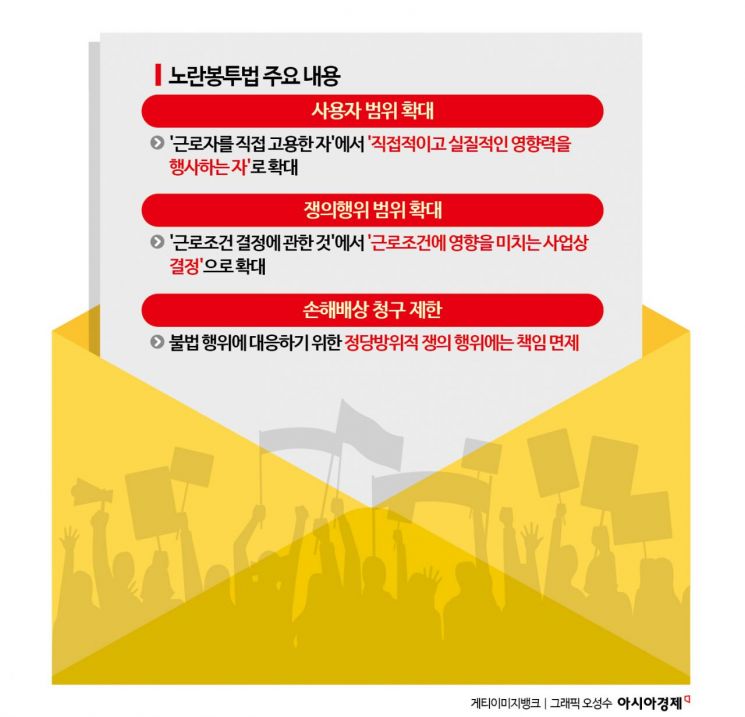
The Yellow Envelope Law poses even greater challenges for SMEs that act as subcontractors to large or mid-sized companies and further subcontract work to maintain productivity. If they fail to properly manage their subcontractors and become embroiled in disputes, they risk losing business with their primary contractors. As a result, there is a growing trend to re-examine subcontracting agreements not only to prepare for the possibility of sudden disputes by subcontractor employees but also to maintain stable business relationships with primary contractors. The aim is to preemptively eliminate any risks that could make the primary contractor appear as an 'employer' in the contract and thus prevent the worst-case scenario.
There are also many cases where companies struggle with consultations due to a complete lack of knowledge about the Yellow Envelope Law. Labor attorney Yoon Jongwoo explained, "Because the law is complex, many people say, 'I have seen it in the news a lot, but I have no idea where to start,'" adding, "Unlike large companies, which can form specialized task forces to respond internally, SMEs are forced to rely on external consulting, which limits their access to information."
The problem is that the lack of detailed government guidelines makes it clear that there are limits to such on-site consulting. The Yellow Envelope Law is fundamentally aimed at expanding the scope of employers and labor disputes, thereby strengthening the bargaining responsibilities of primary contractors. However, the absence of guidelines on how to determine employer status or the scope of industrial action is causing ongoing confusion for companies.
Labor attorney Ahn Chihyun pointed out, "The Ministry of Employment and Labor has not yet issued guidelines, and the enforcement decree for the single bargaining channel system has not been revised, so even among legal experts, opinions on the Yellow Envelope Law are divided," adding, "SMEs, which already have limited capacity to respond, are at a loss as to what they should do." Attorney Kim said, "With only the law itself in place as it is now, we have no choice but to give conservative advice to companies that seek our help," and added, "It is a very difficult situation even for those of us who are supposed to provide legal counsel."
© The Asia Business Daily(www.asiae.co.kr). All rights reserved.
![User Who Sold Erroneously Deposited Bitcoins to Repay Debt and Fund Entertainment... What Did the Supreme Court Decide in 2021? [Legal Issue Check]](https://cwcontent.asiae.co.kr/asiaresize/183/2026020910431234020_1770601391.png)
















