Jensen Huang Makes Surprise Appearance at SC25 in St. Louis
Ian Buck, Father of CUDA, Unveils "Apollo"
NVQLink Adoption Cases Revealed
Quantum-GPU Integration Accelerated with KISTI and Global Centers
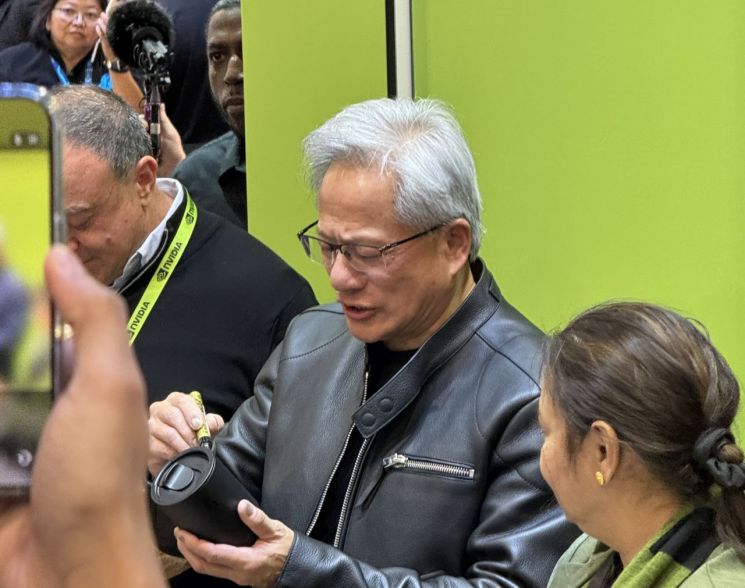 Jensen Huang, CEO of Nvidia, made a surprise appearance at the SC25 event held on the 16th in St. Louis, Missouri, USA, signing cups to distribute to attendees. Photo by Paek Jongmin, Tech Specialist
Amid growing concerns about an artificial intelligence (AI) "bubble" in the stock market, Nvidia is responding by expanding its business domains. Even with its earnings announcement scheduled for the 19th, CEO Jensen Huang made a surprise move, demonstrating his confidence in leadership.
On the 17th (local time), CEO Huang appeared at the SC25 event that began in St. Louis, Missouri, USA. His visit was unannounced. At Nvidia’s booth, he personally handed out autographed cups to attendees. At the booth of Taiwan’s Gigabyte, which sells Nvidia’s graphics processing unit (GPU) servers, he left his signature to mark his visit.
Lee Sangmoon, Executive Director at Gigabyte, said, "We were surprised by CEO Huang’s visit." Even at SC25, a supercomputing event, Nvidia’s booth was by far the most popular. Most supercomputers today are built using Nvidia GPUs. Whereas brands like Cray and SGI were once important in the supercomputer market, now the use of Nvidia GPUs determines performance.
Nvidia’s increased focus on the SC25 event this year and last year was evident. At last year’s SC24, CEO Huang and Vice President Ian Buck only appeared via video message, but this year both visited the venue in person and attended the gala party.
Nvidia GPU and Quantum Computer Integration 'NVQLink' to Be Adopted by Korea’s KISTI
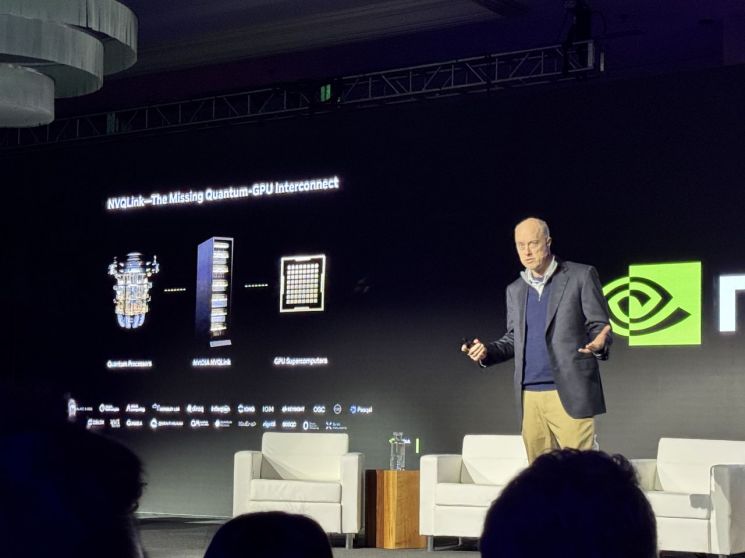 Ian Buck, Vice President of Nvidia, is explaining the integration of Nvidia GPUs with quantum computers. Photo by Paek Jongmin, Tech Specialist
Nvidia rented a hotel near the event venue to actively showcase its technological leadership. Ian Buck, the creator of CUDA and Nvidia Vice President, took the stage to introduce real-world implementation cases of NVQLink, the next-generation quantum GPU integration technology. NVQLink is an open interconnect architecture that links quantum processing units (QPUs) and GPU-accelerated computing with microsecond (μs) latency. Having already outpaced competitors with NVLink, which connects GPUs, Nvidia is now seeking a first-mover advantage by linking to quantum computers. Nvidia’s goal is to build a hybrid computer system that integrates GPUs, central processing units (CPUs), and QPUs.
Vice President Buck emphasized, "The key challenge going forward is how to connect quantum processors (QPUs) to GPU-based supercomputers. We are developing a new architecture to process the complex signals of QPUs in real time." He also predicted, "Quantum processors will not handle every workload, but they will become essential tools for certain calculations."
On this day, Nvidia announced that more than 20 prominent supercomputing centers, including the Korea Institute of Science and Technology Information (KISTI), have decided to adopt NVQLink. KISTI plans to connect IonQ’s "Tempo" quantum computer to the sixth national supercomputer, which is built with Nvidia GPUs. NVQLink will play this role. Lee Sik, President of KISTI, said, "At SC25, we met with Nvidia and agreed to closely collaborate on connecting supercomputers and quantum computers."
KISTI’s adoption of NVQLink was already included in the memorandum of understanding (MOU) signed with the Ministry of Science and ICT during the developer conference (GTC) held in Washington, D.C. last month and during CEO Huang’s visit to Korea.
A demonstration of real-time quantum error correction using NVQLink was also presented. Quantum computing company Quantinuum announced that its latest QPU, "Helios," was integrated with Nvidia GPUs via NVQLink to perform scalable real-time error correction decoding.
Industry-Specific AI Model 'Apollo' and Climate Prediction Platform 'Earth-2' Unveiled
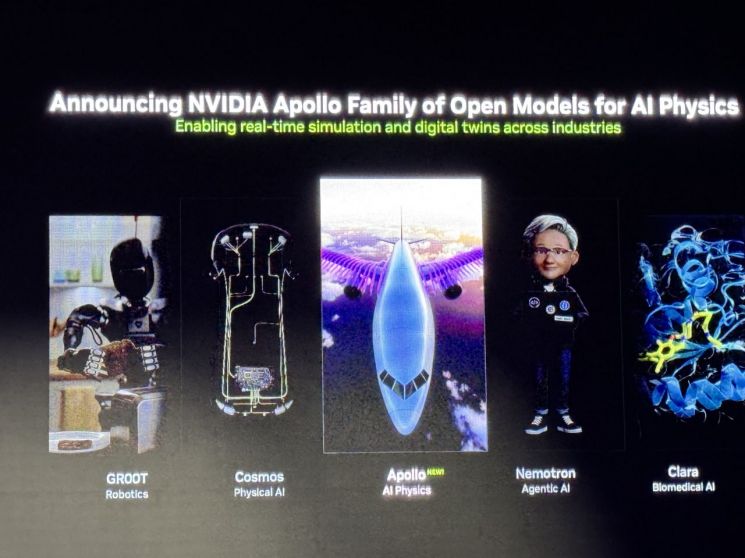 NVIDIA also unveiled a new open model family called "Apollo" for scientific and engineering research at SC25. Apollo is an industry-specific AI model family trained on complex physical simulations in fields such as aerospace, materials, climate, and mechanical engineering. It features the ability to transform problems that previously took hours to compute on supercomputers into prediction models that operate within seconds. Photo by Paek Jongmin, Tech Specialist
Vice President Buck also unveiled a new open model family for scientific and engineering research called "Apollo." Apollo is an industry-specific AI model family trained on complex physical simulations in fields such as aerospace, materials, climate, and mechanical engineering. Its key feature is transforming problems that previously took hours to compute on supercomputers into prediction models that operate within seconds.
Nvidia explained, "Apollo dramatically reduces the cost of traditional high-performance computing (HPC) and significantly accelerates the pace of research and industrial development." Apollo is designed for immediate use in research institutes and industrial sites.
Nvidia also introduced "Earth-2," a next-generation digital twin platform for climate and weather prediction. Earth-2 integrates AI and GPU-accelerated simulation, high-resolution physical modeling, and large-scale data visualization technology to enable real-time analysis and prediction of global climate and weather phenomena at kilometer-scale resolution.
An industry official in the supercomputing sector commented, "By presenting NVQLink and even real-world demonstrations, Nvidia has effectively secured a leading position in the hybrid market for quantum and classical computers."
© The Asia Business Daily(www.asiae.co.kr). All rights reserved.



















