COFIX Rises for Second Consecutive Month
Variable-Rate Mortgage Rates Continue Upward Trend
Interest Burden Expected to Increase Further
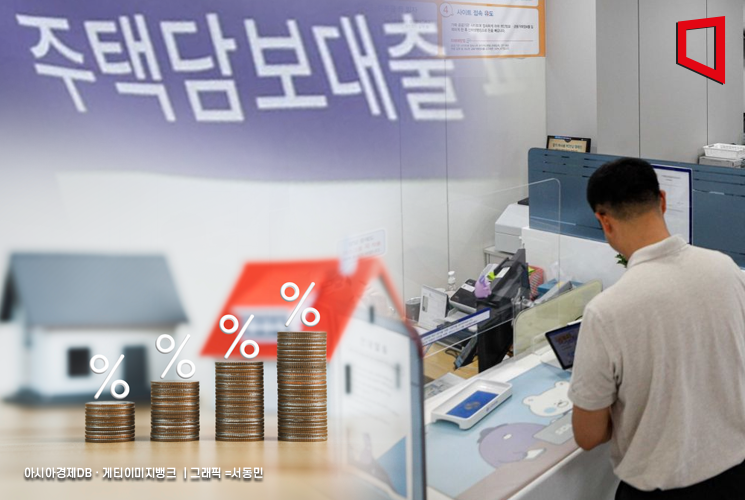
Internet banks have also raised their mortgage loan interest rates, pushing the upper limit of rates into the 7% range. The Cost of Funds Index (COFIX), which serves as the benchmark for variable-rate mortgage loans, has also risen for two consecutive months, suggesting that the interest burden on so-called “Yeongkkeul” borrowers (those who have leveraged themselves to the limit) will increase further.
According to K Bank on November 19, the variable-rate apartment mortgage loan interest rate stood at 4.06-7.72% as of November 18. The lower end of the mortgage rate surpassed the 4% range, while the upper end soared past 7%. Compared to a month ago, the lower end rose by 0.15 percentage points and the upper end by 0.03 percentage points. In this regard, K Bank explained, “Because we also include borrowers with lower credit ratings, our upper-end rates remain higher than those of other banks.”
The variable-rate mortgage loan interest rate at KakaoBank ranged from 3.85% to 5.561%. This is a 0.2 percentage point increase compared to before the suspension of mortgage lending. KakaoBank temporarily halted mortgage loans after the real estate measures announced on October 15, citing system updates, but resumed lending the previous day. While KakaoBank once aggressively expanded its mortgage lending business by offering competitive rates, it now maintains slightly higher rates than commercial banks, due to household loan regulations and other factors.
As of this date, the variable-rate mortgage loan interest rates at the five major banks-KB Kookmin, Shinhan, Woori, Hana, and NH Nonghyup (using new COFIX rates, with Shinhan based on financial bonds)-ranged from 3.63% to 6.18%. This means that, following fixed-rate mortgages, the upper end of variable-rate mortgages has also surpassed 6%. Compared to the end of August, when rates ranged from 3.66% to 5.505%, the upper limit has increased by 0.675 percentage points.
The rise in variable-rate mortgage interest rates is due to the COFIX rate for new loans in the previous month reaching 2.57%, up 0.05 percentage points from 2.52% the month before. COFIX, which had declined from August last year to August this year following the Bank of Korea’s base rate cuts, has now risen for two consecutive months.
The increase in COFIX is attributable to higher funding costs for banks. As a result of a booming stock market, funds have flowed into capital market investments, causing demand deposits-banks’ low-cost funding sources-to move to securities firms as customer deposits. To secure funding stability, banks have responded by raising deposit and savings account interest rates and increasing the issuance of bank bonds.
With market interest rates continuing to rise, there are expectations that COFIX will climb again this month. According to the Korea Financial Investment Association, as of November 17, the annual interest rate for five-year bank bonds (unsecured, AAA-rated) stood at 3.362%, up about 0.4 percentage points from the previous month and about 0.5 percentage points from three months earlier.
© The Asia Business Daily(www.asiae.co.kr). All rights reserved.
![Clutching a Stolen Dior Bag, Saying "I Hate Being Poor but Real"... The Grotesque Con of a "Human Knockoff" [Slate]](https://cwcontent.asiae.co.kr/asiaresize/183/2026021902243444107_1771435474.jpg)











