Hydrogen R&D Directions Centered on Five Priority Research Labs and the Innovation Alliance
A forum was held to discuss ways to strengthen hydrogen technology in order to achieve the 2035 national greenhouse gas reduction target (NDC). On November 18, the Ministry of Science and ICT and the Korea Institute of Energy Research hosted the 6th Hydrogen Economy and Korea's Hydrogen Technology Symposium at EL Tower in Yangjae, Seoul, where they shared strategies for technological innovation across the entire hydrogen value chain-from production and storage to utilization.
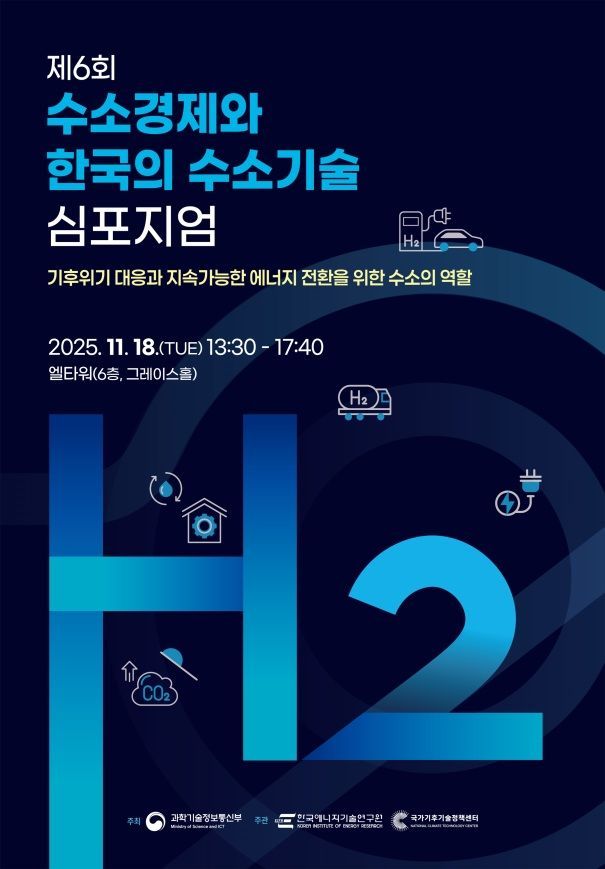 Poster of the 6th Hydrogen Economy and Korea's Hydrogen Technology Symposium. Provided by the Ministry of Science and ICT
The 2035 NDC, confirmed by the government at a Cabinet meeting on November 11, sets a target of reducing emissions by 53-61% compared to 2018 levels, which is a significant increase from the previous 2030 NDC target of 40%. Since a transition from fossil fuel-based structures is required in all sectors-including power, industry, and transportation-the role of hydrogen, which can be used as a 'carbon-free fuel' based on renewable energy, is becoming increasingly prominent.
Hydrogen can be produced without greenhouse gas emissions through water electrolysis powered by renewable electricity and can be utilized across various industries, including fuel cell power generation, hydrogen reduction steelmaking, hydrogen vehicles, and hydrogen ships. In response, the government designated five 'National Hydrogen Priority Research Laboratories' this year and is investing approximately 119 billion won by 2029 to develop large-scale water electrolysis systems and high-efficiency hydrogen production technologies. In September, a 'Clean Hydrogen R&D Innovation Alliance' was established, bringing together 93 organizations from companies, research institutes, and universities to create a system linking technology development with industrial application.
The event was attended by over 300 participants from industry, academia, and research institutes, who discussed topics such as the role of hydrogen from the perspective of the 2035 NDC, hydrogen utilization strategies in various countries, and changes in the international trade environment due to the expansion of hydrogen trade. In addition, government-funded research institutes and companies participating in the innovation alliance shared research outcomes in areas such as water electrolysis, fuel cells, and hydrogen storage alloys, and intensively reviewed strategies for technological integration across fields and the development of the climate tech industry.
Kim Seongsu, Director General for R&D Policy at the Ministry of Science and ICT, stated, "Implementing the 2035 NDC is an essential task for responding to the climate crisis and achieving sustainable growth," adding, "The government will actively support hydrogen technology so that it becomes a key driver of the climate tech industry."
© The Asia Business Daily(www.asiae.co.kr). All rights reserved.
![Clutching a Stolen Dior Bag, Saying "I Hate Being Poor but Real"... The Grotesque Con of a "Human Knockoff" [Slate]](https://cwcontent.asiae.co.kr/asiaresize/183/2026021902243444107_1771435474.jpg)
















