SoftBank Enters Top Ranks with Blackwell-Based Supercomputer
AI Ushers in a New Era for Supercomputing
Rapid Shift Expected from Public to Private Sector Leadership
Samsung, Hyundai, SK, and Naver Poised for Ranking Surge with 260,000 GPUs
The TOP500 list unveiled at "SC25," held on November 16 (local time) in St. Louis, Missouri, USA, once again confirmed that the high-performance computing (HPC) sector is rapidly shifting toward an AI- and GPU-centric structure. It also suggested that the central axis of the field is moving in earnest from government research institutes to private companies focused on artificial intelligence (AI) development.
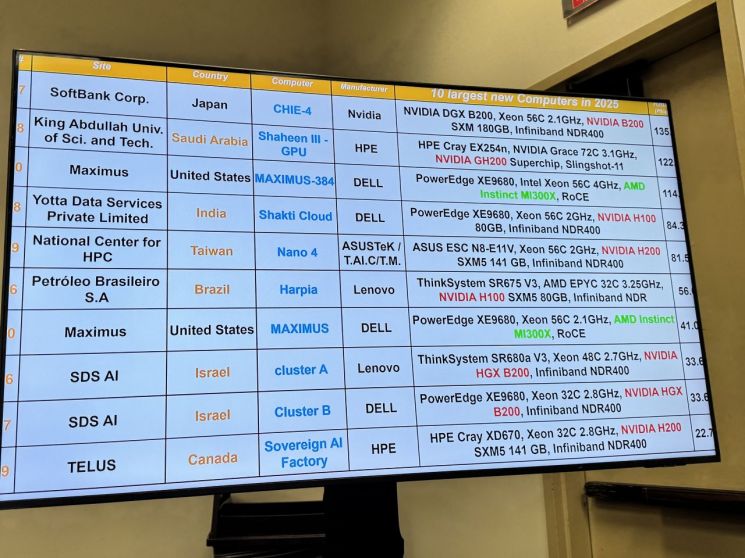 On the 16th, at the SC25 event held in St. Louis, USA, the ranking list of supercomputers newly appearing in this year's rankings was unveiled. SoftBank's supercomputer entered the rankings for the first time at 17th place, achieving the highest position among the newly ranked supercomputers. Photo by Paek Jongmin, Tech Specialist
The top rankings announced that day showed little change from the rankings in May. El Capitan, Frontier, and Aurora, owned by research institutes under the U.S. Department of Energy, along with Europe’s Jupiter, maintained their positions at first through fourth place.
The real change occurred elsewhere. Japan’s SoftBank drew attention with its "CHIE-4," built on Nvidia’s latest Blackwell GPUs. CHIE-4 made an impressive debut at 17th place. The SC25 organizers also highlighted SoftBank’s entry as an exceptional development.
According to the TOP500 rankings, CHIE-4 is based on the Nvidia DGX B200 system and achieved a performance of 4 petaflops (1 petaflop equals 1 quadrillion floating-point operations per second). SoftBank has already emerged as a key player, having placed its H100-based CHIE-3 in the top 20 in the June list. CHIE-4 is particularly notable for being the first Blackwell-based supercomputer to appear in the rankings. SoftBank is accelerating AI development in Japan using this supercomputer.
Growth of Private Company Supercomputers: SoftBank and xAI Stand Out
In the United States, AI supercomputers are also advancing rapidly, led by the private sector. xAI, headed by Elon Musk, is building the Colossus supercomputer for AI training in Memphis, Tennessee, which is reportedly using around 200,000 GPUs. Musk has set a target of scaling up to 1,000,000 GPUs. Unlike traditional HPC systems focused on scientific calculations, Colossus is designed specifically for large-scale AI model training and is cited as a representative example of an "AI supercomputer." Colossus was installed in just 122 days, a feat that reportedly surprised Nvidia CEO Jensen Huang.
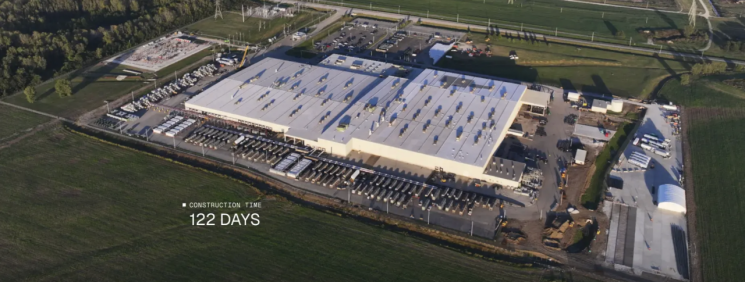 A view of the data center housing xAI's supercomputer installed in Memphis, Tennessee, USA. Currently, the capacity is 200,000 units, with plans to expand to 1,000,000 units in the future. Photo by xAI
Jensen Huang’s Gift: 260,000 GPUs to Boost Korean Supercomputer Rankings
This trend is also connected to changes in Korea. Until now, Korea has competed in this field through the national supercomputer operated by the Korea Institute of Science and Technology Information (KISTI). The sixth national supercomputer, to be introduced next year, will be GPU-centric rather than CPU-centric, enabling support for AI research. KISTI aims for the sixth supercomputer, equipped with about 8,400 H100 GPUs, to enter the global top 10.
But this alone is not enough. Nvidia CEO Jensen Huang, during his visit to Korea for the Asia-Pacific Economic Cooperation (APEC) summit, announced that 260,000 GPUs would be supplied to Korea. As a result, Samsung, Hyundai Motor, SK, and Naver will each secure approximately 50,000 GPUs. This could serve as a decisive catalyst for enhancing the global competitiveness of Korean supercomputers.
Once this volume is fully introduced, Korea will possess the world’s third-largest GPU power. If Korean companies’ supercomputers rise to the top of the rankings within a few years, both corporate and national competitiveness can be expected to improve.
Although Korean companies already own supercomputers, their global competitiveness is still lacking. According to the latest TOP500, Samsung Electronics’ SSC-24 ranked 21st, the highest among supercomputers owned by Korean companies. SSC-24 is used for semiconductor design, simulation, and AI training.
Other supercomputers owned by Naver, Kakao, SK Telecom, KT, and NHN are also ranked, but are not significant enough to change the landscape. Expectations are high that the supply of 260,000 Nvidia GPUs will change the situation.
At the SC25 media briefing, it was noted that with the emergence of Nvidia Blackwell GPUs, the focus of performance competition is shifting to GPUs. It was also suggested that new metrics are needed to evaluate AI performance, reflecting the changes in supercomputers.
The Disappearance of Chinese Supercomputers
Meanwhile, the most unusual aspect of this year’s TOP500 was the absence of Chinese supercomputers. Following the escalation of U.S.-China tensions and U.S. restrictions on CPU and GPU sales to China, China has stopped disclosing information about its supercomputers.
The SC25 organizers assessed that the complete disappearance of China-one of the world’s largest supercomputer-owning countries over the past decade-from the list is a significant variable in the international HPC and AI competition landscape.
China is reportedly building its own independent GPU ecosystem, led by domestic companies such as Huawei and Cambricon. There are concerns that China, having already surprised the U.S. in the AI field with DeepSeek, could do so again in the supercomputer sector.
© The Asia Business Daily(www.asiae.co.kr). All rights reserved.