"I am not worried about inflation re-accelerating"
Jefferson urges caution... "Should proceed slowly"
Intense internal debate expected over December rate path
Christopher Waller, Federal Reserve Board Governor, expressed his support for an additional interest rate cut next month on the 18th (local time). As hawkish (monetary tightening) remarks have recently continued within the Federal Reserve regarding further rate cuts this year, Waller's statement is expected to intensify the debate over the future path of interest rates.
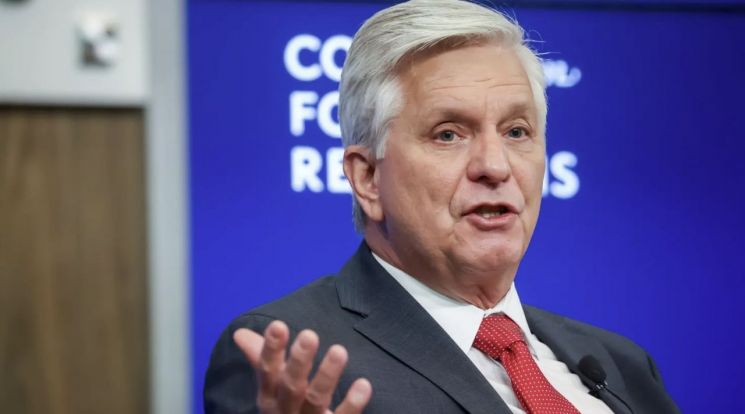
At an event in London, United Kingdom, Waller stated, "My focus is on the labor market," adding, "Given the recent months of employment weakness, it is unlikely that the September employment report due later this week, or other indicators to be released in the coming weeks, will change my view on the need for an additional rate cut."
Regarding inflation, he dismissed market concerns, saying, "I am not worried about inflation re-accelerating or expectations for inflation surging."
The Federal Reserve lowered its benchmark interest rate by 0.25 percentage points in September, marking the first cut this year, and followed with another 0.25 percentage point cut in October. While clear signs of a slowdown in employment have raised calls for further cuts, the persistently high inflation rate has led to diverging opinions within the Federal Reserve over the future rate trajectory. While hawkish members have opposed further cuts due to high inflation, Waller's remarks, along with those of Steve Miran-often referred to as a "Trump economic adviser"-have strengthened the argument for another rate cut within the year. However, unlike Miran, who advocated for a 0.5 percentage point cut, Waller clarified his support for a 0.25 percentage point reduction.
Waller projected that tariffs would not have a long-term impact on inflation, and explained that a December rate cut would be a "risk management measure." He stated, "Restrictive monetary policy is putting a burden on the overall economy, and I am particularly concerned about its impact on middle- and low-income consumers." He added, "A December rate cut would serve as additional insurance to prevent a faster weakening of the labor market and would move policy toward a more neutral stance."
Regarding concerns that monetary policy decisions must be made amid gaps in inflation and employment data following the recent resolution of the federal government shutdown (temporary work stoppage), Waller emphasized, "Despite the shutdown, there is plenty of data available from both the private and public sectors," adding, "While these data are not perfect, they provide a sufficiently actionable picture for assessing the direction of the U.S. economy."
On the same day, Federal Reserve Vice Chair Philip Jefferson took a more cautious stance, stating that additional rate cuts should proceed "slowly."
At a Kansas City Federal Reserve event, he said, "The current policy stance remains somewhat restrictive," and added, "We have moved it closer to a neutral level, which neither restrains nor stimulates the economy." He further explained, "The shifting balance of risks shows that as we approach the neutral rate, we need to move more slowly."
The market is increasingly betting on a rate freeze in December. According to CME FedWatch, the market currently reflects a 57.1% probability that the Federal Reserve will keep the benchmark rate-currently at 3.75% to 4.0%-unchanged at the December Federal Open Market Committee (FOMC) meeting, and a 42.9% probability of a 0.25 percentage point cut.
© The Asia Business Daily(www.asiae.co.kr). All rights reserved.
!["The Woman Who Threw Herself into the Water Clutching a Stolen Dior Bag"...A Grotesque Success Story That Shakes the Korean Psyche [Slate]](https://cwcontent.asiae.co.kr/asiaresize/183/2026021902243444107_1771435474.jpg)
















