Probability of Rate Cut Drops from 88.2% to 45.8%
Fed Officials Expose Divisions
Some Members Voice Opposition to Further Cuts
The Financial Times (FT) reported on November 16 (local time) that expectations on Wall Street for an additional interest rate cut by the Federal Reserve (Fed) next month are rapidly fading.
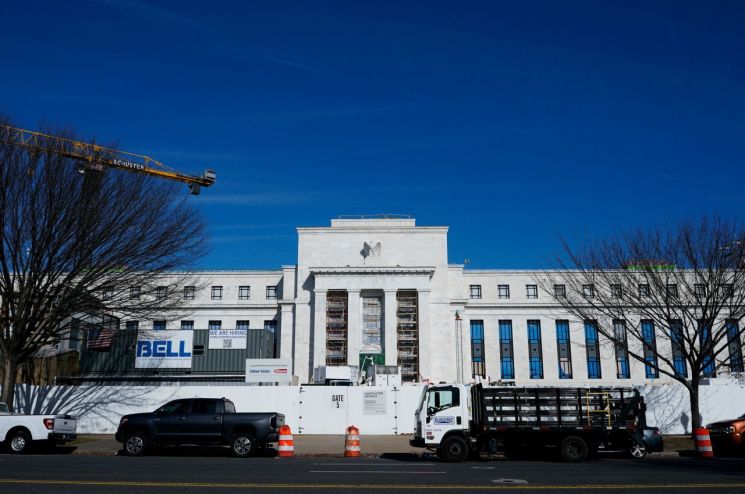 Renovation work is underway at the Federal Reserve Board building in Washington D.C., USA. Photo by Reuters Yonhap News
According to the CME FedWatch tool from the Chicago Mercantile Exchange, the interest rate futures market is currently reflecting a 45.8% probability that the benchmark rate will be lowered by 0.25 percentage points in December. This is a significant decrease compared to a month ago, before the October Federal Open Market Committee (FOMC) meeting, when the probability stood at 88.2%. Conversely, the likelihood of a rate hold has risen to 54.2%.
This shift comes after some committee members publicly stated that they would not support an additional rate cut at the meeting scheduled for December 10.
Previously, Alberto Musalem, President of the Federal Reserve Bank of St. Louis, said at an event in Indiana on November 13, "We need to ensure that monetary policy does not become excessively accommodative," adding, "There is limited room for further easing." He emphasized that the current policy rate is "between moderately restrictive and neutral," and noted, "We must curb inflation that exceeds our target while also providing some support to the labor market."
Neel Kashkari, President of the Federal Reserve Bank of Minneapolis, also pointed out, "Some economic indicators remain solid, but parts of the labor market are under pressure," and added, "The inflation rate is still too high at around 3%."
So far, the Fed has cut rates by 0.25 percentage points at each of the last two meetings, judging that signs of a slowdown in the U.S. labor market and the impact of tariffs imposed by President Donald Trump on inflation were more limited than expected.
However, at last month's meeting, opinions split into three camps, resulting in an unusual division. Fed Governor Stephen Miran, who is supportive of President Trump's dovish monetary policy stance, argued for a 0.5 percentage point cut, while Jeff Schmid, President of the Federal Reserve Bank of Kansas City, supported holding rates steady. As such, the widening divergence within the Fed has made it increasingly difficult for Wall Street to predict future policy direction.
Chair Jerome Powell also warned immediately after the vote, "A December rate cut is not a foregone conclusion." Subsequently, even among regional Fed presidents without voting rights, there were a series of statements saying they "did not agree with last month's cut," exposing internal disagreements. The soon-to-be-released minutes of the October meeting are expected to provide clues about the FOMC's divided stance on the rate path.
Jonathan Millar, an economist at Barclays, analyzed, "The December meeting will also be highly contentious, just as Chair Powell indicated in October."
The market had hoped that the Fed would move to cut rates if employment and inflation indicators deteriorated, but the Fed continues to maintain a cautious stance. Diane Swonk, chief economist at KPMG, said, "Investors have fallen into wishful hoping that the Fed will cut rates whenever weak data is released."
The problem is that some economic indicators, which serve as the basis for monetary policy, may not be released due to the impact of the government shutdown. The Bureau of Labor Statistics (BLS) is scheduled to release the September employment report on November 20, but it remains uncertain whether the October Consumer Price Index (CPI) and employment data will be published. This makes it more difficult for Fed officials to make policy decisions based on data, and also leaves the market without clues about the future direction of monetary policy.
Economist Swonk said, "What is most clear right now is that the Fed is hesitant to move quickly on rate cuts in such an uncertain environment," adding, "Inflation in the services sector also remains."
In fact, the September CPI rose 3% year-on-year, which was lower than market expectations but still exceeds the Fed's 2% target.
Even if the Fed decides to cut rates, or chooses to hold, there is a risk of growing internal opposition. Dovish members such as Chris Waller, Michelle Bowman, and Stephen Miran, all appointed by President Trump, may vote against a decision to hold rates. FT reported that, in this scenario, it could be the first time since 1988 that three Fed governors simultaneously oppose the decision.
© The Asia Business Daily(www.asiae.co.kr). All rights reserved.

















