US Navy Chief: "Korean Nuclear Submarines Will Be Used to Deter China"
On November 17, General Xavier Brunson, Commander of United States Forces Korea (USFK), stated regarding the so-called "flipped East Asia map," which depicts the east at the top, "Korea's geographical location is not a vulnerability but a strategic advantage, and the forces stationed here serve as the most concrete and practical deterrent." He added, "This will expand to contribute to the stability of the entire Indo-Pacific region."
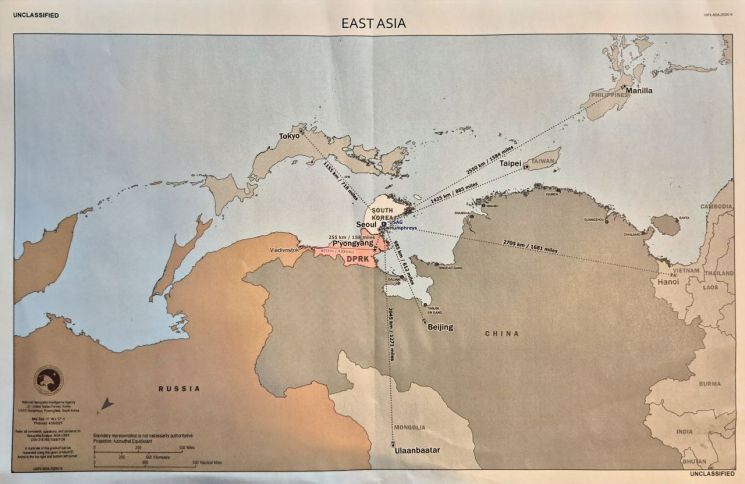
In a written interview with the Ministry of National Defense press corps on the same day, Commander Brunson said, "Korea's geographical location offers a unique advantage, as it can simultaneously influence the three axes of competition involving North Korea, China, and Russia."
The flipped map rotates the Korean Peninsula 180 degrees north-south, placing Korea at the center and encompassing not only North Korea, China, and Russia, but also Japan, Taiwan, and the Philippines. Earlier this year, USFK created this map for internal training purposes, and it is seen as reflecting USFK's intention to expand its role in countering China and other regional challenges.
Commander Brunson explained, "From the perspective of this map, Korea, Japan, and the Philippines are not three separate bilateral relationships, but rather a single connected network." He continued, "This structure especially strengthens the credibility of the allied deterrence against the North Korean threat, which is the fundamental mission of the alliance that begins on the Korean Peninsula."
Regarding the background for releasing the map, he said, "The Korean Peninsula has long been perceived as an outlying forward post, but if we change our perspective, it appears as a strategic central position with accessibility, reach, and influence." He added, "Maintaining a posture that can impose costs from any direction is a key element in solidifying the first line of defense on the Korean Peninsula."
Addressing his earlier comment that the forces stationed on the Korean Peninsula are already "inside the defensive perimeter," Commander Brunson stated, "We are not structured to project power from a distance, but are positioned to operate from within." He also noted, "Threats in the Indo-Pacific region are evolving, and there are a variety of challenges at both the state and non-state levels, including the advancement of North Korea's missile capabilities."
Meanwhile, on November 14, Admiral Daryl Caudle, Chief of Naval Operations of the United States, commented in an interview with reporters at a location in Seoul on Korea's official move to construct nuclear-powered submarines, saying, "It is a natural prediction that these will be used to deter China."
© The Asia Business Daily(www.asiae.co.kr). All rights reserved.

















