Lutnick Said, "No More Talks," but Attending the 9/11 Memorial Became the Turning Point
"National Assembly Ratification Would Be a Self-Defeating Move?It Would Lock In the Negotiation Terms Ourselves"
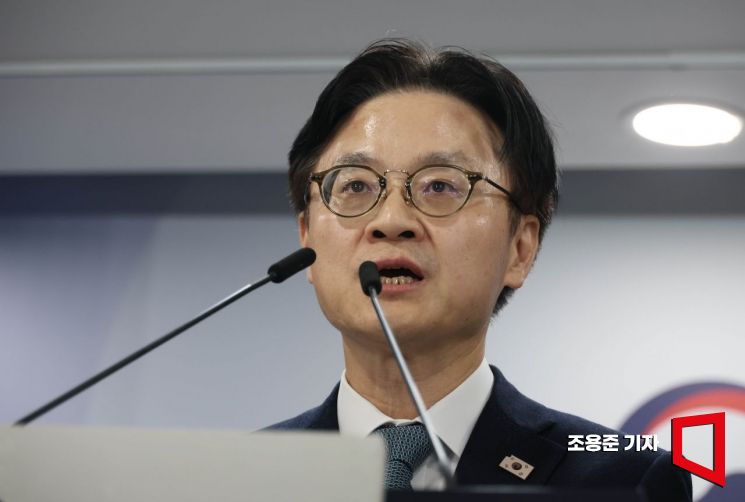 Kim Jeong-Kag, Minister of Trade, Industry and Energy, is briefing on the US-Korea tariff negotiation fact sheet and the memorandum of understanding on strategic investment at the Government Seoul Office in Jongno-gu, Seoul on November 14, 2025. Photo by Jo Yongjun
"At first, I felt refreshed, but now there's a bit of bitterness."
This was the reflection shared by Kim Jeong-Kag, Minister of Trade, Industry and Energy, who stood on the frontlines of the US-Korea tariff negotiations, during a radio interview on the 17th. He revealed that he met Howard Lutnick, US Secretary of Commerce, 30 times and exchanged more than 300 calls and text messages while leading the US-Korea tariff and investment package negotiations. He even said, "There were moments when my heart felt like it was drying up." He added, "Although I believe we gave everything we had, looking at the outcome, I also felt the limits of our national power on an uneven playing field."
"Barely Passed... We Must Strengthen National Power"
Minister Kim appeared on CBS Radio's "Kim Hyun-Jung's News Show" that morning and assessed the outcome of the negotiations as "barely passing." This comment came amid criticism from political circles, calling it an "empty fact sheet." He stated, "Just because you work hard doesn't mean your score automatically goes up. The size of our industry and national power determines our negotiating strength," and continued, "This time, this is as far as we could go, but I always tell my juniors that we must strengthen our national power so that they can score 150 points in the future."
Regarding his counterpart, Secretary Lutnick, he repeatedly emphasized, "He is a truly tough negotiator." Minister Kim recalled, "If he sensed the meeting was turning against him, he would abruptly stand up without changing his expression and say, 'There's no need to talk to you anymore,' and just leave. There were several times when I had to chase after him and ask him to sit back down." Nevertheless, he added, "I respect Secretary Lutnick's patriotism and passion for reviving American manufacturing. Facing such a counterpart, I felt I couldn't afford to lose."
"'9/11 Memorial' Was the Turning Point"
He cited last September as one of the key turning points in the negotiations. At that time, the US side insisted on a structure close to a full $350 billion cash investment, while the Korean side was trying to persuade them on installment payments and currency swaps due to concerns about shocks to the foreign exchange market. Minister Kim said, "Back then, even when our negotiation team went to the US, we couldn't get any meetings. The working-level meetings were blocked, and even when I texted Secretary Lutnick, there was no response."
The breakthrough came from a completely different direction: Secretary Lutnick's personal experience during the 9/11 attacks. Knowing that 656 of his colleagues and his brother, who worked with him in the Twin Towers, had all died and that he had held a memorial service every year since, Minister Kim sent a short message: "I won't discuss negotiations. I just want to attend the 9/11 memorial service." After days of silence, Secretary Lutnick immediately replied, "Yes, thank you," and the atmosphere began to change.
Minister Kim said, "I heard I was the first outsider to attend that service," and continued, "That evening, after returning from the memorial, I received a message asking if we could meet the next afternoon. From that point on, discussions on installment payments resumed." He added, "A line from a movie came to mind: 'It's the small things done with sincerity that change the world.' I believe it was the support and prayers of the entire nation that moved his heart."
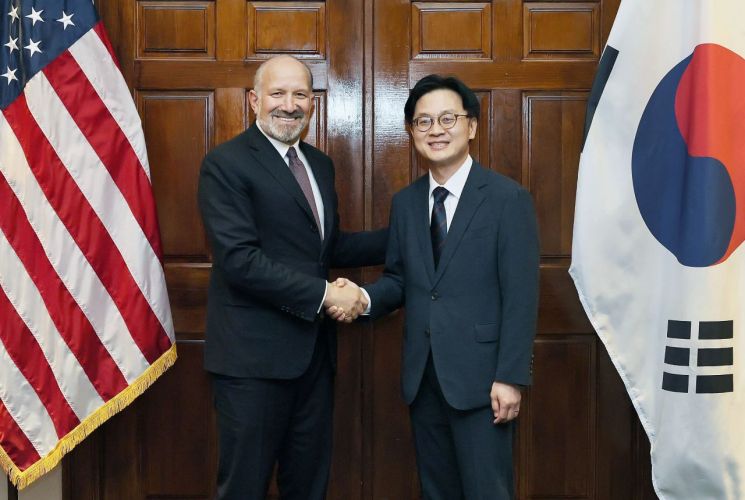
The dramatic breakthrough at the 2025 Asia-Pacific Economic Cooperation (APEC) Summit in Gyeongju was no coincidence. Until just before the meeting, major issues remained unresolved, and both domestic and international observers widely expected that "there would be no conclusion by APEC." Minister Kim also admitted, "At the time, we didn't think it would work out either." His final strategy was "message management." Early in the morning before the APEC opening, he sent Secretary Lutnick a message saying, "We've come this far, so let's continue negotiations, but during APEC, let's issue a message that upholds the dignity of our alliance."
The US side interpreted this message as Korea's "final ultimatum." Minister Kim said, "My intention was simply to manage diplomatic messaging cleanly, but the US seemed to take it as a signal that if they yielded any further, the negotiations would collapse." Not long after, the US side responded that they would accept Korea's position.
On Ratification Controversy: "It Would Be a Self-Defeating Move to Tie Our Own Hands"
Minister Kim expressed concern over the controversy regarding parliamentary ratification. The opposition party is demanding ratification based on the constitutional provision that "treaties imposing significant fiscal burdens on the state or people require parliamentary consent." He responded, "Legally, this agreement is not a treaty and thus does not require ratification," but added, "The real issue is not legal debate, but whether we are tying our own hands by locking the negotiation terms into domestic law."
Regarding the 50:50 investment allocation clause, he pointed out, "This is also a part I regret, but if we ratify it, we lose the flexibility to make more favorable changes in the future." He continued, "Treaty ratification gives domestic legal force, so all the clauses must be strictly followed. Neither Japan nor the US has ratified it. If we voluntarily tie our own hands, it could be a strategic mistake." He explained that parts involving fiscal burdens would go through a separate special law requiring parliamentary approval.
He also addressed detailed issues in the fact sheet. Regarding the phrase "commercial reasonableness" in the investment project review criteria, he said, "It means assessing whether a project can generate enough cash flow to repay principal and interest." He added, "Just to include this one sentence, I had to carefully consider Secretary Lutnick's mood and the timing of negotiations, and it took several attempts."
On concerns about the investment committee and final approval structure, he explained, "Formally, President Trump makes the final decision, but in practice, the committee formed by both countries and the Korean manager will handle project discovery and management." He continued, "The proposal discussed in the committee is reviewed by the investment committee led by Secretary Lutnick, and the president then gives final approval." He added, "The Korean manager is responsible for project operation, and Korean companies are given priority to participate. The US will not blindly invest in projects that do not benefit its manufacturing sector."
"Invisible Economic War... Corporate Competitiveness Is National Power"
Regarding the semiconductor clause, Minister Kim said, "The principle of not applying less favorable conditions than Taiwan remains unchanged," and explained, "However, it was diplomatically inappropriate to name a specific country in an official intergovernmental document, so the phrase 'as determined by the US' was used." He added, "Since there are other semiconductor-producing countries like Malaysia, it was difficult to single out one country. That phrase will not put Korea at a disadvantage compared to Taiwan."
He also dismissed concerns about agricultural market opening and the relaxation of non-tariff barriers related to living modified organisms (LMOs). Minister Kim stated, "Rumors of side agreements on rice, beef, or age restrictions are not true. There is nothing like that at all." Regarding LMO review procedures, he said, "The opposition calls it 'simplification,' but there have been long-standing complaints even domestically that the inter-ministerial procedures are overly complex. We streamlined them for efficiency. It is physically impossible for US agricultural products to flood into Korea. If you look at the actual data, you will understand."
Minister Kim described the negotiations as "one scene in an invisible economic war." He said, "While some countries are engaged in physical wars, most conflicts today take the form of economic wars over tariffs, investment, and supply chains. Our companies are on the frontlines of this battle." He continued, "As corporate competitiveness and industrial strength grow, no country will be able to deal with Korea lightly. I urge the public to support our companies more, and for the government and businesses to work together to strengthen our national power."
He added, "What remains now is how to design the detailed projects to benefit our economy, and how quickly the National Assembly can revise the law for retroactive application of auto tariffs-these are the follow-up tasks." He reiterated, "Above all, the most important task is ultimately to strengthen our national power." He concluded, "This negotiation was a game played on an uneven field. I believe the next generation of negotiators must grow our industries and companies so they can negotiate more confidently on a level playing field."
© The Asia Business Daily(www.asiae.co.kr). All rights reserved.


















