Why Skepticism About Long-Term Investment Is Growing
Majority of Dividends Concentrated Among Top Few
Structural Limits Remain Despite Expanded Tax Incentives
It has been found that the average dividend received by each of South Korea’s approximately 14 million individual investors last year was less than 100,000 won per person.
According to data submitted by the National Tax Service to the National Assembly’s Strategy and Finance Committee, total dividend income in 2023 exceeded 30 trillion won. Although about 17.5 million people received dividends, the actual amount was heavily concentrated among certain high-income groups.
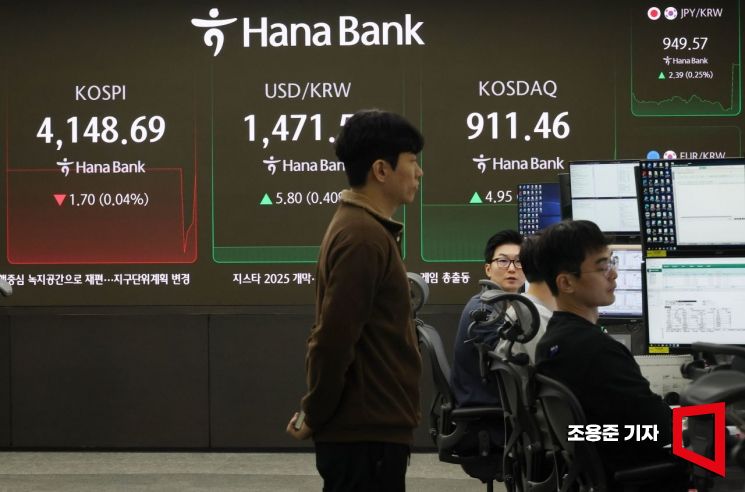 On the 13th, the status board at the Hana Bank dealing room in Jung-gu, Seoul displayed the KOSPI, won/dollar exchange rate, and KOSDAQ index. On that day, the KOSPI opened at 4127.57, down 0.55% from the previous session, and the won/dollar exchange rate started at 1469.0 won, up 3.3 won.
The top 10% took more than 90% of all dividends, with major shareholders and ultra-high-net-worth investors accounting for a large portion of that. In contrast, ordinary investors-who make up 80% of all recipients-received only around 100,000 won per person in dividends.
Various tax incentives have been discussed to encourage individuals to invest for the long term, but there is a growing consensus that it is structurally difficult to provide benefits that most investors can actually feel.
This is because dividend yields themselves are lower than bank deposit rates, and since the financial investment income tax has not yet been introduced, there is no tax base for capital gains, which limits the options available to tax authorities. Under the current system, capital gains tax is only imposed on major shareholders who invest more than 5 billion won in a single stock.
Even if policymakers were to take the extreme step of exempting all ordinary investors from dividend income tax, the total tax reduction would likely only amount to several hundred billion won. In fact, the amount of dividend income tax collected in recent years has remained largely unchanged at around 4 trillion won per year. Since the bottom 80% receive only a very small share of total dividends, the effect of reducing their tax burden is inevitably limited.
The Ministry of Economy and Finance has stated that it is reviewing various measures to encourage long-term investment. The most frequently discussed option is expanding the functions of the Individual Savings Account (ISA). The current ISA offers tax-free benefits up to a certain amount if maintained for more than three years, and both the government and lawmakers are discussing reforms such as raising the tax-free limit or strengthening the requirements for long-term investment.
The financial investment industry has proposed introducing a “Junior ISA” to provide a foundation for minors to invest, and there are also suggestions to increase the tax deduction limit for Individual Retirement Pensions (IRP), which help individuals accumulate assets for retirement.
Some also argue for reinstating the “long-term stock holding dividend income special provision,” which was introduced after the Asian financial crisis but later abolished. This system applied a lower tax rate to dividends from stocks held for a certain period and is credited with helping to foster a long-term investment culture.
© The Asia Business Daily(www.asiae.co.kr). All rights reserved.

















