U.S. Combat Ships to Undergo MRO in Korea as Early as Next Year
No Mention of Nuclear Submarines
"Hegseth Reaffirms Support for Korean Nuclear Submarines"
On November 14, Defense Minister Shin Kyubaek announced the 57th Korea-U.S. Security Consultative Meeting (SCM) joint statement, which included the decision to pursue the Full Operational Capability (FOC) verification for the future Combined Forces Command headquarters in 2026. Previously, Minister Shin and U.S. Secretary of Defense Pete Hegseth had already prepared a joint statement during the SCM meeting on November 4, but the announcement was delayed until now due to the time required to draft a Joint Fact Sheet (JFS) reflecting the outcomes of Korea-U.S. trade and security package negotiations.
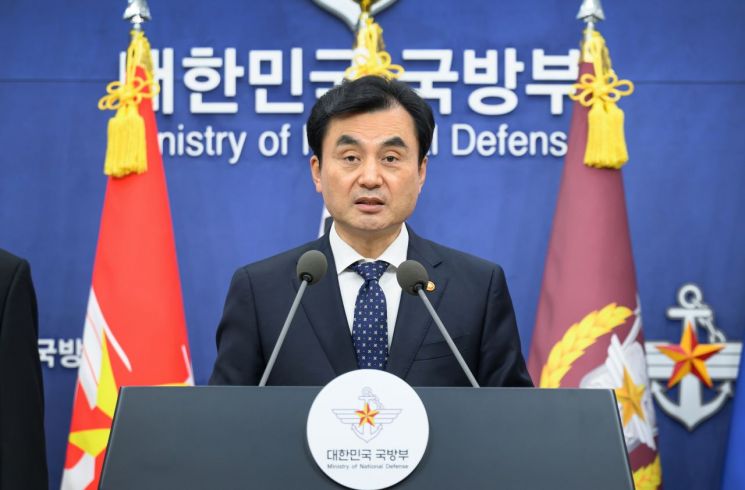
In the joint statement, both ministers reaffirmed that the transfer of OPCON must proceed systematically, stably, and proactively, provided that all conditions specified in the Conditions-based OPCON Transition Plan (COTP) are met. They also agreed that significant progress had been made in readiness and capability during this year’s joint assessment, and committed to developing a roadmap for acquiring the essential capabilities needed to accelerate fulfillment of the conditions required for OPCON transfer.
Furthermore, both ministers agreed to complete FOC verification next year, emphasizing that the OPCON transfer will strengthen South Korea’s and the alliance’s capabilities, as well as the combined defense posture. The OPCON transfer process consists of three stages: Initial Operational Capability (IOC), Full Operational Capability (FOC), and Full Mission Capability (FMC) verification. IOC was verified in 2019, and while FOC was evaluated in 2022, it has not yet been verified. Once FOC verification is completed, the defense ministers of both countries will recommend the year for FMC verification to their respective presidents. This makes the “OPCON transfer within the presidential term” pledge of the Lee Jaemyung administration increasingly tangible.
During the FMC process, the three main conditions for OPCON transfer will be verified: the military capabilities required to lead combined defense, the alliance’s comprehensive ability to respond to North Korea’s nuclear and missile threats, and the security environment on the Korean Peninsula and in the region that aligns with a stable OPCON transfer. Since these conditions are largely qualitative, political decisions by the presidents of both countries will be essential. Minister Shin also recently stated at the National Assembly that completing FMC verification within the Lee Jaemyung administration’s term would require a political judgment.
A Ministry of National Defense official stated, “Going forward, South Korea and the United States will proceed with the evaluation and verification procedures for FOC and FMC, and will conduct them based on the conditions specified in the COPT, as agreed by both countries. Considering all these factors, we believe it is fully achievable to complete the OPCON transfer within the Lee Jaemyung administration’s term.”
This SCM joint statement also included content on defense industry cooperation, particularly the expansion of Korea-U.S. combat ship MRO collaboration. Until now, Korean shipbuilders have only conducted MRO projects for U.S. non-combat vessels, but the path is now open to expand these operations to combat ships. According to the statement, “Secretary Hegseth announced that U.S. combat ships will receive MRO in Korea for the first time, marking a historic advancement that will enhance U.S. readiness and deterrence capabilities.”
The ministers further shared their views on the necessity of shipbuilding cooperation, as discussed at the recent Korea-U.S. summit, and emphasized the need to accelerate collaboration in ship construction to strengthen the U.S. Navy’s readiness. They also agreed that legal and institutional barriers are creating challenges in deepening defense industry cooperation, including ship construction, and in enhancing supply chain resilience, and recognized the need for cooperation to address these issues.
As a result, it is expected that U.S. combat ships could be serviced in Korea as early as next year. A Ministry of National Defense official explained, “Previously, MRO was mainly focused on logistics support ships, but as the U.S. side is experiencing difficulties in maintaining combat ships, both sides have mutually agreed to discuss conducting such maintenance in Korea. We anticipate that this could be implemented for some vessels as early as next year.”
Agreements related to the modernization of the Korea-U.S. alliance, such as raising defense spending to 3.5% of GDP, also followed. The ministers stated, “Minister Shin emphasized that South Korea will play a leading role in the defense of the Korean Peninsula and will work to develop core defense capabilities to achieve this goal. Both countries will also enhance the U.S. conventional deterrence posture against all regional threats to the alliance, including those from North Korea.”
Regarding the introduction of nuclear-powered submarines, Minister Shin said, “We have decided to actively pursue cooperation on the construction of nuclear-powered submarines as agreed between the leaders of South Korea and the United States.” However, the SCM joint statement did not include any separate agreement on nuclear submarines. A Ministry of National Defense official explained, “The issue of nuclear submarines was raised during the Asia-Pacific Economic Cooperation (APEC) summit in Gyeongju, and since the SCM took place immediately afterward, it was somewhat difficult for the defense ministers to discuss it at that time. As there is much to be discussed between South Korea and the United States going forward, the discussion was limited to forming mutual support and consensus.”
The official added that the issue was discussed during the Korea-U.S. summit held on October 29 during the Gyeongju APEC summit, and with the SCM following just a few days later on November 4, there was insufficient time for in-depth discussions. The official stated, “Secretary Hegseth has expressed support for nuclear submarines on several occasions, and both South Korean and U.S. military authorities have reached a consensus to actively consult on the introduction of nuclear-powered submarines.”
© The Asia Business Daily(www.asiae.co.kr). All rights reserved.
!["The Woman Who Threw Herself into the Water Clutching a Stolen Dior Bag"...A Grotesque Success Story That Shakes the Korean Psyche [Slate]](https://cwcontent.asiae.co.kr/asiaresize/183/2026021902243444107_1771435474.jpg)
















