KAIA, the Catalyst for Housing Innovation Following 'Smart Tolling' and KTX Localization
"Modular Construction Is a Necessity, Not an Option... Delivering Both Speed and Safety"
Factory-Built Homes... "Technology to Eliminate the Three Major Con
"Modular construction is no longer an option but a necessity. It is the only solution capable of meeting the market's demand for rapid supply, and it offers a way to prevent the three major types of construction site accidents: falls, being caught in machinery, and falling objects."
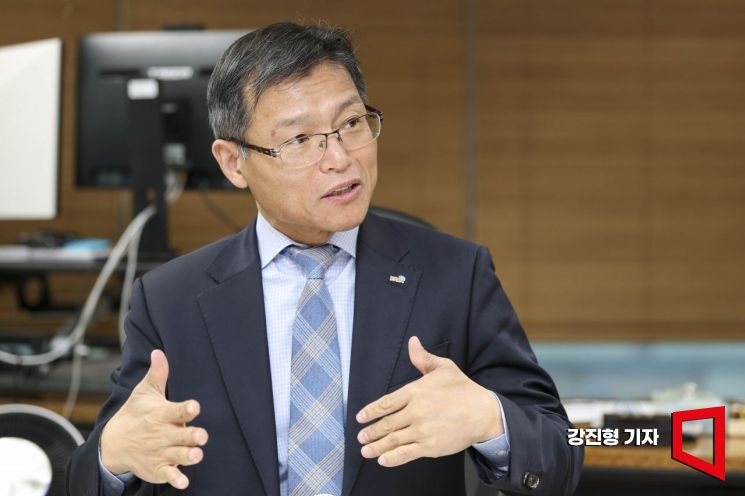 Kim Jeonghee, President of the Korea Agency for Infrastructure Technology Advancement, is being interviewed on the 13th at the Korea Agency for Infrastructure Technology Advancement in Anyang, Gyeonggi Province. Photo by Kang Jinhyung
As a solution to the industrial accidents plaguing construction sites-a major concern of the current administration-Kim Jeonghee, President of the Korea Agency for Infrastructure Technology Advancement (KAIA), has proposed "modular housing." In an interview at KAIA in Anyang, Gyeonggi Province, on the 13th, Kim described modular housing as a "new weapon" that can nearly halve construction time and dramatically reduce safety incidents, with KAIA serving as a catalyst for its adoption. The Ministry of Land, Infrastructure and Transport announced in its September 7 supply plan that it would accelerate housing supply through modular construction, pledging to order 3,000 public housing units annually using this method. KAIA is playing a pivotal role in driving technological innovation in this area.
Modular construction involves manufacturing over 80% of the building process in automated factories, then assembling the modules on-site like Lego blocks. This approach minimizes high-altitude work and hazardous temporary structures, thereby ensuring both efficiency and safety. Kim, a career bureaucrat with 30 years of experience in housing, construction, and transportation at the Ministry of Land, Infrastructure and Transport, emphasized, "With traditional methods, it takes four to five years to build a house, but with modular construction, it can be done in two to three years."
This method of housing supply has already been recognized for its innovation overseas, while South Korea has lagged somewhat behind. "Singapore built the 56-story Avenue South Residence-the world's tallest modular building-using this method, and both the UK and the US have constructed high-rise buildings approaching 50 stories," he said, adding, "We need to catch up quickly." He also revealed that KAIA is currently conducting 25 billion won worth of R&D to overcome technical hurdles and enable the construction of complexes over 20 stories high. Kim plans to visit a modular factory in the near future.
Domestically, the market remains small, preventing economies of scale from taking effect. The industry has yet to overcome the barrier that modular construction costs 30% more than traditional methods. Kim explained, "It's simply that economies of scale have not yet kicked in. Each site requires different specifications, so new molds must be created every time, and the logistics costs for transporting heavy modules are substantial." However, he stressed, "If we move to mass production with standardized processes, as in the automotive industry, costs will drop dramatically. And when you consider the astronomical 'hidden safety costs' of having to halt construction and rebuild due to major accidents, modular construction is by no means an expensive choice."
He also noted, "We should pay attention to Elon Musk's introduction of a $10,000 'tiny house,' saying that building a house is easier than making a complex car. With companies like Samsung Electronics and LG Electronics already entering the modular housing market, electronics and automotive firms could become powerful competitors in the housing sector in the future."
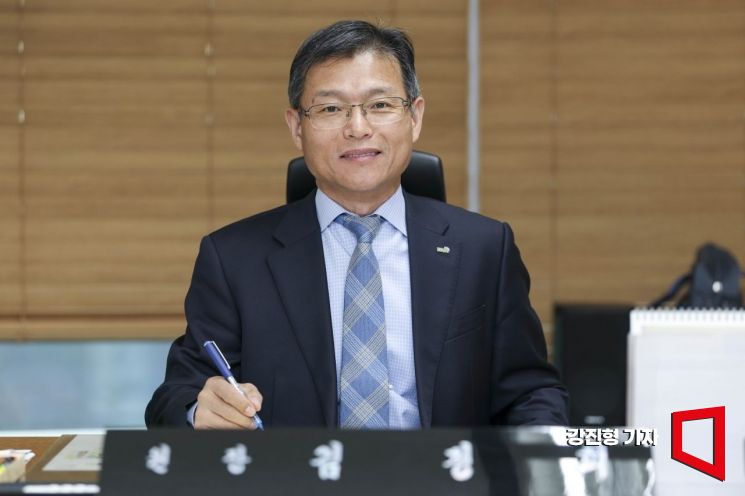 Kim Jeonghee, President of the Korea Agency for Infrastructure Technology Advancement, is posing ahead of an interview at the Korea Agency for Infrastructure Technology Advancement in Anyang, Gyeonggi Province on the 13th. Photo by Kang Jinhyung
Although 'KAIA' may sound unfamiliar, the agency has already made significant technological contributions to our daily lives. Its R&D achievements include the "highway smart tolling" system, which can recognize two lanes simultaneously and process toll payments even at speeds of 120 km/h; KTX localization technology; high-rise construction technologies used for the 123-story Lotte World Tower; and super-long-span bridge technology applied to the world's longest suspension bridge, the 1915 Canakkale Bridge in Turkey. KAIA serves as the Ministry of Land, Infrastructure and Transport's "R&D control tower," overseeing everything from identifying technology needs and selecting and managing researchers to disseminating results.
Since taking office in January, Kim has set an ambitious goal: to raise the land and infrastructure R&D budget-which currently stands at 541.3 billion won, or 1.8% of the government's total R&D spending-to 1 trillion won by 2030. To this end, he explained, "Instead of the traditional slow planning process, where a single project could take more than two years to get started, KAIA is now proactively identifying issues and rapidly responding with 'in-house planned R&D' projects, aiming to address them within a year." A prime example is the immediate planning of R&D for an "aircraft runway overrun prevention system (EMAS)" and a "bird deterrence system" following the accident at Muan International Airport last year, both of which will launch as new projects next year.
In terms of organizational management, Kim has emphasized "communication" and "collective intelligence." He stated, "I wanted to break down the silos and isolation that are chronic problems in bureaucratic organizations." To eliminate the culture where staff hide problems and struggle alone, he holds weekly "major project review meetings." These meetings are attended not only by current managers but also by their predecessors and heads of related departments to ensure continuity. "By adding the experience of former managers and the perspectives of related departments, we are beginning to find solutions to problems that once seemed intractable," he said. "My mission is to create results that the public can truly feel, using the ideas generated by collective intelligence."
© The Asia Business Daily(www.asiae.co.kr). All rights reserved.


















