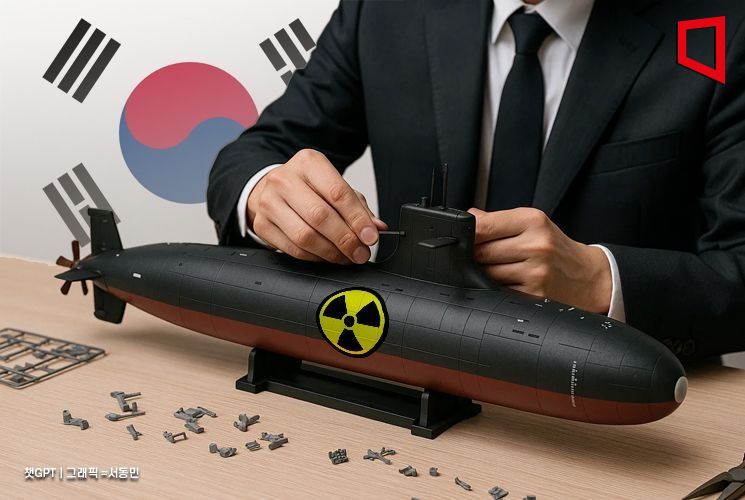
South Korea and the United States have agreed to the construction of a nuclear-powered submarine for South Korea, as documented in the Joint Fact Sheet (JFS) outlining the results of their tariff and security package negotiations. The construction of the nuclear-powered submarine is expected to take place in South Korea.
On the morning of November 14, President Lee Jaemyung held a press conference at the presidential office in Yongsan, Seoul, and stated regarding the JFS, "Through these negotiations, the Republic of Korea has united in its resolve to pursue the construction of a nuclear-powered submarine, a long-standing national aspiration and an essential strategic asset for peace and stability on the Korean Peninsula." He added, "We have also succeeded in securing the support of the U.S. government for expanding our authority in uranium enrichment and spent nuclear fuel reprocessing."
The White House also posted the JFS on its website the same day, stating, "The United States has approved South Korea’s construction of a nuclear-powered submarine," and, "The United States will work closely with South Korea to meet the requirements of the shipbuilding project, including fuel procurement."
The location of the nuclear submarine construction, which had been a key issue, is expected to be South Korea. Defense Minister Ahn Kyubaek recently appeared on a broadcast and stated that, considering technology and facilities, it is most reasonable to build the nuclear submarine domestically rather than in the United States, and that construction could be completed within 10 years if fuel is secured.
Wi Sunglak, Director of the National Security Office, said during a Q&A session that day, "The discussion between the leaders regarding the construction site of the nuclear submarine was based on the premise that it would be built in South Korea. There was no mention of building our nuclear submarine in the United States," adding, "We will be building it here, in South Korea."
Meanwhile, through this JFS, South Korea and the United States also agreed to provide extended deterrence through mechanisms such as the Nuclear Consultative Group (NCG), to increase South Korea’s defense spending to 3.5% of GDP, to introduce U.S. weapons systems worth 25 billion dollars by 2030, and to provide comprehensive support for U.S. Forces Korea totaling 33 billion dollars. Notably, the two countries agreed to respond to "all regional threats" to the alliance, including those from North Korea. This suggests that the South Korea-U.S. alliance may expand beyond countering North Korea to include checks on China and other regional threats.
Progress is also expected in the transfer of wartime operational control. At the South Korea-U.S. Security Consultative Meeting (SCM) held on November 4, it was reported that the two sides discussed completing the Full Operational Capability (FOC) verification process, the second stage of the transfer, by next year. Director Wi also stated, "The issue of operational control transfer is proceeding smoothly."
© The Asia Business Daily(www.asiae.co.kr). All rights reserved.
![Clutching a Stolen Dior Bag, Saying "I Hate Being Poor but Real"... The Grotesque Con of a "Human Knockoff" [Slate]](https://cwcontent.asiae.co.kr/asiaresize/183/2026021902243444107_1771435474.jpg)











