Government Holds Market Situation Review Meeting
"Plans to Develop Exchange Rate Stabilization Measures with National Pension Service and Export Companies"
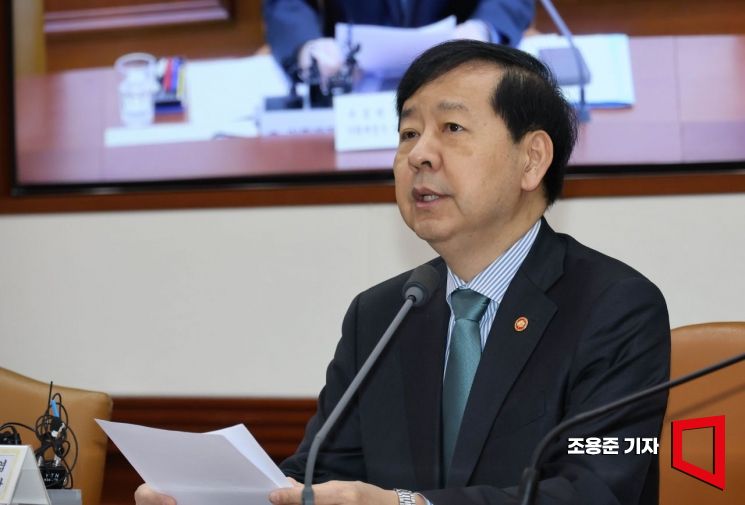 Economic Deputy Prime Minister and Minister of Economy and Finance Koo Yoon-chul is attending and speaking at the Economic Ministers' Meeting, Price Ministers' Meeting, and Industrial Competitiveness Enhancement Ministers' Meeting held at the Government Seoul Office in Jongno-gu, Seoul on November 4, 2025. Photo by Jo Yongjun
On November 14, Koo Yoon-chul, Deputy Prime Minister for Economic Affairs and Minister of Economy and Finance, stated that uncertainty in the foreign exchange market has been increasing recently, adding, "If the imbalance in foreign exchange supply and demand persists, we will actively utilize all available measures to respond."
Deputy Prime Minister Koo presided over a market situation review meeting on this day, where recent trends in domestic and international financial and foreign exchange markets were assessed and future response strategies were discussed. The meeting was attended by Bank of Korea Governor Rhee Changyong, Financial Services Commission Chairman Lee Eogwon, and Financial Supervisory Service Governor Lee Chanjin.
The won-dollar exchange rate closed at 1,467.6 won in the previous week's trading, up 2.0 won, marking a third consecutive day of increases. The sharp rise in government bond yields, driven by concerns that the Bank of Korea's rate-cutting cycle may be ending, has contributed to upward pressure on the exchange rate. Continued yen weakness, driven by expectations for Japanese government fiscal policy, has led the won to follow a similar trend, while demand for currency exchange from Korean retail investors investing overseas has also played a role in pushing up the exchange rate.
Participants noted, "Although the domestic stock market has shown some short-term volatility recently, it remains generally stable overall," and added, "While government bond yields have risen due to changing market expectations about future interest rate trends, the demand base for Korean government bonds remains solid, especially considering the potential inclusion in the World Government Bond Index (WGBI) next year."
They also expressed concern that "uncertainty in the foreign exchange market is increasing, with the won-dollar exchange rate temporarily exceeding 1,470 won due to the recent expansion of overseas investments by domestic investors," and agreed on the need for structural improvements in foreign exchange supply and demand.
In particular, they shared the view that "if the imbalance in foreign exchange supply and demand caused by overseas investments continues, expectations for a weaker won among market participants could become entrenched, which could significantly affect the rigidity of the exchange rate on the downside. Therefore, it is necessary to actively utilize all available measures to respond."
They further stated, "The foreign exchange and financial authorities will continue to thoroughly analyze the causes of the exchange rate increase to ensure the stability of the national economy and financial and foreign exchange markets, and will work closely with key supply and demand entities such as the National Pension Service and exporters to devise measures to stabilize the exchange rate."
© The Asia Business Daily(www.asiae.co.kr). All rights reserved.
![User Who Sold Erroneously Deposited Bitcoins to Repay Debt and Fund Entertainment... What Did the Supreme Court Decide in 2021? [Legal Issue Check]](https://cwcontent.asiae.co.kr/asiaresize/183/2026020910431234020_1770601391.png)
















