Hong testifies at Yoon's sedition trial on the 13th
Yoon challenges credibility: "Hong Jangwon Memo looks like worm-like handwriting"
Special prosecutor: "The witness completed it with his own annotations"
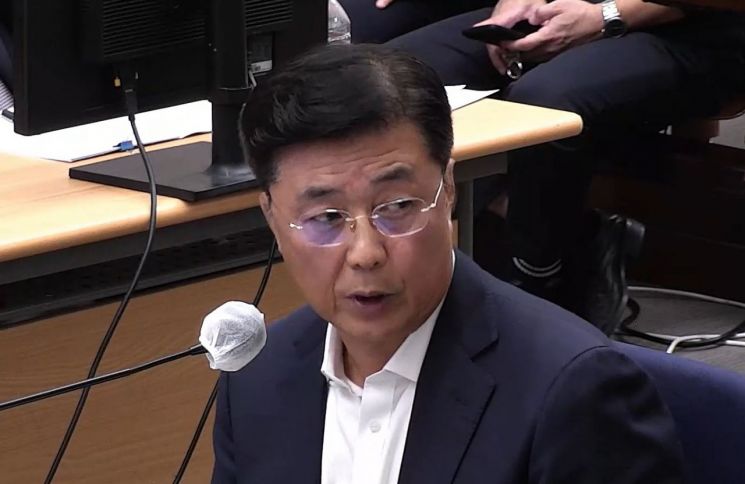
Hong Jangwon, former First Deputy Director of the National Intelligence Service, who claims that he received an order from former President Yoon Sukyeol to "arrest everyone" during the 12·3 Martial Law, appeared as a witness at Yoon's sedition trial and engaged in a heated debate over the so-called "Hong Jangwon Memo."
On November 13, Hong attended the ongoing first trial at the Seoul Central District Court Criminal Agreement Division 25 (Presiding Judge Ji Guyon), where former President Yoon stands accused of leading a rebellion and abusing his authority. This marked the first face-to-face encounter between Yoon and Hong in nine months.
The main issue in court that day was the "Hong Jangwon Memo," whose credibility had also been debated during the impeachment proceedings. On the day martial law was declared, Hong drafted the first handwritten memo while on the phone with Ye Inhyeong, former Commander of the Defense Security Command. Based on this, his aide created a second, neatly written version. The next day, the aide wrote a third memo based on memory, and later, Hong made additional markings, such as drawing thin lines, resulting in a fourth version. The first and second memos were destroyed, and the special prosecutor’s team submitted the fourth memo as evidence in court that day.
The memo disclosed in court listed names such as Lee Jaemyung, Woo Wonsik, Han Donghoon, Kim Minseok, Ddanzi Ilbo, Kim Eojun, Cho Kuk, Park Chandae, Jung Cheongrae, Constitutional Court Justices, Supreme Court Justices, National Election Commission Chair, Kim Myungsoo, Kim Minwoo, Kwon Sunil, and others. On December 6 last year, Hong sent the fourth memo to Park Sunwon, a lawmaker from the Democratic Party of Korea. During the subsequent investigation, Hong reportedly drew lines through some names to indicate that the number of people to be arrested was not 16, and circled 14 names, making further annotations.
Former President Yoon’s legal team argued, "There are very few parts of the memo that the witness actually wrote. The rest appears to have been written by his aide. Shouldn’t the authenticity of those parts be separately verified?"
The court asked, "When you draft a document, you give instructions for the draft, review it, and if anything is missing, you make additional notes. In that case, shouldn't it be considered your own writing?"
Former President Yoon responded directly, saying, "If you look at the draft section of Hong’s memo, it looks like worm-like handwriting. It was so squiggly, like Arabic script, that even university students made T-shirts with it." He continued, "They say the aide made something like this based on that, but the draft itself is not similar to the later versions."
The special prosecutor’s team countered, "As the judge mentioned, this part was merely transcribed by the aide, and the witness later reviewed and annotated the content, so it is reasonable to consider him the author."
Hong explained in detail how the memo was created. He said, "After the martial law declaration, former President Yoon called me on a secure phone and asked if I had watched the martial law broadcast. When I said yes, he told me, 'Arrest everyone and clean things up completely this time,' and also said, 'I will support your counterespionage investigation authority.' He instructed me to support the Defense Security Command, not just in a simple way, but by providing all necessary personnel and budget. I remember he was very forceful about this."
Hong then called former Commander Ye and conveyed, "The president called and told me to support you." Ye replied, "The National Assembly has been blocked in cooperation with the police. Please help us, senior. The arrest teams are out, but we can't locate some people. I will give you the list." After the arrests, Ye explained that those on the list would be detained at the Defense Security Command facility for interrogation and that there would be first and second arrest operations.
The court decided to summon Hong again on the 20th for cross-examination by former President Yoon's legal team.
Previously, former President Yoon questioned Park Taejoo, Colonel and head of the Defense Security Command’s Information Protection Unit, who had appeared as a witness, suggesting that his order for the Defense Security Command to be dispatched to the National Election Commission during martial law was legitimate under the Martial Law Act. When Colonel Park responded that military deployment to a civilian institution would be illegal even under martial law, Yoon countered, "Election management is an administrative task, and under the Martial Law Act, administrative and clerical work can be directed by the martial law authorities. Didn’t you review this?"
Yoon further stated, "There are many hacking groups in North Korea, such as Lazarus and Kimsuky. Haven’t you seen reports in the media about such groups infiltrating the Ministry of the Interior and Safety or judicial agencies? If martial law is declared and the Defense Security Command’s cyber team is sent to the National Election Commission, wouldn’t it be related to such threats? Did you not consider this possibility at all?"
The court remarked, "It seems we should set the deadline for proceedings as January 12 next year and conclude the trial by then. For now, January 14 and 15 will also be set as tentative dates, and the court will coordinate the detailed schedule."
© The Asia Business Daily(www.asiae.co.kr). All rights reserved.












