Approved After Third Deliberation and Commission Vote
Korea Hydro & Nuclear Power to Upgrade Facilities Over Three Months...Reoperation Set for Early Next Year
Delayed Review Leaves Actual Operation Period Just Over Seven Years
Reviews for Continued Operation of Remaining Reactors Expected to Accelerate
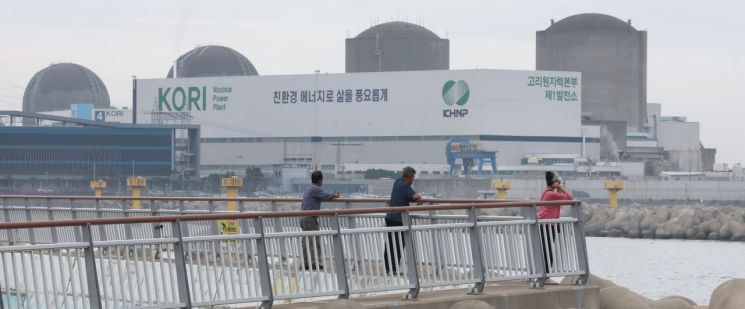 View of Gori Unit 2 (second from the right) from Wolnae, Jangan-eup, Gijang-gun, Busan Photo by Yonhap News
After 40 years of operation, Gori Unit 2 (with an electric output of 685 MWe), which had been shut down for 2 years and 8 months since April 2023, will resume operations starting early next year. With the decision to continue operating Gori Unit 2, it is expected that the review process for continued operation of the remaining nine reactors, whose design lifespans will expire and operations will cease by 2030, will also accelerate.
On November 13, the Nuclear Safety and Security Commission held its 224th meeting and approved the proposal to allow continued operation of Gori Nuclear Power Plant Unit 2 in Gijang, Busan.
The Commission had previously tabled the continued operation of Gori Unit 2 at its 222nd (September 25) and 223rd (October 23) meetings. In those earlier reviews, the decision was postponed at the request of commissioners who said further review was necessary.
At the meeting on November 13, some commissioners continued to express opposition to the continued operation. Ultimately, the proposal was passed by a vote, with five out of six commissioners in favor.
Gori Unit 2, a pressurized water reactor (Westinghouse type), received its construction permit in 1978 and began operation on April 9, 1983. It was shut down on April 8, 2023, after exceeding its 40-year operating license period. It is the oldest nuclear power plant in the country that has not been permanently decommissioned.
Korea Hydro & Nuclear Power submitted the results of periodic safety assessments, including major equipment lifespan evaluations, for continued operation of Gori Unit 2 on April 4, 2022. Subsequently, after collecting residents' opinions, the company submitted the application for an operating license amendment along with a radiological environmental impact assessment report on March 30, 2023.
The Korea Institute of Nuclear Safety (KINS), a regulatory agency under the Commission, conducted a safety review for about 3 years and 4 months (from April 2022 to July 2025). The Nuclear Safety Expert Committee conducted a preliminary review of KINS's assessment results for about 7 months, from March to September this year, and concluded that the results were appropriate.
At the meeting, the Commission reviewed the lifespan assessment of structures, systems, and components, as well as equipment replacement plans, and confirmed that sufficient safety margins would be maintained during the continued operation period.
The radiological environmental impact assessment also confirmed that the impact of continued operation, including major accidents and severe incidents, meets all safety standards, leading to the approval of continued operation for Gori Unit 2.
Korea Hydro & Nuclear Power to invest 175.8 billion won in facility upgrades...Reoperation expected early next year
The period for this continued operation license is 10 years after the expiration of the original operating license, until April 8, 2033. As a result, the actual remaining operational period is expected to be just over 7 years.
Following the Commission's decision, Korea Hydro & Nuclear Power plans to carry out replacement of equipment related to securing safety margins for Gori Unit 2 over the next three months. After the Commission completes its on-site inspection and confirms compliance, the unit will resume operation. The company estimates that about 175.8 billion won will be invested in facility improvements.
To enhance the safety of Gori Unit 2 as it resumes operation, Korea Hydro & Nuclear Power will implement measures such as replacing seismic sensors, expanding the spent fuel pool heat exchanger, adding additional radiation alarms in the containment building, and developing newly certified protective coatings.
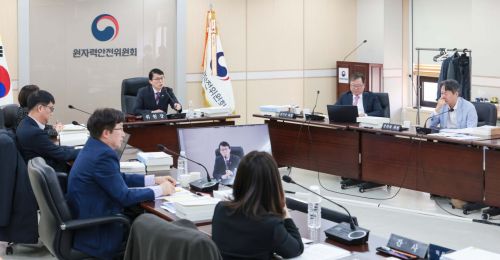 Wonho Choi, Chairman of the Nuclear Safety and Security Commission, is discussing agenda items with commissioners at the 224th Nuclear Safety and Security Commission meeting held on November 13, 2025, in the main conference room of the Nuclear Safety and Security Commission in Jung-gu, Seoul. Photo by Nuclear Safety and Security Commission
Previously, at the October 23 meeting, the Commission approved the accident management plan for Gori Unit 2. However, the decision on continued operation was postponed due to differing opinions regarding the wording in the regulations about "changes in the radiological environmental impact assessment after the operating license." At the meeting on November 13, Commissioner Jin Jaeyong (attorney at Kangnam Law Firm) continued to oppose, arguing that the environmental impact assessment at the time of the operating license should be compared with the current one.
In response, the Commission's secretariat explained that the regulation is intended to require the application of the latest technology in the assessment. Chairman Choi Wonho agreed, stating, "It is interpreted as a requirement to fully reflect the current situation." At the time of the original operating license for Gori Unit 2, no radiological environmental impact assessment was conducted, so there is no basis for comparison.
At the start of the meeting, some environmental groups who had applied to attend in person caused a disturbance in protest against the continued operation of Gori Unit 2, resulting in their removal from the venue.
Chairman Choi stated, "We will thoroughly verify through on-site inspections that Korea Hydro & Nuclear Power's facility improvements are implemented in accordance with safety standards, ensuring that Gori Unit 2 can be operated safely."
"Overseas, nuclear plants operate for up to 80 years...Expedited reviews needed for other reactors"
The review of Gori Unit 2 by the Commission was the first among the 10 reactors for which Korea Hydro & Nuclear Power has applied for continued operation. The company has also applied for continued operation of Gori Units 3 and 4 in Gijang, Busan; Hanbit Units 1 and 2 in Yeonggwang, Jeollanam-do; Hanul Units 1 and 2 in Uljin, Gyeongsangbuk-do; and Wolseong Units 2, 3, and 4 in Gyeongju, Gyeongsangbuk-do.
Of these, Gori Units 3 and 4 ceased operation when their licenses expired on September 28, 2023, and August 6, 2024, respectively. Hanbit Unit 1 will stop operation on December 22, 2024, and Unit 2 on September 11, 2025. As a result, the nuclear industry is calling for expedited reviews of continued operation to ensure a stable power supply in Korea.
Internationally, there are many cases where nuclear plants operate far beyond their original design lifespans. As of December 2024, 238 out of 439 operating nuclear reactors worldwide (54%) have been approved for continued operation. Of these, 204 reactors (46%) have already entered continued operation.
In the United States, 86 out of 94 operating reactors (91%) have been approved for continued operation, with 64 reactors (68%) already back in operation. Notably, 22 reactors have applied for a second continued operation (for a total of 80 years of operation), and 8 of these have been approved.
In Europe, 72 out of 97 operating reactors (74%) have been approved for continued operation, with 64 reactors (66%) currently in continued operation.
© The Asia Business Daily(www.asiae.co.kr). All rights reserved.
![Clutching a Stolen Dior Bag, Saying "I Hate Being Poor but Real"... The Grotesque Con of a "Human Knockoff" [Slate]](https://cwcontent.asiae.co.kr/asiaresize/183/2026021902243444107_1771435474.jpg)

















