K-Bank Makes Third Push for IPO
Stock Market Rally Offers Tailwind,
But KakaoBank’s Weak Share Price Weighs on Valuation
Growth Prospects Dimmed Further by Household Debt Stabilization Measures
There is growing interest in whether K-Bank, now making its third attempt, will finally be able to go public this time. Riding the bullish momentum of the stock market, with the KOSPI index surpassing the 4,000 mark, K-Bank has renewed its efforts to list. However, concerns have arisen due to the sluggish stock performance of KakaoBank, which serves as a direct comparison for K-Bank’s valuation, and a decline in third-quarter net profit caused by household debt stabilization measures, casting doubts on its growth potential. With shareholder agreements with financial investors (FIs) making it difficult to postpone the IPO any further, all eyes are on what decision K-Bank will make.
According to the financial industry on November 14, K-Bank recently filed for a preliminary review for listing on the Korea Exchange's main board. Given that such reviews typically take two to three months, the public offering is expected in the first half of next year. The lead underwriters are NH Investment & Securities and Samsung Securities. For its peer group to determine corporate value, K-Bank is expected to present KakaoBank as well as two foreign banks.
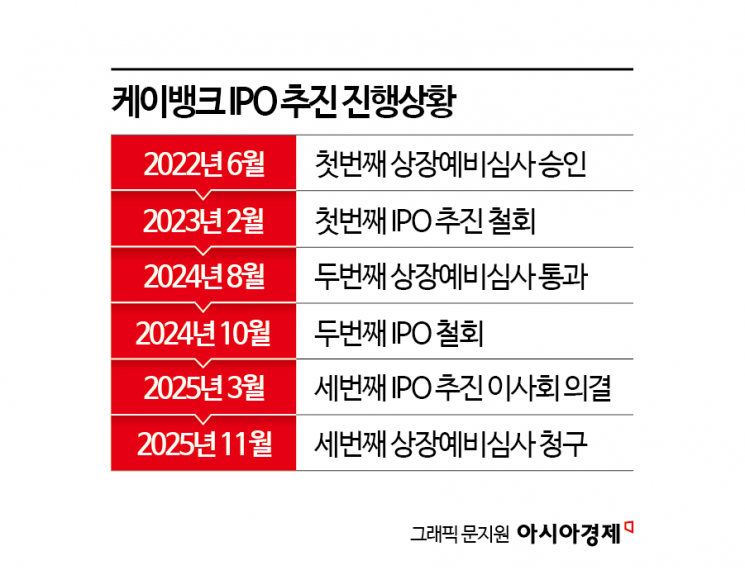
This marks K-Bank’s third attempt at an initial public offering (IPO). In its first attempt in 2022, K-Bank passed the preliminary review but withdrew its listing due to deteriorating market conditions and the poor performance of KakaoBank’s stock, its direct peer. In June last year, K-Bank again passed the preliminary review and began institutional investor demand forecasting in October, but postponed the listing once more amid controversy over overvaluation and continued weakness in KakaoBank’s stock. At that time, K-Bank had set its desired IPO price range at 9,500 to 12,000 won per share, aiming for a corporate value of up to 5 trillion won. However, as the overvaluation controversy persisted, the company voluntarily withdrew its application.
This time, while the stock market environment is favorable, it remains uncertain whether K-Bank will be able to justify its desired valuation given KakaoBank’s weak stock performance. While the KOSPI index has risen by about 72% this year, KakaoBank’s stock has only increased by 6% during the same period. Moreover, this is even lower than KakaoBank’s highest price this year of 38,750 won (as of intraday trading on June 24). On November 13, KakaoBank closed at 22,500 won.
The impact of household debt stabilization measures, which have curbed growth potential, is also a concern. K-Bank achieved its first annual net profit of 22.5 billion won in 2021 and recorded its largest-ever net profit of 128.1 billion won last year. In the second quarter of this year, it posted a record quarterly profit of 68.2 billion won, but third-quarter net profit fell to 19.2 billion won, a 48.1% decrease compared to the same period last year. Cumulative net profit for the first three quarters also dropped by 15.5% year-on-year to 103.4 billion won.
Despite these unfavorable circumstances, K-Bank finds itself in a dilemma where it can no longer delay its listing. This is because its shareholder agreement with financial investors includes a clause requiring listing by July 2026. If K-Bank fails to go public this time, FIs may exercise drag-along rights or put options to recover their investment by October next year.
An industry insider said, "K-Bank’s target price-to-book ratio (PBR) for its desired IPO price is 2.5 times, which is significantly higher than KakaoBank’s PBR of 1.6 times. To be valued at the 4 trillion to 5 trillion won level K-Bank hopes for, it must prove its platform value exceeds that of KakaoBank. However, it remains uncertain whether the market will view K-Bank as a platform company."
As of the end of June, K-Bank’s major shareholders were BC Card with a 33.72% stake, Woori Bank with 11.96%, and NH Investment & Securities with 5.52%.
© The Asia Business Daily(www.asiae.co.kr). All rights reserved.

![Clutching a Stolen Dior Bag, Saying "I Hate Being Poor but Real"... The Grotesque Con of a "Human Knockoff" [Slate]](https://cwcontent.asiae.co.kr/asiaresize/183/2026021902243444107_1771435474.jpg)
















