UN Refugee Agency Releases Report
"No Escape II: The Way Forward"
It has been found that over the past decade, 250 million people have become displaced refugees due to climate crises such as floods, droughts, and heatwaves. Most of these individuals bear no responsibility for greenhouse gas emissions, yet they have not received assistance from relief funds.
According to the British daily The Guardian on the 9th (local time), the United Nations High Commissioner for Refugees (UNHCR) recently released a report on the impact of climate refugees titled "No Escape II: The Way Forward," which contains these findings.
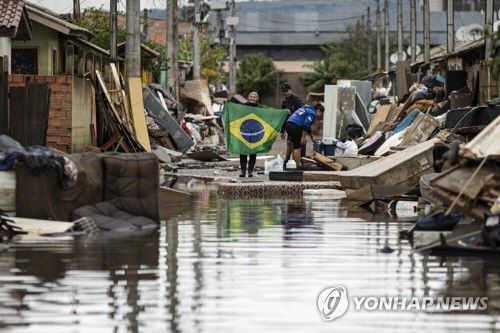 On the 3rd (local time), a woman stands holding the Brazilian flag in the flood-affected area of Porto Alegre, Brazil. Photo by Porto Alegre EPA·EFE Yonhap News
The report cited the heavy rains in Rio Grande do Sul, Brazil, in May last year as an example of a climate crisis that led to large-scale displacement. The torrential rains in May resulted in 181 deaths and left 580,000 people homeless across 154 cities.
The report concluded that as the climate crisis intensifies, existing inequalities such as conflict, violence, and forced migration are worsening. The climate crisis is acting as a risk multiplier, exacerbating already difficult situations.
The report analyzed that nearly half of the world's displaced refugees are experiencing both conflict and climate crises simultaneously. Most of these people live in politically unstable countries such as Sudan, Syria, the Democratic Republic of the Congo, and Lebanon. The number of countries facing both conflict and climate crises has tripled compared to 2009.
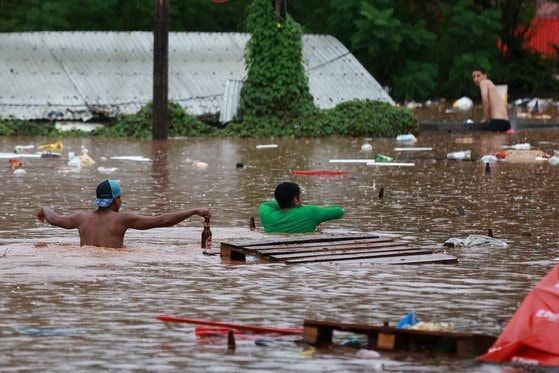
Three-quarters of displaced refugees remain unable to leave climate crisis-affected areas, leading to repeated cycles of harm. Chad in Africa is a prime example. The number of refugees hosted by Chad exceeds 1.4 million. At the same time, just last year, more than 1.3 million people became displaced refugees due to flooding alone. This figure surpasses the total number of refugees generated in the past 15 years.
Most of these victims are not significantly responsible for the greenhouse gas emissions identified as the cause of the climate crisis. Nevertheless, they do not benefit from climate funds. The report warned that without fundamental measures to curb climate disasters and support impoverished countries, the situation will only worsen.
Previously, in May, it was reported that floods caused by heavy rain in Baghlan, northern Afghanistan, resulted in a total of 315 deaths. Additionally, about 2,000 households had their homes destroyed, 600,000 people were affected by the floods, and more than half of them were children. Subsequently, in July, floods caused by heavy rain occurred in eight provinces nationwide, including the capital Kabul, resulting in at least 31 deaths and 74 injuries.
© The Asia Business Daily(www.asiae.co.kr). All rights reserved.


















