Province Sets Initial 2026 Budget at 8.3731 Trillion Won
7.3% Increase... Government Subsidies Up by 400 Billion Won
Accelerating Key Initiatives Including Semiconductor and Firefighter Welfare Improvements
Governor Kim Jin-Tae: "Focusing Investment on Three Core Areas: Industry, Local Economy, and Welfare"
Gangwon Special Self-Governing Province has entered the era of an 8 trillion won budget for the first time ever with its budget proposal for next year.
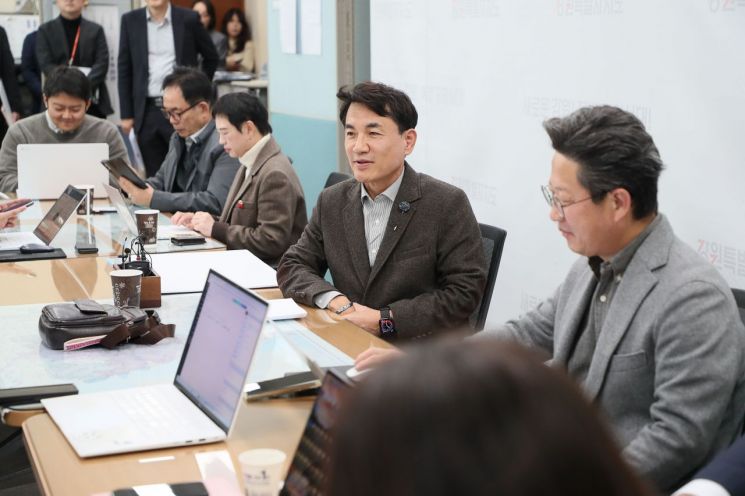 Governor Jin-Tae Kim held a press conference on the 10th and announced that the initial budget for 2026, totaling 8.3731 trillion won, an increase of 7.3% compared to the previous year, will be prepared and submitted to the Provincial Council on the 11th. Provided by Gangwon Province
Governor Kim Jin-Tae held a press conference on the 10th and announced that the initial budget for 2026 has been set at 8.3731 trillion won, a 7.3% increase compared to the previous year, and will be submitted to the Provincial Council on the 11th.
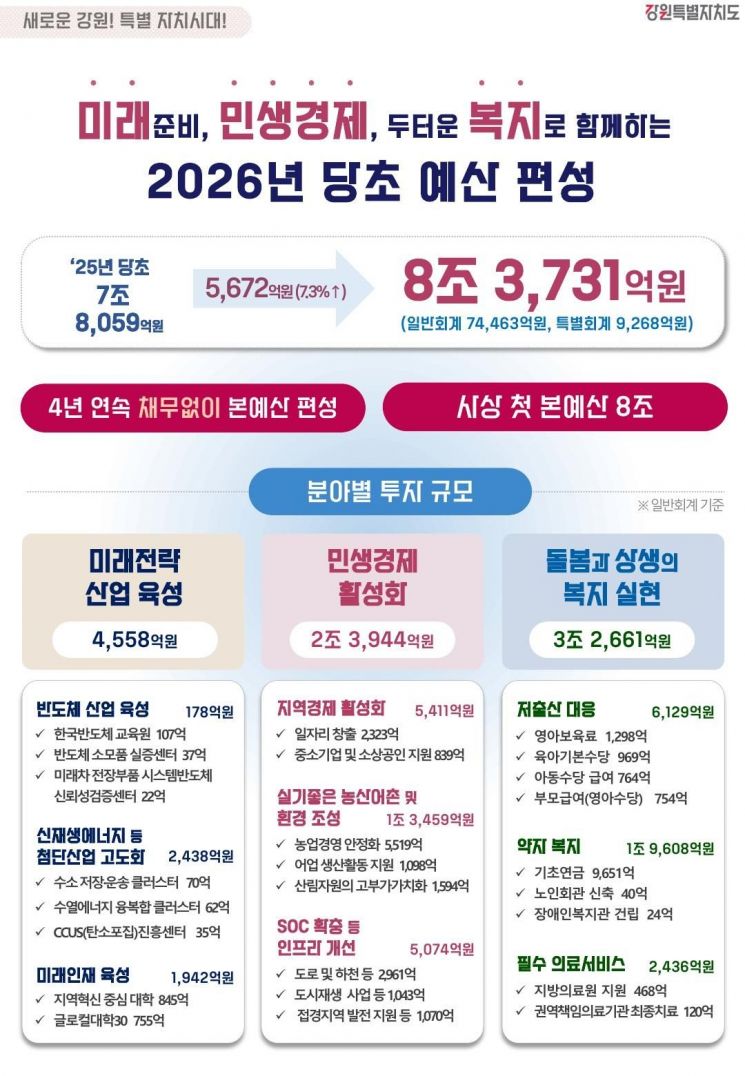
This budget proposal is the result not only of increases in local taxes and general grants, but also of the active efforts by staff to secure national funding, leading to a 400 billion won increase in government subsidies. In particular, Gangwon Special Self-Governing Province has demonstrated fiscal soundness by preparing its budget for the fourth consecutive year without issuing local bonds.
The secured budget will be focused on three core areas: fostering future strategic industries, revitalizing the local economy, and realizing welfare based on care and coexistence.
First, the province will invest 455.8 billion won in fostering future strategic industries.
This includes funding for the semiconductor testbed project, the Korea Semiconductor Academy, and construction costs for the hydrogen storage and transportation cluster, which is a key project in the nation’s first designated hydrogen-specialized complex. Additionally, 160 billion won will be invested in nurturing talent in core fields such as semiconductors, artificial intelligence, and biotechnology.
A total of 2.3944 trillion won will be invested to revitalize the local economy.
For financial support to small and medium-sized enterprises and small business owners, 28.7 billion won has been allocated. For the strategic industry venture fund, which will be established with a scale of 150 billion won, 12.5 billion won has been set aside to create a virtuous cycle of public-private investment.
The ‘Half-Price Agricultural Materials’ project, which aims to increase the real income and production base of farmers, will see an increase in funding compared to this year and will continue to be implemented. The budget for maintenance of farmland drainage facilities will be significantly increased from 12 billion won to 19.7 billion won, and the budget for agricultural machinery will also be expanded from 3.8 billion won to 7.8 billion won. In addition, 9.5 billion won has been allocated for four forest and timber clusters, and 2 billion won for three welfare centers for foreign fishery workers.
Policies to support youth employment, entrepreneurship, and housing cost relief will continue without interruption.
For youth settlement support projects (including monthly rent support) aimed at easing housing costs for young people, 22.4 billion won will be invested, a 30% increase compared to this year. Additionally, 2.4 billion won has been allocated for job-seeking activity support grants (including support for women job seekers), and 1.5 billion won for interest-free startup loans.
For social overhead capital (SOC), 167.8 billion won has been allocated for roads, 55.8 billion won for river maintenance, and 52.8 billion won for urban regeneration projects. The budget for water and sewage systems has been increased by more than 40% compared to this year. Furthermore, 27.6 billion won has been allocated for the construction of the new provincial government building.
A total of 3.2661 trillion won has been allocated to address low birth rates, support for vulnerable groups, veterans, and public healthcare, including support for childbirth and childcare.
The child allowance will be expanded to cover children up to age 8 (from age 7), with a budget of 76.4 billion won for next year. Salary support for pediatric emergency specialists at regional emergency medical centers in Chuncheon and the Wonju-Chungju area will be extended to the Yeongdong region (Gangneung Asan Hospital) starting next year.
Due to the increase in the standard median income, benefits for basic pensions, livelihood support, housing benefits, and disability pensions for seniors and vulnerable groups have been expanded. Comprehensive health checkup expenses for 2,195 social welfare facility workers will be newly supported to improve their working conditions. The annual honorarium for veterans and patriots will receive 8.6 billion won to ensure they are properly recognized.
Support for local medical centers (facilities, equipment, and operations) will total 46.8 billion won, and the facility and equipment reinforcement project for Gangwon National University Hospital, the regional core medical institution, will be quadrupled from 2.9 billion won to 12 billion won, further strengthening the local healthcare system.
Additionally, the unit price for snacks provided to firefighters during dispatches will be increased for the first time in the nation to 6,000 won (from 4,000 won to 6,000 won, a 50% increase), improving the treatment of firefighting personnel.
In the field of culture and arts, 12 billion won will be invested in expanding infrastructure such as art museums, libraries, and cultural centers, and 8.6 billion won will be allocated to support artists and organizations. For tourism, the budget for the 2026 Visit Gangwon Year project will be doubled compared to this year, and in sports, a new shooting team will be established to strengthen competitiveness in professional sports.
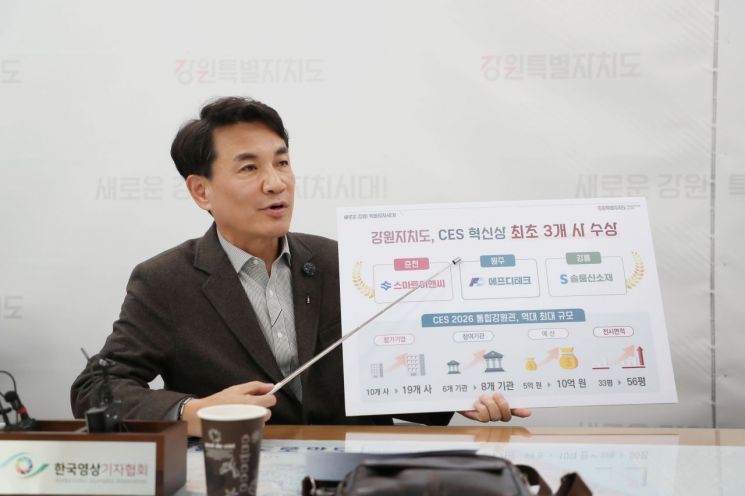 Governor Kim Jintae held a press conference on the 10th and announced that the initial budget for 2026 has been set at a total of 8.3731 trillion won, an increase of 7.3% compared to the previous year, and will be submitted to the Provincial Council on the 11th. Provided by Gangwon Province
Kim Jin-Tae, Governor of Gangwon Special Self-Governing Province, stated, "The main budget proposal for next year will be submitted tomorrow, and for the first time ever, it exceeds 8 trillion won."
He added, "This is not only due to an increase in local taxes, but also because government subsidies have increased by 400 billion won," emphasizing, "This is the result of the hard work of our staff and municipal and county officials in securing national funds."
He continued, "Once again, we have prepared the budget for the fourth consecutive year without issuing local bonds, which is a source of pride. We plan to focus on the three key areas of industry, local economy, and welfare."
© The Asia Business Daily(www.asiae.co.kr). All rights reserved.



















