The mechanism behind how cells autonomously determine their direction of movement has been elucidated. This discovery is expected to provide clues for identifying the causes of cancer metastasis and immune disorders, paving the way for new therapeutic strategies.
On November 10, KAIST announced that a research team led by Distinguished Professor Huh Wondo from the Department of Biological Sciences, in collaboration with a team led by Distinguished Professor Cho Kwanghyun from the Department of Bio and Brain Engineering at KAIST, and a team led by Professor Lee Gapsang from Johns Hopkins University, USA, has identified the "autonomous navigation mechanism" by which cells determine their direction of movement without external signals.
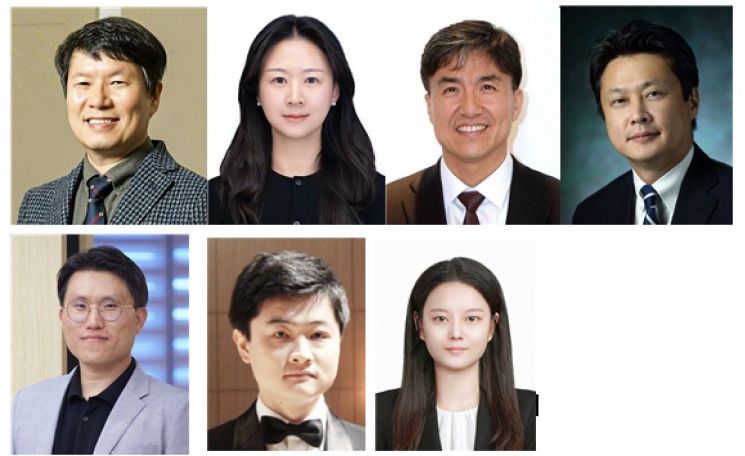 (From top left) Professor Huh Wondo of KAIST, Postdoctoral Researcher Lee Heeyoung of KAIST, Professor Cho Kwanghyun of KAIST, Professor Lee Gapsang of Johns Hopkins University, USA, (From bottom left) Dr. Lee Sangkyu of IBS, Dr. Kim Dongsan of LIBD, Dr. Seo Yeji of Hurux. Provided by KAIST
The joint research team also developed a new imaging technology called "INSPECT (INtracellular Separation of Protein Engineered Condensation Technique)," which allows for the visual observation of how proteins interact with each other inside living cells.
The INSPECT technology artificially implements the "phase separation" phenomenon, in which proteins, when binding together, naturally form distinct, unmixed regions. This enables direct visualization of how proteins actually bind inside cells using fluorescent signals.
Through this technology, the joint research team was able to visually confirm "condensates," which are droplet-like aggregates formed when proteins such as ferritin and the fluorescent protein DsRed bind together.
Based on these findings, the team newly analyzed the operating mechanisms of the Rho family proteins (Rac1, Cdc42, RhoA), which are key regulators of cell movement. They discovered that these proteins do not simply divide the front and back of the cell as previously thought, but rather, the direction of cell movement is determined by which proteins they bind to.
Furthermore, by combining 15 types of Rho proteins with 19 types of binding proteins, the team analyzed a total of 285 pairs of interactions and confirmed that actual binding occurred in 139 pairs. Among these, the Cdc42-FMNL protein combination was found to be the key circuit responsible for "straight movement" of the cell, while the Rac1-ROCK protein combination played a critical role in "directional switching."
The joint research team also found that when they slightly altered a part of the Rac1 protein (the 37th amino acid) to prevent it from binding effectively with the ROCK protein, which acts as a "handle," the cell was unable to change direction and continued to move in a straight line.
Conversely, in normal cells, Rac1 and ROCK bind well to form a structure called the "arc stress fiber" at the front of the cell, which enables the cell to make nearly right-angle turns when changing direction.
In experiments where the environment to which the cell was attached was altered, normal cells changed their migration speed depending on the surrounding environment. However, cells with a defective "handle" (Rac1F37W cells) maintained a constant speed regardless of environmental changes. This demonstrates that the Rac-ROCK protein axis finely regulates the cell's ability to sense and adapt to its surroundings.
Professor Huh stated, "This study is significant in that it reveals cell migration is not random but is precisely controlled by an intrinsic program created by the ensemble of Rho signaling proteins and cell migration-related proteins. The newly developed INSPECT technology is a powerful tool for visualizing intracellular protein interactions and will be widely used to elucidate the molecular mechanisms of various biological phenomena and diseases, such as cancer metastasis and neuronal cell migration."
Meanwhile, this research was jointly led by Dr. Lee Heeyoung of KAIST, Dr. Lee Sangkyu (currently at the Institute for Basic Science), Dr. Seo Yeji (currently at Hurux), and Dr. Kim Dongsan (currently at LIBD), who served as co-first authors. The research findings (paper) were published in Nature Communications on October 31.
© The Asia Business Daily(www.asiae.co.kr). All rights reserved.

















