On social media: "Companies are flocking to the U.S. because of tariffs"
Expresses frustration: "Does the Supreme Court not know this?"
Bessent clarifies: "Dividends result from tax cuts, not tariffs"
As the U.S. Supreme Court reviews the legality of tariff policies, President Donald Trump stated on November 9 (local time), "Thanks to tariffs, we are earning trillions of dollars, and we will soon begin to pay off our massive debt of $37 trillion." Even as conservative Supreme Court justices express skepticism about tariff policies, President Trump has been actively defending tariffs, which are a core part of his foreign policy.
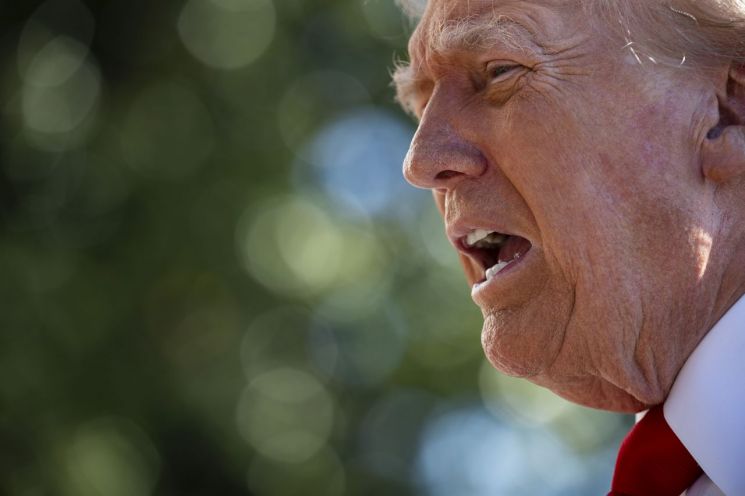
On this day, President Trump wrote on his self-created social networking service, Truth Social, "Those who oppose tariffs are fools," adding, "We have now become the wealthiest and most respected country in the world. Inflation is almost nonexistent, stock prices are at record highs, and 401(k) retirement accounts are at their highest levels ever."
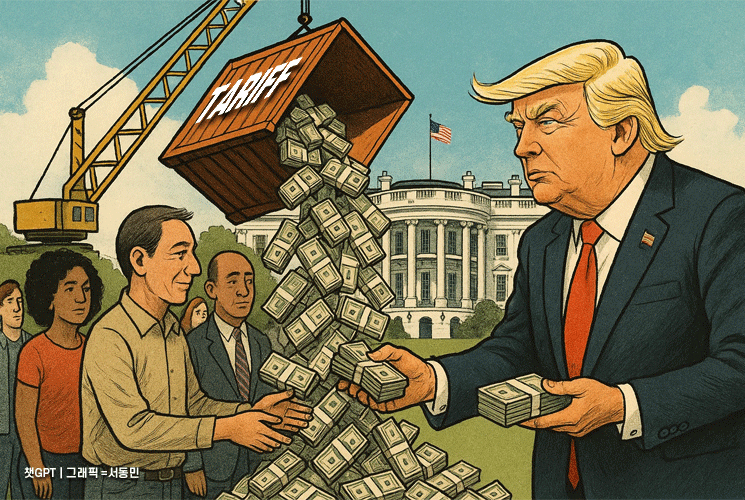
He continued, "Record investments are being made across the United States, and factories are being built everywhere," and added, "Every person, except for those in high-income brackets, will receive a minimum dividend of $2,000 per person."
However, he did not provide any specific details regarding the dividend payments. In the market, there is widespread belief that rather than receiving dividend benefits, the increased tariffs will become a burden for companies, which is highly likely to ultimately lead to higher consumer prices in the United States.
In this context, U.S. Treasury Secretary Scott Bessent explained in an interview with ABC News on the same day that the proposed dividends could be realized not through tariff revenue, but as a result of tax cuts from the tax reduction bill that passed Congress in July. Since the Constitution grants taxation authority to Congress, President Trump's statement about "paying dividends to the public with tariff revenue" appears to be made with an awareness that it could negatively affect the Supreme Court's future ruling.
President Trump went on to say in another post, "Let me make this clear," stating, "The President of the United States (with full approval from Congress) can suspend all trade with foreign countries-which is a much harsher measure than tariffs-and can also grant permission to foreign countries." He criticized, "However, if even imposing tariffs on foreign countries for national security purposes is not allowed, that is not what the Founding Fathers intended, and it would be utterly ridiculous."
He argued, "Other countries impose tariffs on us, but if we cannot impose tariffs on them, that would be their dream," and claimed, "Companies are flooding into the United States solely because of tariffs." He also expressed his dissatisfaction with the Supreme Court, saying, "Has the U.S. Supreme Court not heard this? What on earth is going on?"
Previously, the Supreme Court began reviewing the legality of the Trump administration's reciprocal tariff policy based on the International Emergency Economic Powers Act (IEEPA) on November 5. The policy was ruled illegal in both the first and second trials, and a final decision from the Supreme Court is now pending. If the Supreme Court rules the tariff policy illegal, the Trump administration would be required to refund more than $100 billion in tax revenue. While it is highly likely that the Trump administration will push ahead with its tariff policy through other legal means, the legitimacy and momentum of the tariff policy are expected to suffer. The Supreme Court's final decision is expected as early as the end of the year.
© The Asia Business Daily(www.asiae.co.kr). All rights reserved.


















