Ruling Party, Government, and Presidential Office Likely to Consider Additional 10 Percentage Point Reduction
"Goal of 'Productive Financial Transformation'... Ruling Party, Government, and Presidential Office Must Unite in Response to Public Opinion"
The Office of the President has stated that a united stance among the ruling party, government, and presidential office is necessary to effectively enhance shareholder value through expanded dividends and other measures, reflecting public opinion. This is being interpreted as support for lowering the top tax rate on separately taxed dividend income. Since President Lee Jaemyung has consistently emphasized a "productive financial transformation," there is strong consideration of easing the top tax rate on separately taxed dividend income from 35% (as proposed by the government) to 25%, a reduction of 10 percentage points, to sustain the stock market stimulus.
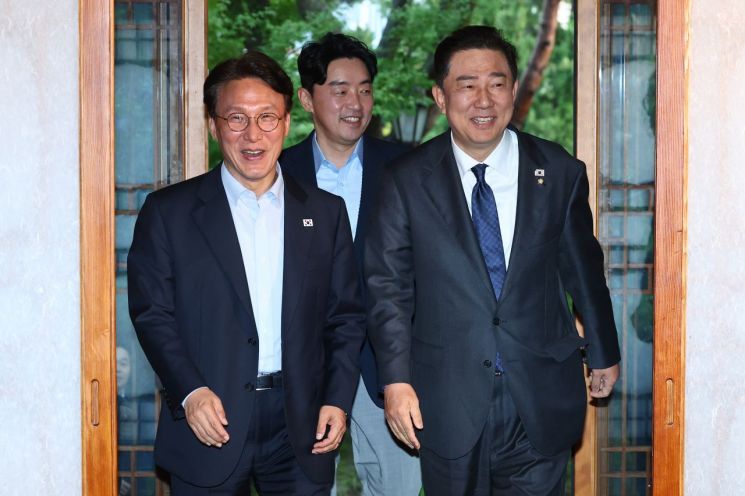
At a high-level party-government meeting held at the Prime Minister’s official residence in Samcheong-dong, Seoul, on the 9th, Senior Presidential Secretary Kang stated, "Over the past two months, a variety of opinions have been presented and discussed in the public, corporate, and financial markets, including the tax rate applied to separately taxed dividend income." Kang has been pursuing policies to channel funds excessively concentrated in real estate into productive financial sectors such as the stock market and corporate investment, and said that this policy direction will remain unchanged going forward.
Kang reiterated that he has been promoting policies to redirect funds overly concentrated in real estate into productive financial sectors like the stock market and corporate investment, and emphasized that this policy direction will remain unchanged. This suggests that decisions regarding the top tax rate on separately taxed dividend income, among other matters, should be made with sufficient consideration of public opinion, with a focus on achieving a productive financial transformation.
In July, the government announced a tax reform plan to tax dividend income separately from comprehensive financial income, applying different tax rates based on income brackets. For dividend income exceeding 300 million won, a 35% tax rate would apply. However, as capital market experts and some within the ruling party argued that the top rate should be reduced to 25% to boost stock prices, the atmosphere began to shift. In particular, as the KOSPI, which had surpassed 4,200 points, recently plunged due to concerns over a bubble in the artificial intelligence (AI) sector, calls have grown for measures to improve investor sentiment. A senior official from the Office of the President stated on the 10th, "The goal of a productive financial transformation has never changed," and added, "We are listening to as many diverse opinions as possible to achieve this goal."
However, concerns remain regarding reduced tax revenue and the structural impact of tax cuts. Given that the average shareholding ratio of the largest shareholders in domestic listed companies is 48%, there are concerns that lowering the top tax rate could primarily ease the tax burden on major shareholders. As a result, during parliamentary discussions, the requirements for "high-dividend companies" eligible for separate taxation of dividend income may become more stringent. Professor Jung Seun of Chungnam National University pointed out at the "2026 Government Budget Analysis Forum" that "even if the introduction of separate taxation for dividend income leads to increased dividends, major shareholders would enjoy significant tax benefits, while national tax revenue would decrease and the benefits to the majority of retail investors would be limited, thereby worsening redistribution."
Additionally, Kang emphasized that, when making difficult decisions regarding the greenhouse gas reduction target (2035 NDC) and the transition to artificial intelligence (AI), close cooperation based on the principle of "national interest first" is essential. He stated, "I feel a heavy sense of responsibility to protect future generations from the climate crisis, to ensure that industry continues to create jobs and opportunities for future generations, and to make sure there are no difficulties in the overall societal transition to AI," adding, "Whenever the government faces difficult choices, the ruling party, government, and presidential office must work closely together, prioritizing the national interest."
© The Asia Business Daily(www.asiae.co.kr). All rights reserved.

















