2025 Gumi Ramen Festival Kicks Off on the 7th
Crowds Gather with Freshly Made Shin Ramyun from the Factory
Old Downtown Near Gumi Station Revitalized... Nongshim Gumi Factory Grows 7% Annually
On the 7th, in front of Gumi Station in North Gyeongsang Province, a 475-meter-long "world's longest ramen restaurant" was created. Visitors, carrying transparent plastic bags filled with freshly produced Shin Ramyun, Chapagetti, and Neoguri from the Nongshim Gumi Factory, walked with excitement. All around, a variety of ramen-based dishes such as "Chili Burrito," "Honey Pear LA Galbi Jjajang Ramen," and "Eel Soup Noodles" were sold, filling the air with rich aromas. As soon as the festival began at 10 a.m., 10,000 people gathered, and the number of orders exceeded 2,000.
Mr. A, an office worker living in Seoul, said, "After reading reviews from last year and hearing that I could buy freshly produced Shin Ramyun directly from the factory, I made the effort to come down early in the morning," adding, "If you love ramen, this is a festival you absolutely must visit at least once."
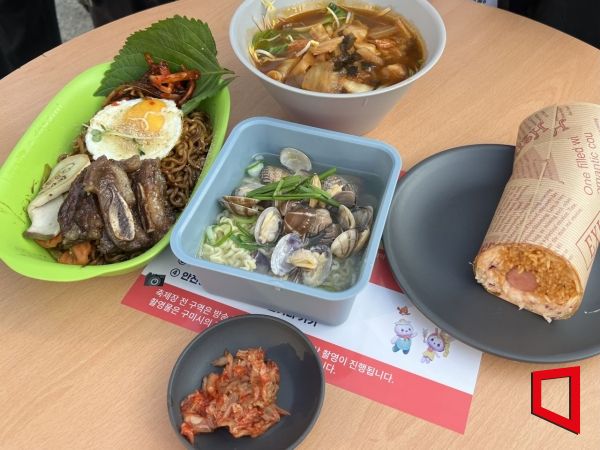
Ms. B, a university student who visited with her family from Gumi, said, "It's my first time trying ramen in so many different ways," and laughed, "It was new to see such a festival happening in Gumi, and when I posted photos on social media, my friends were envious."
The Fourth Gumi Ramen Festival... Boosting the Local Economy
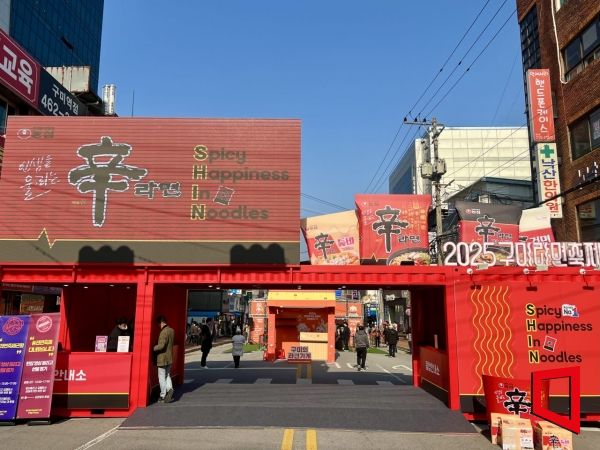 On the 7th, the '2025 Gumi Ramen Festival' was held. Nongshim set up an exclusive booth at the main entrance to conduct tasting events for their newly launched product, 'Shin Ramyun Kimchi Bokkeummyeon,' recently announced for both domestic and global markets, as well as their premium ramen, 'Shin Ramyun Black.' Photo by Han Yeju
The "2025 Gumi Ramen Festival," which began at the Nongshim Gumi Factory, the largest ramen production base in Korea, marks its fourth year in 2025. Last year, a total of 170,000 people visited the event, generating a consumption effect of 1.5 billion won, and the ramen festival has now established itself as a signature local festival representing Gumi.
Kim Jangho, Mayor of Gumi, said, "Compared to the second ramen festival, the number of visitors more than doubled at the third event last year, and more people are coming every year," adding, "This year, we expect ramen sales to reach 400,000 units."
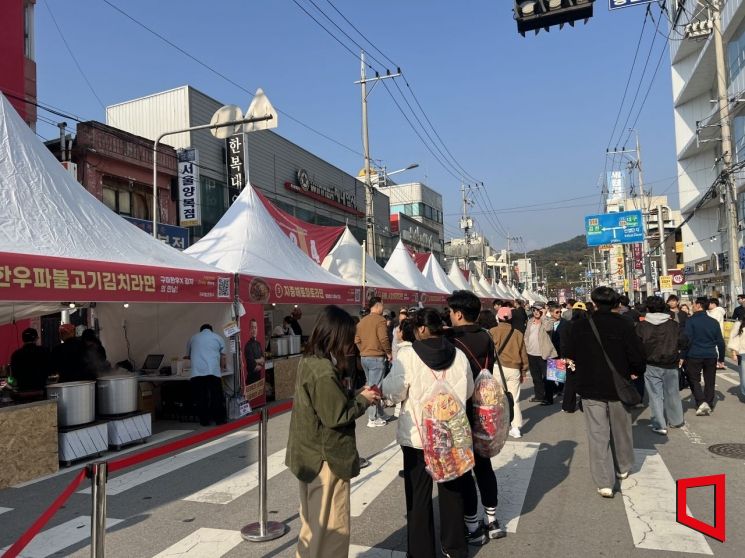 Citizens enjoying the "2025 Gumi Ramyeon Festival" carrying transparent plastic bags filled with freshly produced Shin Ramyeon, Chapagetti, and Neoguri from the Nongshim Gumi Factory. Photo by Han Yeju
The festival has also revitalized the old downtown area around Gumi Station, which had been in decline. Mayor Kim explained, "The traditional market and nearby shops used to be quiet, but during the festival, crowds have completely changed the atmosphere. Some cafes ran out of coffee beans by 3 p.m., and people had to take waiting tickets at traditional market soup restaurants." Small business owners call the ramen festival a "13th month bonus." Among the booth operators, there were cases where sales reached 20 million won over three days.
Mr. C, who runs a noodle shop in the traditional market, said, "We had many customers last year, but I expected even more this year, so I prepared twice as many ingredients as usual," adding, "I feel truly happy because the market comes alive every time the festival is held."
The Heart of Nongshim, Gumi Factory... "Production Expected to Reach 1 Trillion Won by 2028"
At the center of the Gumi Ramen Festival is the Nongshim Gumi Factory. Not only does Gumi handle 75% of Nongshim's Shin Ramyun production, but it also serves as the "heart" that maintains the consistent quality of flagship products such as Chapagetti and Neoguri.
Kim Sanghun, head of the Nongshim Gumi Factory, said, "The Gumi Factory is equipped with 12 production lines for bag and cup noodles and 4 lines for snacks, totaling 16 production lines. The daily production capacity is 6.65 million servings, which is enough for all citizens in the Daegu and North Gyeongsang regions to eat Nongshim products for three meals a day."
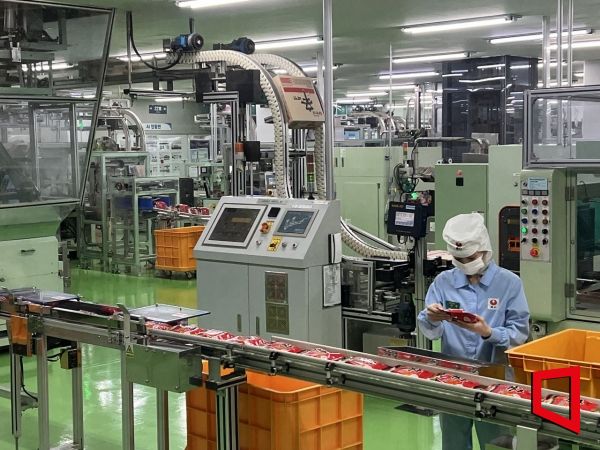
Thanks to the high production volume, the automation rate of the entire ramen process has been raised to 90%. The factory has also developed eight proprietary artificial intelligence (AI) technologies. Currently, 46 processes at the Gumi Factory utilize AI technology. Kim explained, "The 'AI Object Recognition Program,' which Nongshim introduced first in the industry, visually recognizes objects with cameras to build data, and artificial neural networks analyze hundreds of thousands of product images to detect abnormalities. The AI-based inspection system independently learns details such as print quality, packaging patterns, and noodle thickness, reducing errors and maintaining precise standards for each product."
Recently, the Gumi Factory has been growing rapidly due to increased export volumes. The factory's average annual growth rate is 7%, and last year it produced products worth 844.2 billion won. Kim said, "The Gumi Factory was originally focused on the domestic market, but it now also handles export volumes that the Busan plant cannot accommodate. We are exporting 23 products to four countries, and by 2028, production is expected to reach 1 trillion won."
A Nongshim representative stated, "The Gumi Factory is not only a production base symbolizing Nongshim's technological prowess and commitment to quality, but also the starting point for our global expansion. We will continue to deliver spicy happiness to people around the world under the slogan 'Spicy Happiness In Noodles.'"
© The Asia Business Daily(www.asiae.co.kr). All rights reserved.



















