"Ipa Trading" Garlic Scapes and "Heemang Sangsa" Frozen Spinach
Residual pesticides exceeding the permissible limits were detected in Chinese garlic scapes and frozen spinach, prompting the Ministry of Food and Drug Safety to issue a recall.
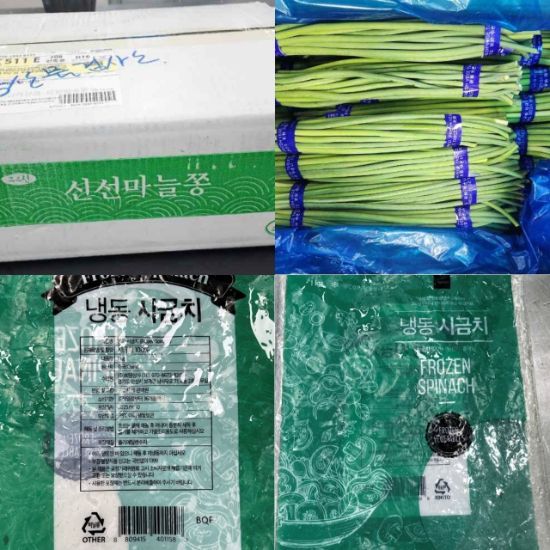 On the 7th, residual pesticides exceeding the limit were detected in Chinese garlic scapes and frozen spinach, leading the Ministry of Food and Drug Safety to issue a recall. Ministry of Food and Drug Safety
On November 7, the Ministry of Food and Drug Safety announced that residual pesticides exceeding the standard were found in imported garlic scapes sold by "Ipa Trading," an import and distribution company based in Songpa-gu, Seoul, and in imported frozen spinach sold by "Heemang Sangsa" in Anseong, Gyeonggi Province. Both products are of Chinese origin. The Ministry stated that it has suspended sales of these products and initiated a recall.
In the garlic scapes, "Imidazil" was detected at levels exceeding the maximum residue limit. The food safety standard is 0.01 mg/kg, but the detected level in the garlic scapes was 0.13 mg/kg. Imidazil is mainly used to control citrus mold and is regulated as a substance with potential neurotoxicity and carcinogenicity. In the frozen spinach, "Famoxadone" was found in excess. The standard is 0.01 mg/kg, but the detected level in the frozen spinach was 0.52 mg/kg. Famoxadone is mainly used to control blight in peppers and potatoes and downy mildew in cucumbers and cabbages, and is classified as a toxic substance that can cause eye damage with prolonged exposure.
The garlic scapes subject to recall amount to 49,896 kg (packaged in 7 kg units) with a consumption deadline in 2025, while the frozen spinach subject to recall totals 22,000 kg, labeled with a packaging date of June 10, 2025, and a consumption deadline of 36 months from the packaging date.
The Ministry of Food and Drug Safety stated, "We have taken swift action to recall the affected products," and urged, "Consumers who have purchased these products should stop using them and return them to the place of purchase."
Meanwhile, on November 6, "Seongmin Trading," an import and distribution company based in Ansan, Gyeonggi Province, also suspended sales and initiated a recall after residual carbendazim exceeding the standard (0.01 mg/kg or less) was detected in "wood ear mushrooms" imported from China and sold by the company.
Currently, pesticides used by farms have been developed to minimize accumulation in the human body. However, if residual pesticides exceed the permissible limits, sales are suspended.
For fruits and vegetables that are within the permissible limits for residual pesticides, it is best to soak them in tap water and then rinse under running water before consumption. Studies have shown that there is little difference in the removal rate of pesticides when washing with running water, vinegar, or salt water.
© The Asia Business Daily(www.asiae.co.kr). All rights reserved.
![Clutching a Stolen Dior Bag, Saying "I Hate Being Poor but Real"... The Grotesque Con of a "Human Knockoff" [Slate]](https://cwcontent.asiae.co.kr/asiaresize/183/2026021902243444107_1771435474.jpg)
















