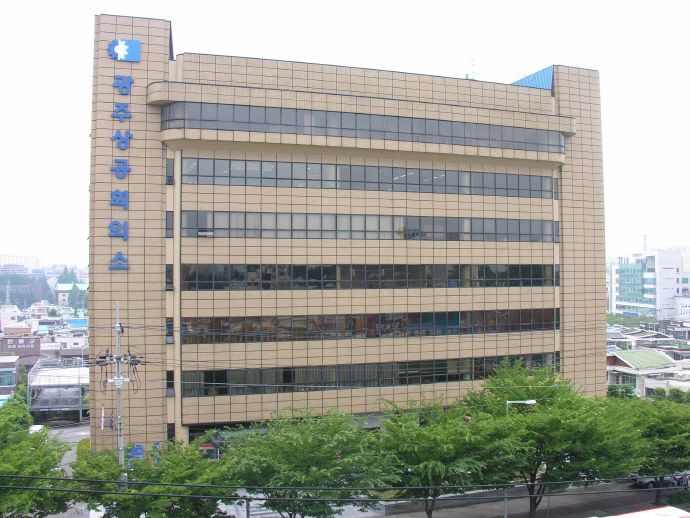
The Gwangju Chamber of Commerce and Industry has called for an increase in the central government's share of funding for the Honam Expressway expansion project, citing that the current burden on local governments is placing significant financial pressure on the region.
On November 7, the Gwangju Chamber of Commerce and Industry released a statement, saying, "The financial burden on local governments for the Donggwangju to Gwangsan Interchange section of the Honam Expressway expansion project is excessive and is causing severe strain on the region's finances. It is necessary to adjust the cost-sharing ratio between the central government and Korea Expressway Corporation in favor of a higher government contribution."
On this day, the Gwangju Chamber of Commerce and Industry delivered its statement to the Presidential Office (Policy Division), the Ministry of Economy and Finance, the Ministry of Land, Infrastructure and Transport, Korea Expressway Corporation, the leader of the Democratic Party of Korea, and local National Assembly members.
The Chamber explained, "Since the Donggwangju to Gwangsan Interchange section of the Honam Expressway was expanded to four lanes in 1986, approximately 140,000 vehicles now use this section daily. This is 2.7 times the optimal traffic volume of 51,300 vehicles. As a result, chronic congestion and accident risks persist, and the section is identified as a key logistics corridor connecting Gwangju’s urban area and industrial complexes, as well as a major bottleneck."
They continued, "Despite the fact that this section directly impacts the national logistics flow, the current cost-sharing structure allocates 20% to the central government, 30% to Korea Expressway Corporation, and 50% to Gwangju Metropolitan City, placing an excessive burden on the local government. In the initial discussions in 2012, the cost-sharing structure was 80% for the central government and 20% for Gwangju City, but following a request for renegotiation from the Ministry of Economy and Finance, the structure was changed, resulting in a sharp increase in the local government's share."
They further stated, "The total project cost increased from 276.2 billion won in the 2015 project plan to 793.4 billion won according to the 2023 implementation design, an increase of approximately 510 billion won. The Chamber analyzed that this increase is not simply due to inflation, but is an unavoidable result of the government's strengthened environmental and safety policies."
Additionally, they argued, "It is unfair for local governments to bear the same proportion of the increased project costs resulting from these changes in government policy. We propose that the central government and Korea Expressway Corporation should cover the additional 340 billion won out of the total 793.4 billion won, which was incurred due to the government's policy enhancements, and that Gwangju City should only be responsible for 50% (226.7 billion won) of the remaining 453 billion won."
© The Asia Business Daily(www.asiae.co.kr). All rights reserved.

















