Professor Nam Okhyun's Team Leads Next-Generation Semiconductor Technology
Korea Polytechnic University announced on November 8 that the research team led by Professor Nam Okhyun from the Department of Semiconductor Engineering has achieved a world-class breakthrough in the field of diamond wafers, which are attracting attention as next-generation semiconductor materials.
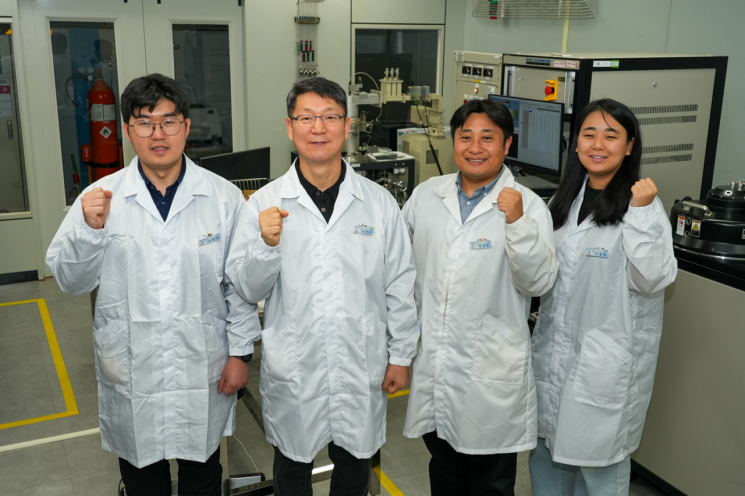 Research team of Professor Nam Okhyun from the Department of Semiconductor Engineering at Korea Polytechnic University. (From left) Dr. Kwak Taemyung, Professor Nam Okhyun, Dr. Yoo Geunho, and Seolyoung Oh (PhD candidate). Korea Polytechnic University
This research marks the world's first successful growth of "twin-free (111) single-crystal diamond" on an r-plane sapphire substrate.
Diamond is referred to as the "ultimate semiconductor" because it possesses a much wider bandgap, higher thermal conductivity, and superior breakdown field strength compared to silicon (Si), silicon carbide (SiC), and gallium nitride (GaN).
In particular, its excellent radiation resistance enables stable performance even in extreme environments such as space and defense, making it a key material for future strategic industries.
However, the large-area growth of single-crystal diamond wafers has been technically very challenging and has remained an unsolved issue worldwide.
While (111) diamond exhibits superior semiconductor properties compared to the more commonly studied (100) orientation, the growth process has been hindered by the easy formation of twin defects due to competition between two domains, making it difficult to achieve high-quality growth.
To overcome these limitations, Professor Nam Okhyun's research team at Korea Polytechnic University utilized a low-symmetry r-plane sapphire substrate to induce diamond growth in a single domain, thereby achieving (111) single-crystal diamond completely free of twin defects.
This achievement with (111) single-crystal diamond is expected to have a significant impact not only on power devices but also on quantum sensing, communication, and computing applications. The (111) substrate favors the alignment of nitrogen-vacancy (NV) centers, which enhances photon extraction efficiency and signal-to-noise ratio. This, in turn, leads to improved device uniformity and yield in wafer-scale quantum device integration.
Additionally, the research team succeeded in growing single-crystal diamond with a diameter of 2 inches in the (100) orientation as well, making meaningful progress in both (111) and (100) orientations and opening new possibilities for the development of large-area diamond wafers.
Dr. Kwak Taemyung, the principal developer, stated, "This achievement is an important milestone that positions Korea to take a global leadership role in the field of diamond semiconductors."
Professor Nam Okhyun said, "We will continue to pursue both large-area and high-quality diamond wafers so that Korea's diamond technology can lead not only the future power semiconductor market but also next-generation semiconductors and quantum technology markets for extreme environments such as space and defense."
He added, "Wide bandgap (WBG) semiconductors, including diamond, are classified as strategic core materials by many countries, and securing domestic technology is directly linked to national competitiveness. This achievement is significant in that Korea has secured its own proprietary diamond material technology."
This research was supported by the Ministry of Trade, Industry and Energy's Alchemist Project and the Ministry of Science and ICT's Nano Material Technology Development Program (Future Technology Research Laboratory).
The results were published as the cover article in the online edition of the internationally renowned journal Diamond and Related Materials (September 20, 2025, DOI: 10.1016/j.diamond.2025.112857). The core technology developed has been filed for patents in major countries, including the United States, Japan, Europe, and China, demonstrating its global technological competitiveness.
© The Asia Business Daily(www.asiae.co.kr). All rights reserved.

















