Professor Sung-Hwan Yoon's Team Develops Task-Adaptive Wireless Image Transmission Technology
Up to 45 Times Higher Transmission Efficiency
Benefits for Metaverse, Autonomous Driving, and More
Published in JSAC
An AI technology capable of reducing the amount of image data transmitted has been developed.
This innovation is expected to benefit fields that require the real-time exchange of large-scale video data without delay, such as perception systems for autonomous vehicles, remote surgery and diagnostics, and real-time rendering in the metaverse.
On November 6, Professor Sung-Hwan Yoon's team at the UNIST Graduate School of Artificial Intelligence announced the development of "Task-Adaptive Semantic Communication," an AI-based wireless image transmission technology that selectively delivers only the essential semantic information required for a given purpose.
 Research team, Professor Sung-Hwan Yoon (left), Researcher Jung-Hoon Park (first author). Provided by UNIST
Image information is divided into semantic structures such as objects, layouts, and relations. However, current wireless image transmission technologies do not consider these semantic structures, instead compressing and transmitting the entire image as a whole. As a result, bandwidth limitations and transmission delays occur, making it difficult to send and receive high-resolution video in real time.
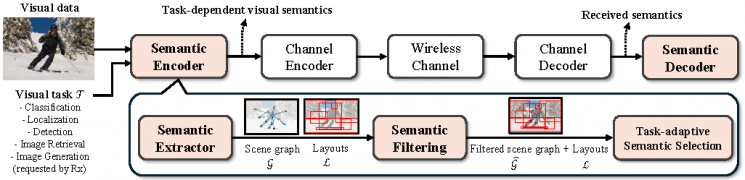
The technology developed by the research team transmits only the semantic information essential for the task, rather than all the information contained in an image.
For example, if the task is simply to classify objects in a photo, only object information such as "cat" or "car" is sent. If the goal is image generation, such as "a cat wearing a hat" or "a person sitting on a chair," then information about the layout and relationships between objects is also transmitted.
Furthermore, in the process of transmitting relational information, the team developed and applied a semantic filtering algorithm to eliminate information that is always true (such as "a person has a head") or redundant information (such as "holding a stick in hand" and "a person is holding a stick"). Through this process, unnecessary data transmission is reduced, while maintaining the context needed for task performance and greatly improving transmission efficiency.
Simulation results showed that this technology achieved up to 45 times higher transmission efficiency compared to existing methods, and was proven capable of performing real-time visual tasks under various wireless channel conditions.
Professor Sung-Hwan Yoon stated, "Going forward, the core of communication will shift from simply 'transmitting accurately' to 'transmitting meaningfully.' This research marks a turning point in the landscape of intelligent wireless communication."
Jung-Hoon Park, the first author of the study, expressed optimism, saying, "This technology is expected to help fields that require the real-time exchange of large-scale video data without delay, such as perception systems for autonomous vehicles, remote surgery and diagnostics, and real-time rendering in the metaverse."
The research results were published on October 20 in the IEEE Journal on Selected Areas in Communications (JSAC), one of the top journals in the field of communications.
The study was conducted with support from the Ministry of Science and ICT and the Institute of Information & Communications Technology Planning & Evaluation (IITP) through the Regional Intelligence Innovation Talent Development Project, the Graduate School of Artificial Intelligence (UNIST) Project, the AI Star Fellowship (UNIST) Project, the Ministry of Health and Welfare's Health and Medical Technology R&D Project, and the National Research Foundation's Mid-Career Researcher Program for Basic Research.
© The Asia Business Daily(www.asiae.co.kr). All rights reserved.
![Clutching a Stolen Dior Bag, Saying "I Hate Being Poor but Real"... The Grotesque Con of a "Human Knockoff" [Slate]](https://cwcontent.asiae.co.kr/asiaresize/183/2026021902243444107_1771435474.jpg)
















