Tough Response to Surge in Online Scams: Up to 24 Strokes of the Cane
AI-Generated Pornography and Deepfake Crimes Now Subject to Penalties
Singapore has taken the drastic measure of introducing caning in an effort to curb the recent surge in international online scams, including voice phishing and romance scams.
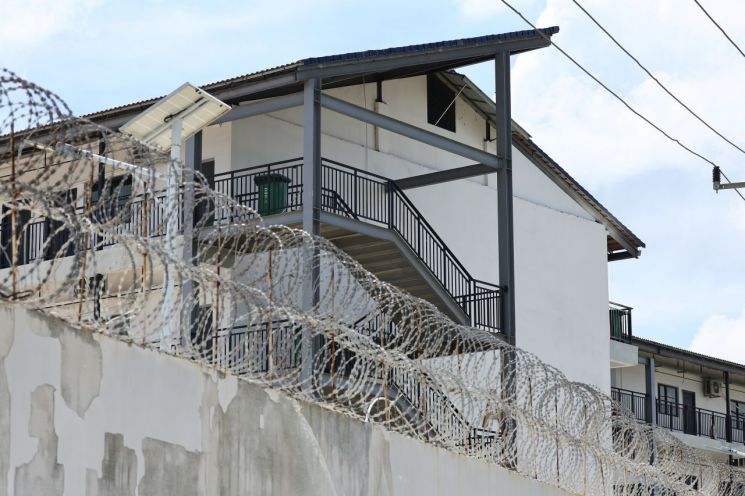 The Taeja Complex surrounded by high outer walls and barbed wire. Image to aid understanding of the article. Photo by Yonhap News
According to Bloomberg and The Straits Times on November 4 (local time), the Singaporean parliament has passed an amendment to the Penal Code that significantly strengthens penalties for scam-related crimes. Under the new law, members of scam organizations and accomplices who recruit victims are now subject to mandatory caning of at least six strokes and up to twenty-four strokes.
Additionally, individuals who provide mule accounts, identification cards, or mobile phone SIM cards for scam operations, or who assist in money laundering, may face up to twelve strokes of caning.
Sim Ann, Singapore’s Senior Minister of State for Home Affairs, stated, “Scams are currently the most common type of crime in Singapore, accounting for 60% of all reported crimes.” In fact, according to Singapore Police data, there have been 190,000 reports of scam-related losses from 2020 through the first half of this year, with total damages amounting to approximately 3.7 billion Singapore dollars (about 4.08 trillion won).
Notably, the amount of damages reached a record high last year at around 1.1 billion Singapore dollars (about 1.21 trillion won), prompting the Singaporean government to implement strong countermeasures. Since the beginning of this year, authorities have allowed police to immediately restrict bank account transactions of individuals suspected of being involved in scams.
On October 30, Singaporean police launched an investigation into the Prince Group and its chairman Chen Zhi (aged 39), who had been operating a large-scale scam syndicate in Cambodia. Authorities seized and froze related assets worth about 150 million Singapore dollars (approximately 165 billion won). The group is known to have operated notorious voice phishing and romance scam organizations, such as the so-called "Taeja Complex."
The latest Penal Code amendment also introduces penalties for "deepfake" crimes, in which sexually explicit images or videos are generated or distributed using artificial intelligence (AI) without the subject’s consent. Furthermore, even if no real child is involved, AI-generated realistic child sexual abuse material will now be punishable as a child abuse crime.
© The Asia Business Daily(www.asiae.co.kr). All rights reserved.
![Clutching a Stolen Dior Bag, Saying "I Hate Being Poor but Real"... The Grotesque Con of a "Human Knockoff" [Slate]](https://cwcontent.asiae.co.kr/asiaresize/183/2026021902243444107_1771435474.jpg)











