KOSPI Plunges 6% Intraday on Heavy Foreign Sell-Off
Retail Investors Step In to Defend the 4,000 Mark with Bargain Buying
"Correction Likely to Be Short-Term... Not a Prolonged Downtrend"
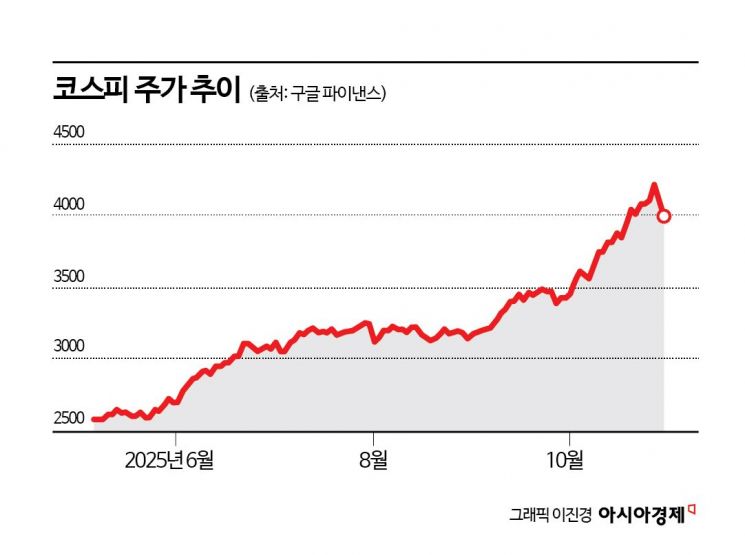
Amid renewed concerns over an artificial intelligence (AI) bubble, the KOSPI faced a "Black Wednesday" but managed to hold the 4,000-point level, thanks to strong buying from retail investors. Attention is now focused on whether these so-called "Donghak Ants," who have been stockpiling cash and waiting for an opportunity to enter the market, can act as a stabilizing force to prevent panic selling during this correction period.
According to the Korea Exchange on November 6, the KOSPI closed at 4,004.42 the previous day, down 2.85%. Foreign investors, who had driven the KOSPI rally since September, sold off 6 trillion won worth of shares just this month, putting downward pressure on the index. As both the KOSPI and KOSDAQ futures markets plunged by 5% and 6% respectively, sell-side circuit breakers were triggered simultaneously in both markets for the first time in about one year and three months, since "Black Monday" on August 5 last year.
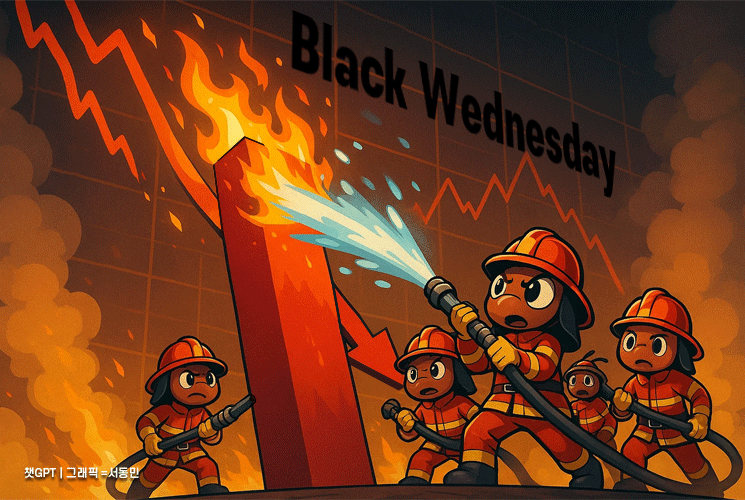
As the KOSPI plunged more than 6% during the session and panic selling loomed, retail investors stepped in as the market's firefighters. On this day, they bought 3 trillion won worth of shares on the KOSPI and KOSDAQ, absorbing the bulk of foreign sell-offs. In particular, they snapped up 2.1863 trillion won of SK Hynix and 1.276 trillion won of Samsung Electronics, the leading stocks that foreign investors had been selling to realize profits this month, effectively carrying forward the semiconductor rally.
Given that most of the stocks purchased by individual investors have recently surged and are now facing pressure from high valuations, it is expected that avoiding losses will be difficult. However, it is encouraging that the securities industry largely believes this correction will be short-lived and will not turn into a sustained downtrend.
The Samsung Securities Research Center issued an emergency domestic market outlook, stating, "Although the U.S. government shutdown is dragging on, it is a solvable issue. Considering the Federal Reserve's stance and the state of the U.S. economy, there is still a high probability that the Federal Open Market Committee (FOMC) will cut rates in December." The center added that while market volatility may increase in the short term, it does not expect the market to enter a medium- to long-term correction phase.
Some analysts say the recent two-day decline is an inevitable correction that typically follows a bull market. Assuming the current bull market in Korean stocks began in April, the rally has lasted about 200 days. In the past three bull markets, which lasted two to three years each, a short-term correction also occurred around day 200. In fact, during the "triple low boom" period (low dollar, low oil prices, low interest rates), which is considered similar to the current macro environment, the KOSPI experienced a -10.9% correction over about a month in April 1986.
Ha Inhwan, a researcher at KB Securities, said, "Based on past experience, the correction could last until mid-December," adding, "It is very significant that the FOMC, a crucial event, is scheduled for December 9-10, which coincides with the inflection point suggested by historical patterns."
Another positive factor is that retail investors' "dry powder," which could serve as a source of bargain-hunting during the correction, has reached a record level. According to the Korea Financial Investment Association, as of November 4, investor deposits stood at 86.8 trillion won, an all-time high. Investor deposits refer to funds that investors have placed in brokerage accounts in preparation to buy stocks or have yet to withdraw after selling stocks-essentially, cash on the sidelines ready to enter the market.
Na Junghwan, a researcher at NH Investment & Securities, said, "For the time being, the domestic stock market is likely to see sector rotation and stock-specific trading, due to concerns over exchange rate volatility and uncertainty over a December rate cut." He added, "However, given the ample sideline funds centered around retail investors and the improving earnings outlook for domestic companies next year, there is a high likelihood that stock prices will resume their upward trend after a short-term correction."
© The Asia Business Daily(www.asiae.co.kr). All rights reserved.


















