Closed the Week at 1,449.4 Won, Up 11.5 Won
Uncertainty Over U.S. Fed Rate Path and Risk Aversion
Large-Scale Profit-Taking by Foreign Investors in Korean Stock Market Also a Factor
On the 5th, the won-dollar exchange rate closed weekly trading just below 1,450 won. The rise was amplified as foreign investors sold off large amounts of domestic stocks.
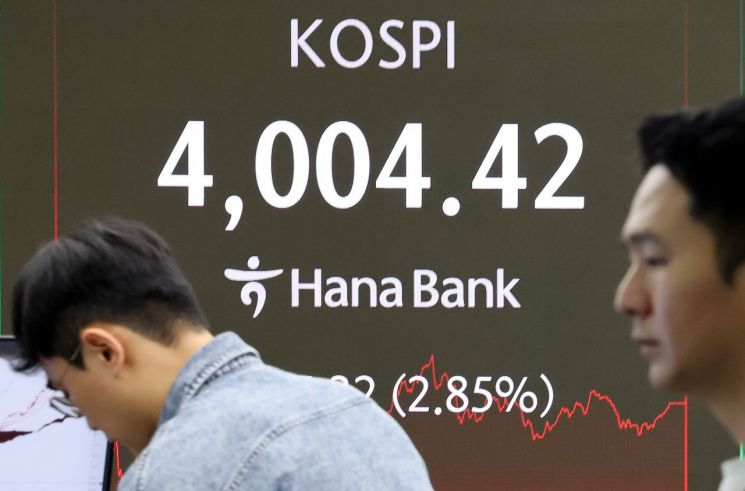 On the 5th, a dealer is working in the dealing room at the Hana Bank headquarters in Jung-gu, Seoul. Photo by Yonhap News
On this day, the closing price for the weekly trading of the won-dollar exchange rate in the Seoul foreign exchange market (as of 3:30 p.m.) was 1,449.4 won, up 11.5 won from the previous trading day. This is the highest level in about seven months since April 11, when it reached 1,449.9 won. The won-dollar exchange rate opened at 1,443.5 won, up 5.6 won from the previous session, and continued to rise. In the latter part of the session, it even surpassed 1,450 won. This is also the first time since April 11 (1,457.2 won) that the rate has exceeded 1,450 won during trading hours.
Recently, concerns over uncertainty regarding the U.S. Federal Reserve's interest rate trajectory have fueled risk aversion, resulting in a stronger dollar. The dollar index, which measures the value of the dollar against the currencies of six major countries, rose 0.33% from the previous day to 100.136. The selling trend of foreign investors in the domestic stock market also contributed to the rise in the exchange rate. Foreign investors have recorded net sales of more than 2 trillion won for two consecutive days in the domestic stock market.
In the market, there are growing concerns that, due to the burden of large-scale investments in the United States, downward pressure on the won may intensify, leading to a higher exchange rate becoming entrenched over the medium to long term. Analysts point out that if a significant portion of foreign currency asset management returns are used for investments in the United States, concerns over external soundness may increase and negatively affect the value of the won.
© The Asia Business Daily(www.asiae.co.kr). All rights reserved.

















