On November 5, Daishin Securities suggested that the Korean won to US dollar exchange rate would range between 1,360 and 1,480 won per dollar over the next three months.
Lee Juwon, a researcher at Daishin Securities, stated in the November foreign exchange report titled "Is the Dollar Back?" released on November 5, "For the external value of the dollar to decline and for the dollar-won exchange rate to stabilize downward, it must be reconfirmed that the US interest rate cut cycle and the global liquidity expansion phase remain valid."
First, through a review of the October foreign exchange market, Lee pointed out that the Dollar Index, which measures the value of the US dollar against six major currencies, rebounded compared to the beginning of the month. He explained, "The US federal government shutdown, which has been prolonged, along with political uncertainties in countries such as France and Japan, and the ongoing US-China tensions, have caused fluctuations." He added, "In addition, the recent cautious stance of the US Federal Reserve has highlighted uncertainty regarding the monetary policy path."
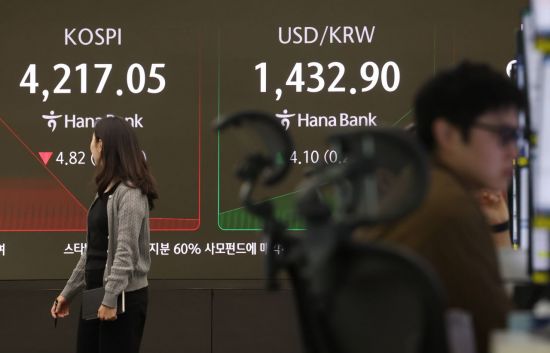
Previously, the dollar-won exchange rate, which had risen to the 1,440 won level before the conclusion of US-Korea negotiations-a factor contributing to the weakness of the won-subsequently dropped to the 1,420 won range. However, as the external value of the dollar rose at the end of the month, the rate rebounded. In the Seoul foreign exchange market the previous day, the weekly closing price (as of 3:30 p.m.) of the won against the US dollar was 1,437.9 won, the highest level in about two weeks.
Regarding the November foreign exchange market, Lee commented, "If signs of an economic slowdown in the US are confirmed in economic indicators after the end of the shutdown, expectations for a rate cut are likely to revive. The risk-on sentiment driven by US-centered global liquidity expansion remains valid, and if policy uncertainty is resolved, the dollar is likely to resume its weakening trend." Specifically, he cited the following as background factors: an economic slowdown masked from a fundamental perspective, the need for further monetary easing from a policy perspective, and liquidity from a supply-demand perspective.
However, he also pointed out, "Even with the resolution of US-Korea negotiation uncertainties, the decline in the dollar-won exchange rate will be limited," adding, "The current situation has not fully reflected the decline in the external value of the dollar." He continued, "If monetary policy uncertainties in major countries, including the US and Japan, are resolved and the weak dollar trend resumes, the dollar-won exchange rate could see a greater decline. However, the ongoing trend of increasing direct and indirect investment in the US is likely to gradually raise the lower bound of the dollar-won exchange rate in the long term." Therefore, he emphasized that for the exchange rate to stabilize downward, it is necessary for the US interest rate cut cycle and the global liquidity expansion phase to be reconfirmed.
© The Asia Business Daily(www.asiae.co.kr). All rights reserved.
![From Bar Hostess to Organ Seller to High Society... The Grotesque Con of a "Human Counterfeit" [Slate]](https://cwcontent.asiae.co.kr/asiaresize/183/2026021902243444107_1771435474.jpg)
















