Construction in Munich Aiming for Operation in Q1 Next Year
Servers Equipped with 10,000 Blackwell GPUs to Be Installed
Part of the 'Made for Germany' Initiative
Nvidia is set to build the world's first artificial intelligence (AI) industrial complex in Germany, with an investment of 1 billion euros (approximately 1.6 trillion won). This initiative is expected to provide a new growth engine for the German economy, which has lost momentum due to the stagnation of traditional manufacturing industries. Observers also note that this could be an opportunity for Europe, whose AI competitiveness lags behind that of the United States and China, to narrow the gap.
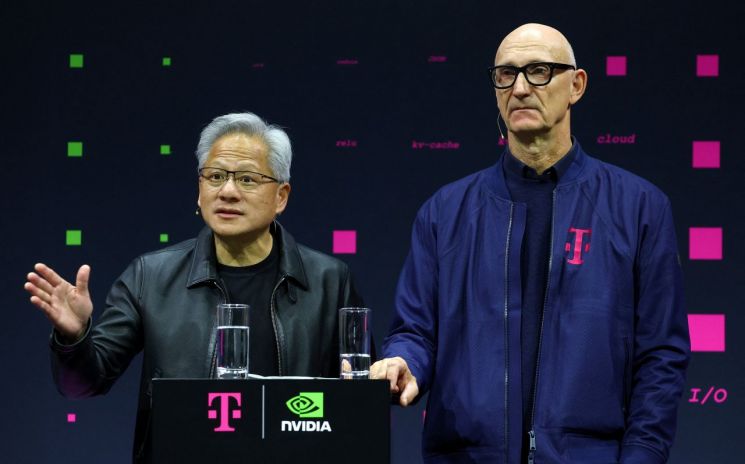 Jensen Huang, CEO of Nvidia (left), and Timotheus H?ttges, CEO of Deutsche Telekom, introduced the 'Industrial AI Cloud' project at a press conference held on the 4th (local time) in Berlin, Germany. Photo by Reuters Yonhap News
On November 4 (local time), Nvidia and German telecommunications company Deutsche Telekom announced that they will construct an industrial AI cloud platform in Munich, Bavaria, southern Germany, with the goal of launching operations in the first quarter of next year.
Jensen Huang, CEO of Nvidia, had previously stated at the developer event (GTC) held in Paris, France, in June that "the world's first industrial AI cloud will be built in Europe." Less than half a year later, the company has now revealed concrete plans.
This platform will be equipped with around 1,000 servers, each fitted with 10,000 units of Nvidia's latest 'Blackwell' graphics processing units (GPUs). It will also run Nvidia's AI Enterprise, Omniverse, and other software.
Deutsche Telekom predicted that once the platform is established, it will improve AI performance in Germany by approximately 50%. The system is designed not for general users, but specifically for corporate environments in Europe, including the manufacturing, healthcare, energy, and pharmaceutical industries. In addition, considering the strict AI-related regulations in Europe, the 'Sovereign AI' principle has been applied to ensure that data does not leave the country.
Siemens, a leading German technology company, has been selected as the initial client. Siemens stated that it will be able to utilize AI-based simulations for automotive manufacturers through this platform.
In addition, more than 10 companies-including AI search firm Perplexity, German robotics company Agile Robots, and German drone manufacturer Quantum Systems-have expressed their intention to use the platform.
CEO Huang emphasized, "In the future, every manufacturing company will have two factories: one that produces cars, and another that develops the artificial intelligence that powers those cars." He described the newly established AI cluster as a "modern-day factory" and a "factory of intelligence."
Deutsche Telekom stated that the establishment of this cluster is the first key project of the "Made for Germany" initiative, in which over 100 companies will invest a total of approximately 1,000 trillion won over three years to help revive the German economy. This project, led by major German corporations such as Siemens, was announced in July, and Nvidia has been involved from the outset.
Timotheus Hoettges, CEO of Deutsche Telekom, stressed, "At a time when Germany is struggling with a two-year economic downturn, AI represents a tremendous opportunity."
AFP evaluated the construction of this cluster as an attempt by Europe to close the gap in the race for AI dominance, which is currently led by the United States and China.
© The Asia Business Daily(www.asiae.co.kr). All rights reserved.

















