10,000 Troops Deployed for Border Guard Duties
Signs of Preparations for Additional Deployments Detected
The National Intelligence Service (NIS) has revealed that over 5,000 North Korean military construction troops are being sequentially deployed to Russia and are expected to be assigned to infrastructure restoration work. It has been confirmed that around 1,000 combat engineers are already engaged in mine-clearing operations near the Russia-Ukraine front line.
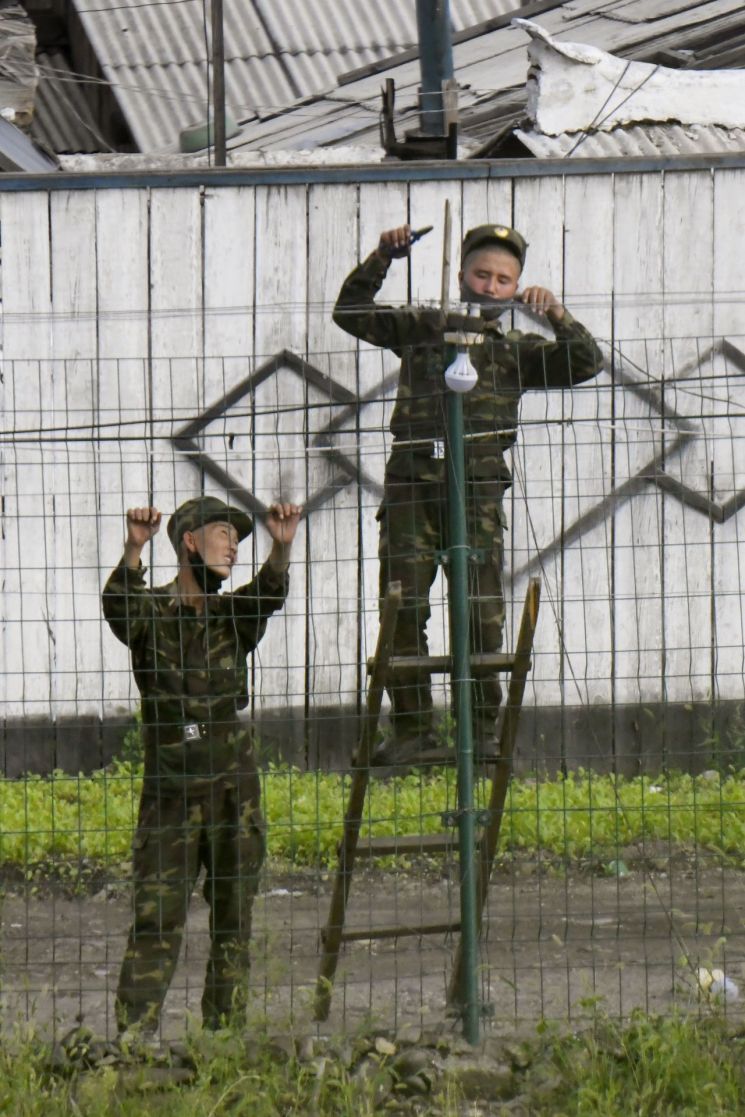
On November 4, during a National Assembly Intelligence Committee audit held at its headquarters in Seocho-gu, Seoul, the NIS reported, "Approximately 10,000 North Korean troops dispatched overseas have been forward-deployed near the Russia-Ukraine border and are tasked with guard duties. Recently, we have also continuously detected trends of additional troop selection and training for further deployments."
The NIS explained, "The movement of North Korean military construction units to Russia has been taking place in phases since September, and it is highly likely that they will be assigned to infrastructure-related work, primarily postwar recovery and facility reconstruction."
The NIS further stated, "North Korea's military technology is also advancing rapidly. The solid-fueled intercontinental ballistic missile (ICBM) 'Hwasong-20,' which appeared at a recent military parade, features a lighter fuselage and improved propulsion performance compared to the previous Hwasong-19 model."
The NIS added, "The warhead section has been expanded, increasing the likelihood of multiple independently targetable reentry vehicle (MIRV) deployment or a heavier warhead."
Additionally, the NIS warned, "North Korea is enhancing missile guidance and precision with Russian technological support, and the pace of unmanned aerial vehicle development is also accelerating. Such advancements could pose a significant security threat."
However, the NIS assessed that "it will still take considerable time for North Korea to achieve operational-level performance in hypersonic missiles, reconnaissance satellites, and destroyers, while the development of underwater capabilities such as nuclear submarines and long-range submarine-launched ballistic missiles (SLBMs) remains at a slow stage."
© The Asia Business Daily(www.asiae.co.kr). All rights reserved.
![User Who Sold Erroneously Deposited Bitcoins to Repay Debt and Fund Entertainment... What Did the Supreme Court Decide in 2021? [Legal Issue Check]](https://cwcontent.asiae.co.kr/asiaresize/183/2026020910431234020_1770601391.png)















