Eight Major Industry Associations Submit Joint Statement to Government
"Reduction Capacity and Industrial Competitiveness Must Both Be Considered"
The industrial sector has officially requested the government to reconsider the '2035 Nationally Determined Contribution (NDC)' and the allocation plan for the fourth phase of the Emissions Trading Scheme, arguing that these targets are excessive. They called for a review that reflects realistic reduction capacity and industrial competitiveness.
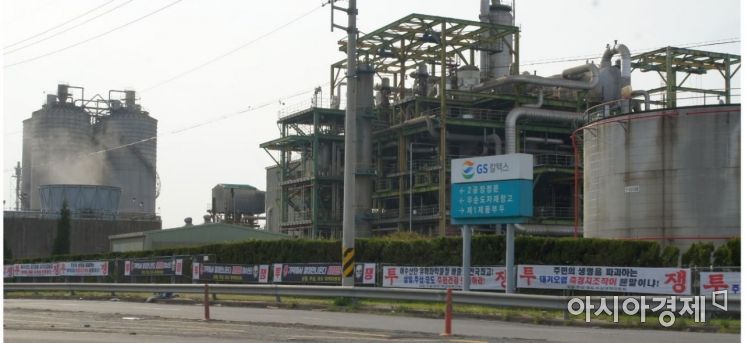 On the 22nd, a banner condemning the manipulation of air pollutant measurement data was hung on the road in front of GS Caltex in Yeosu National Industrial Complex, Jeonnam.
On November 4, eight industry associations-including the Korea Chamber of Commerce and Industry, Korea Iron & Steel Association, Korea Chemical Industry Council, Korea Cement Association, Korea Petroleum Association, Korea Nonferrous Metals Association, Korea Paper Manufacturers Association, and Korea Chemical Fiber Association-submitted a joint statement to the government regarding the '2035 NDC and the Fourth Emissions Trading Scheme Allocation Plan.'
In the statement, the industrial sector expressed concerns, saying, "Amid a crisis in manufacturing due to oversupply from China, tariff hikes by major countries, and prolonged domestic demand stagnation, the government's reduction scenario and allocation plan will place a severe burden on industrial competitiveness."
They further stressed, "A reasonable NDC target that takes into account both national and industrial competitiveness is necessary," adding, "The government must provide multi-layered support, including financial assistance, infrastructure expansion, and institutional improvements, alongside efforts in technological development."
The industrial sector specifically pointed out, "Except for the 48% scenario, the reduction scenarios (48%, 53%, 61%, 65%) presented by the Ministry of Climate, Energy and Environment lack concrete reduction measures for each sector," and demanded, "The government must clearly specify the reduction amounts and implementation methods for each sector and industry."
Regarding the Emissions Trading Scheme, they also stated, "The allocation plan for the fourth phase applies an excessive reduction rate compared to the 2030 NDC," and insisted, "It should be aligned with the existing industrial sector reduction rate of 11.4% compared to 2018."
According to an industry survey, if the current plan is implemented as is, the additional emission allowances that must be purchased by major industries such as steel, refining, cement, and petrochemicals will total 99.82 million tons. At a price of 50,000 won per ton, the total financial burden is expected to reach 5 trillion won.
In response, the industrial sector emphasized, "Companies will inevitably bear a burden that exceeds their actual reduction capacity," and added, "Countermeasures are needed that also take into account secondary costs such as rising electricity rates."
© The Asia Business Daily(www.asiae.co.kr). All rights reserved.

















