At the End of October, Foreign Exchange Reserves Reach 428.82 Billion Dollars
Up by 6.8 Billion Dollars from 422.02 Billion Dollars at the End of Previous Month
Driven by Higher Investment Returns and New Issuance of Foreign Currency Stabilizati
South Korea's foreign exchange reserves have increased for the fifth consecutive month, surpassing 428.8 billion dollars. This is the highest level since January 2023. The increase is attributed to higher investment returns and the issuance of new foreign currency stabilization bonds.
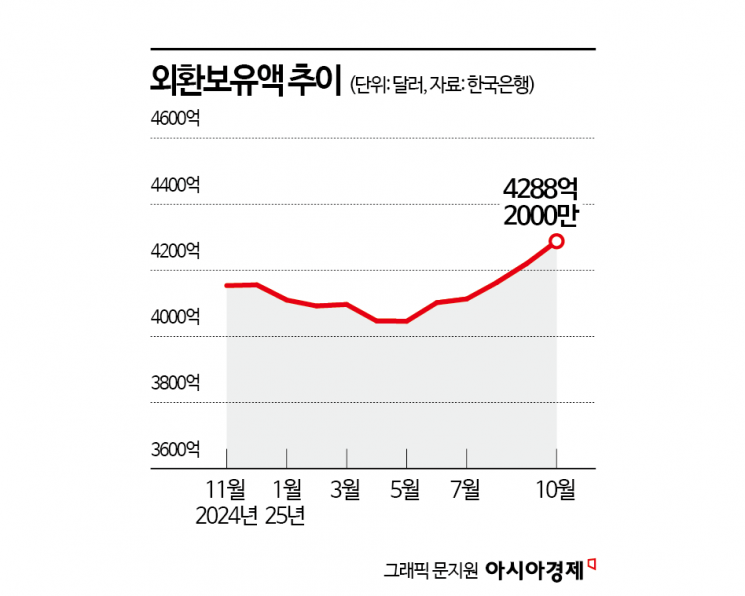
According to the Bank of Korea on November 5, as of the end of last month, South Korea's foreign exchange reserves stood at 428.82 billion dollars, up 6.8 billion dollars from 422.02 billion dollars at the end of the previous month. This marks the highest level in two years and nine months since January 2023 (429.97 billion dollars). The increase was influenced by higher investment returns and the issuance of new foreign currency stabilization bonds.
South Korea's foreign exchange reserves steadily increased until the second half of 2021, peaking at 469.2 billion dollars at the end of October 2021. However, they began to decline due to factors such as interest rate hikes by the US Federal Reserve in 2022. From February to May this year, reserves fell below 410 billion dollars, but have now risen for five consecutive months, approaching 430 billion dollars as of the end of October.
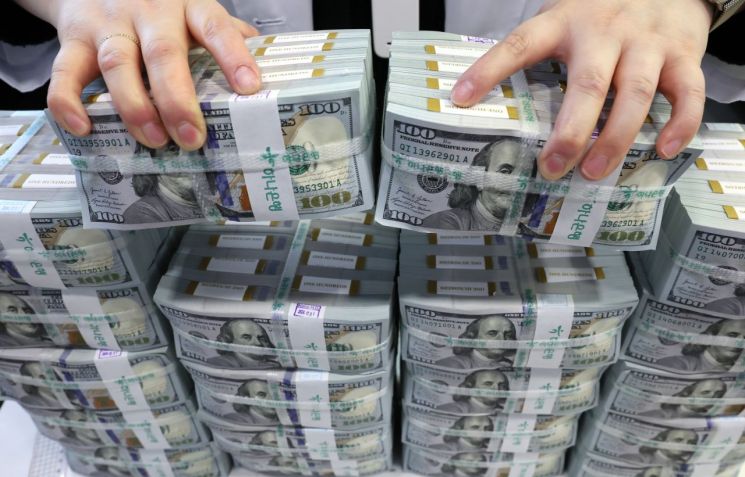 An employee is organizing US dollars at the Hana Bank Counterfeit Response Center in Jung-gu, Seoul. Photo by Yonhap News.
In October, among the components of foreign exchange reserves, securities-which include government bonds, corporate bonds, and agency bonds-decreased by 460 million dollars from the previous month to 377.96 billion dollars. The proportion of securities in total foreign exchange reserves fell to 88.1%. In contrast, deposits increased by 7.4 billion dollars to 25.94 billion dollars (6.0%). Special Drawing Rights (SDR) from the International Monetary Fund (IMF) amounted to 15.71 billion dollars (3.7%), gold holdings were 4.79 billion dollars (1.1%), and the IMF position was 4.41 billion dollars (1.0%).
Meanwhile, as of the end of September, South Korea ranked ninth in the world in terms of foreign exchange reserves, moving up one spot from the previous month. While most major countries saw an increase in their foreign exchange reserves, among the top ten, only Saudi Arabia (ranked eighth) and Hong Kong (ranked tenth) experienced declines, with their reserves falling by 5.9 billion dollars and 2.5 billion dollars, respectively.
© The Asia Business Daily(www.asiae.co.kr). All rights reserved.



















