"Billions Invested in Nuclear Submarine R&D Over the Past 30 Years"
"Introducing U.S. Nuclear Submarines Would Result in Astronomical Budget Waste"
"After Establishing a Korea-U.S. Consultative Body, the U.S. Must Be Persuaded"
Yoo Yongwon, a member of the National Defense Committee of the National Assembly from the People Power Party, stated on the 4th that he "welcomes" the nuclear-powered submarine project, which is a result of the recent South Korea-U.S. summit. However, he emphasized that, as former U.S. President Donald Trump mentioned, if the submarine is built at the Philadelphia Shipyard in the United States, it will inevitably require significantly more cost and time. Therefore, he argued, the United States should be persuaded to allow construction at a Korean shipyard.
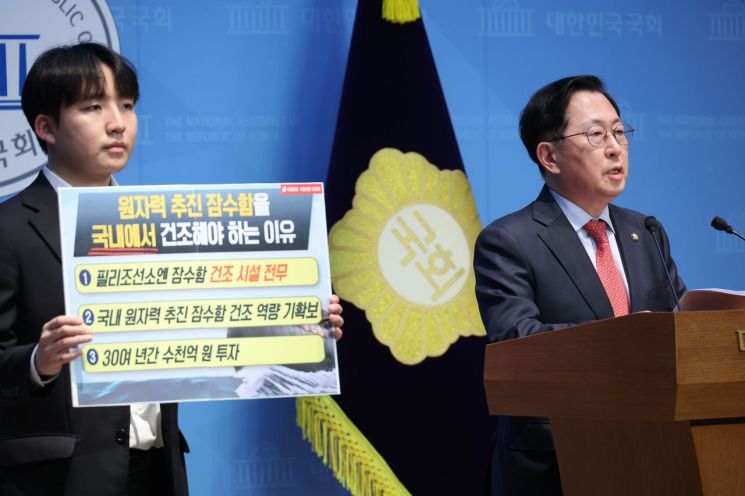 Yoo Yongwon, a member of the People Power Party, is holding a press conference on the nuclear-powered submarine project at the National Assembly Communication Office in Yeouido, Seoul, on the 4th. Photo by Yonhap News Agency
During a press conference at the National Assembly Communication Office that afternoon, Assemblyman Yoo said, "I once again welcome the fact that President Lee Jaemyung requested the construction of a nuclear-powered submarine and the supply of nuclear fuel at this Korea-U.S. summit, and that President Trump approved it. This decision is significant as it shows that the Korea-U.S. alliance has entered a new phase of military and technological cooperation."
However, Assemblyman Yoo stressed, "A nuclear-powered submarine is not just an enhancement of our military capabilities; it is a core strategic weapon that protects our Navy's operational capabilities and maritime interests. It is most rational to pursue its construction domestically, utilizing our industrial base and defense industry capabilities throughout the design, technology, and safety management processes."
Previously, after the summit, President Trump announced that he had approved President Lee's proposal to build a nuclear-powered submarine. However, he added via Truth Social that "Korea will build the nuclear-powered submarine at the Philadelphia Shipyard." This shipyard in Philadelphia was fully acquired last year by Hanwha Ocean and Hanwha Systems, which now own 100% of its shares.
In response, Assemblyman Yoo pointed out, "Although Korean companies own shares in the Philadelphia Shipyard, it is currently a merchant ship-focused shipyard with no submarine construction facilities. To build a nuclear-powered submarine there, it would be necessary to newly establish a dedicated submarine construction hall, a reactor module production line, radiation shielding facilities, security and protection systems, conduct environmental impact assessments and obtain local community consent, and go through the process of being designated as a U.S. defense contractor, among a series of administrative and technical procedures."
For these reasons, Assemblyman Yoo explained that building a nuclear-powered submarine in the United States would take at least 5 to 10 years longer than constructing it at a Korean shipyard.
Assemblyman Yoo also stated that Korea already possesses sufficient capabilities to build nuclear-powered submarines. He said, "The domestic shipbuilding industry is fully equipped with new construction and maintenance facilities for large submarines, and has a solid defense industry base and skilled workforce. The Agency for Defense Development and domestic research institutes have accumulated research achievements in small reactors and thermal-hydraulic analysis over the past 30 years." It is known that the cumulative budget invested in the classified research and development of nuclear-powered submarines over the past 30 years amounts to several hundred billion won.
He also pointed out a problem: while U.S. nuclear submarines use highly enriched uranium with an enrichment level of about 95%, Korea has focused its research and development on low-enriched uranium fuel with an enrichment level below 20%. Assemblyman Yoo said, "If we abandon the Korean nuclear-powered submarine project, into which a massive budget has already been invested, and instead introduce American nuclear-powered submarines, it could lead to controversy over astronomical budget waste. If the United States provides highly enriched uranium, we would have to redesign our small reactors."
Assemblyman Yoo added, "This could result in several years of schedule delays and enormous additional costs. Therefore, the most realistic and optimal approach is to utilize the existing domestic technological base and build nuclear-powered submarines using low-enriched uranium in Korea."
Speaking with reporters, Assemblyman Yoo emphasized, "The government should set a clear direction, establish a Korea-U.S. consultative body, and actively persuade the United States through this body. We need to provide various grounds to show that building nuclear-powered submarines in Korea does not go against the MASGA (Make American Shipbuilding Great Again) policy and can actually benefit the United States."
© The Asia Business Daily(www.asiae.co.kr). All rights reserved.

















