Rice up 21.3%, apples up 21.6%
Petroleum products see highest rise in 8 months at 4.8%
Service prices increase due to extended holiday
Overseas group travel fees up 12.2%, among others
Core inflation by OECD standard rises 2.2%
Ko
Last month, consumer prices rose by 2.4%, marking the highest level in 15 months. This was due to rising prices of agricultural, livestock, and fisheries products-including rice and apples-as well as petroleum products. Additionally, prices for services such as accommodation and travel increased during the extended Chuseok holiday. The government plans to focus on stabilizing the cost of living going forward. Starting this month, efforts will be made to ease the burden of grocery prices during the kimchi-making season.
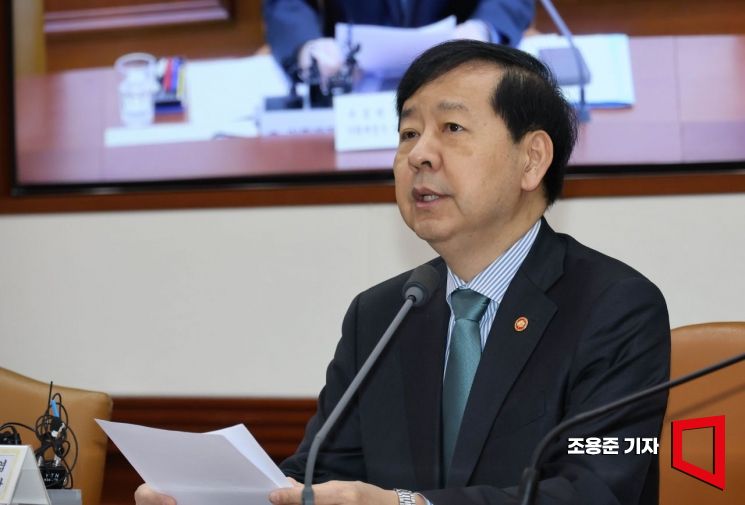 Deputy Prime Minister and Minister of Economy and Finance Koo Yoon-cheol is speaking at the Economic Ministers' Meeting, Price Ministers' Meeting, and Industrial Competitiveness Enhancement Ministers' Meeting held at the Government Complex Seoul in Jongno-gu, Seoul on the 4th.
According to the "Consumer Price Trends for October 2025" released by the National Data Office on the 4th, last month's consumer price index rose by 2.4% compared to the same month last year. This is a 0.3 percentage point increase from the previous month (2.1%), and the highest since July of last year (2.6%). Except for May (1.9%) and August (1.7%) of this year, the consumer price inflation rate remained in the low 2% range, but last month saw the largest increase of the year.
By item, prices of agricultural, livestock, and fisheries products increased by 3.1%. Agricultural products rose by 1.1%, while livestock and fisheries products jumped by 5.3% and 5.9%, respectively. Breaking down agricultural products, vegetable prices fell by 14.1% due to declines in items such as cabbage (-34.5%) and radish (-40.5%). However, grain prices, including rice (21.3%), rose by 21.8% due to delayed shipments and last year's base effect, and fruit prices, including apples (21.6%), increased by 10.9%.
Prices of industrial goods rose by 2.3%. With Chuseok holiday sales on items like pancake mix and cooking oil, the increase in processed foods (3.5%) was smaller than the previous month (4.2%). However, coffee (14.7%) and bread (6.6%) saw relatively large increases. Petroleum products (4.8%) experienced a larger increase than the previous month (2.3%), despite falling international oil prices, due to a rise in the exchange rate and last year's base effect. This is the highest increase since February (6.3%).
Service prices rose by 2.5%. Among these, the personal services category (3.4%) saw a greater increase than the previous month (2.9%). Personal services including dining out (3.0%) recorded a lower rate of increase than the previous month (3.4%) due to sales on items like hamburgers and pizza, but personal services excluding dining out rose from 2.6% to 3.6% in just one month, a 1 percentage point increase.
Lee Dowon, Director of Economic Trend Statistics at the National Data Office, explained, "Last month, travel-related items such as overseas group travel expenses (12.2%), passenger car rental fees (14.5%), and condominium usage fees (26.4%) increased due to the extended Chuseok holiday, leading to a rise in personal services excluding dining out." He added, "Travel-related items are usually affected by the number of peak holiday days, and this cannot be attributed to the consumption coupon effect for livelihood recovery."
Looking at core inflation, which shows price trends, the OECD standard index excluding food and energy rose by 2.2%, up from 2.0% the previous month. This is the highest since July of last year (2.2%). The index excluding agricultural products and petroleum products, which is the Korean standard, also rose by 2.5%, up from 2.4% the previous month. The cost of living index, which includes items with high household expenditure, increased by 2.5%.
Deputy Prime Minister and Minister of Economy and Finance Koo Yooncheol stated at the Economic Ministers' Meeting and Price Ministers' Meeting held at the Government Complex Seoul on this day, "We will make every effort to stabilize the cost of living, which is at the core of the people's economy." He added, "With the kimchi-making season approaching, we will mobilize all available means to reduce the burden of grocery prices during this period." He also said, "Following agricultural products, we will fundamentally improve the distribution structure of fisheries products as well."
© The Asia Business Daily(www.asiae.co.kr). All rights reserved.

















