A next-generation solid electrolyte that could accelerate the commercialization of lithium metal batteries has been developed. Lithium metal batteries are gaining attention as high-energy next-generation batteries that could replace conventional lithium-ion batteries.
However, flammable liquid electrolytes have posed a significant fire risk, hindering the commercialization of lithium metal batteries. As an alternative, "organic solid electrolytes" have been highlighted, but their slow lithium-ion transfer rate at room temperature has been a major limitation.
In contrast, the newly developed solid electrolyte improves lithium-ion mobility by a factor of 100 and operates at room temperature, raising expectations that it will contribute to the commercialization of lithium metal batteries.
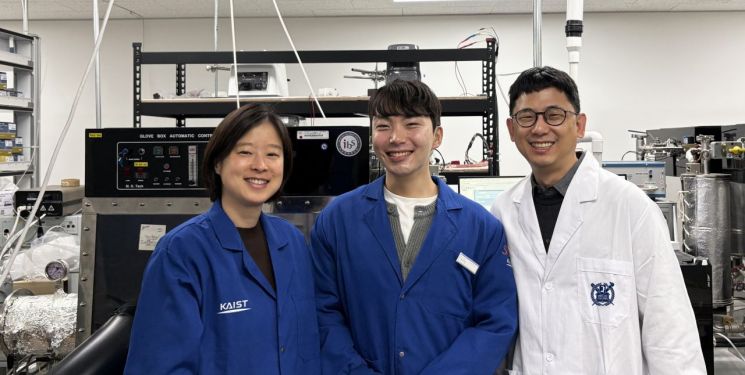 (From left) Professor Hyeryeong Byun, Integrated MS-PhD student Rakhyun Choi from KAIST Department of Chemistry, and Professor Changyun Son from Seoul National University. Courtesy of KAIST
On November 4, KAIST announced that a research team led by Professor Hyeryeong Byun from the Department of Chemistry at KAIST and Professor Changyun Son from Seoul National University had developed a new organic solid electrolyte film that operates stably at room temperature.
First, the research team used a novel material with a porous structure in which pores are regularly arranged, known as a Covalent Organic Framework (COF), to fabricate a solid electrolyte with a thickness of 20 micrometers-about one-fifth the thickness of a human hair.
The COF electrolyte features a porous crystalline structure similar to the Metal Organic Framework (MOF), which won this year's Nobel Prize in Chemistry, but it is characterized by higher chemical stability under battery operating conditions.
The team precisely arranged functional groups that facilitate lithium-ion transport at regular intervals, enabling lithium ions to move rapidly along these groups even at room temperature. This design addresses the previous issue of lithium ions only moving efficiently at high temperatures and allows for molecular-level control of lithium-ion transport pathways within the solid electrolyte structure.
In particular, the researchers introduced "dual sulfonation functional groups" into the nanopores to promote easy dissociation and movement of lithium ions, creating pathways that allow lithium ions to travel rapidly along the shortest straight routes.
Molecular dynamics (MD) simulations confirmed that this structure lowers the energy required for lithium-ion movement, enabling fast and stable operation at room temperature with minimal energy input.
The newly developed electrolyte film is produced using a "self-assembly" process, resulting in a smooth surface and uniform structure. According to the research team, this allows lithium ions to adhere seamlessly to the lithium metal electrode, enabling more stable movement between electrodes.
As a result, the developed electrolyte demonstrated lithium-ion mobility 10 to 100 times faster than existing organic solid electrolytes and, when applied to lithium metal-based lithium iron phosphate (LiFePO₄) batteries, maintained over 95% of its initial capacity even after more than 300 charge-discharge cycles. It also exhibited high stability with almost no energy loss, as evidenced by a coulombic efficiency of 99.999%.
Professor Byun stated, "This research is significant in that it demonstrates an organic solid electrolyte capable of rapid lithium-ion transport at room temperature, thereby enhancing the commercialization potential of lithium metal batteries. If the COF electrolyte is combined in a hybrid form with inorganic solid electrolytes, it is expected to further improve interfacial stability."
Meanwhile, Rakhyun Choi, a graduate student from the Department of Chemistry at KAIST, participated as the first author of this study. The research findings were recently published in the international journal 'Advanced Energy Materials.'
© The Asia Business Daily(www.asiae.co.kr). All rights reserved.

![Clutching a Stolen Dior Bag, Saying "I Hate Being Poor but Real"... The Grotesque Con of a "Human Knockoff" [Slate]](https://cwcontent.asiae.co.kr/asiaresize/183/2026021902243444107_1771435474.jpg)














